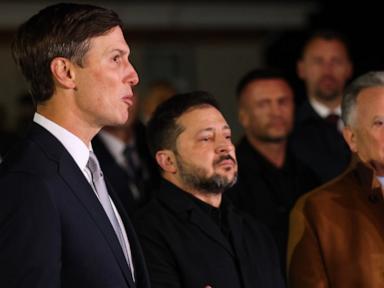
Volodymyr Zelenskyy isn't buying Washington's latest diplomatic pitch, and honestly, it's easy to see why.
In November 2026, U.S. envoys Jared Kushner and Steve Witkoff floated a sweeping new idea during peace negotiations in Abu Dhabi and Moscow. Instead of treating the Russia-Ukraine war as an isolated conflict, the Trump administration wants to link Ukraine's postwar survival directly to a brand-new European security framework. On paper, that sounds like grand statesmanship. In reality, Kyiv sees a massive trap. For a different perspective, consider: this related article.
Zelenskyy warned that opening up Europe's entire defense architecture while Russian missiles are still hitting Ukrainian cities gives Vladimir Putin the exact bargaining chip he has craved since 2021. Moscow gets to demand NATO troop pullbacks across Eastern Europe, challenge the status of newer alliance members, and stall actual ceasefire progress—all while keeping its boots on Ukrainian soil.
What Washington Actually Put on the Table
To understand why Kyiv is sounding the alarm, you have to look at the mechanics of what U.S. negotiators proposed. Related reporting on the subject has been shared by Associated Press.
During talks with Ukrainian and Russian officials in mid-November 2026, Kushner argued that security guarantees for Ukraine cannot be finalized in isolation from a broader post-war European security architecture. Writing publicly on X after meeting leaders in Berlin and following Trump's trilateral discussions in Shenzhen with Putin and Chinese President Xi Jinping, Kushner pitched "Article 5-like" security guarantees for Kyiv.
That phrasing grabs headlines, yet the fine print tells a very different story.
- Territorial trade-offs floated privately: Zelenskyy revealed that U.S. officials asked for the first time whether Kyiv would withdraw from parts of the eastern Donbas region that Russian forces don't even control, supposedly in exchange for NATO membership or security backing.
- Conditional American backing: Kushner noted that Donald Trump would only support these guarantees if they strictly served American national interests and minimized the risk of ever being triggered.
- Undefined enforcement: While France and the U.K. have spearheaded a "Coalition of the Willing" to deploy European peacekeeping forces after a ceasefire, Trump hasn't formally signed off on binding American military backup.
- Temporary timelines: Kyiv fears any security arrangement tied to current executive goodwill could evaporate in two years, turning a peace deal into a brief intermission before Russia attacks again.
Zelenskyy flatly rejected surrendering unoccupied Donbas territory or altering Ukraine's constitution to enshrine permanent neutrality. "We need security guarantees not for two years, but forever," he said, pointing out that a temporary freeze isn't real peace.
Why Zelenskyy Sees a 2021 Trap Repeating Itself
If you've followed Eastern European geopolitics closely over the past five years, Moscow's reaction to Washington's proposal feels eerily familiar.
In December 2021—just two months before launching its full-scale invasion—the Kremlin handed Washington and NATO two draft treaties. Those documents demanded that NATO permanently halt eastward expansion, pull all troops and weapons back to their 1997 borders, and stop military drills near Russian territory. NATO allies rejected those ultimatums immediately.
Now, Putin sees a golden opportunity to dust off that exact wishlist.
When Kushner and Witkoff met Putin in Moscow on November 12, 2026, Kremlin foreign policy aide Yuri Ushakov confirmed that Putin immediately brought up those 2021 proposals and said Moscow would update them with "fresh considerations". Zelenskyy predicted precisely what comes next if Europe lets Russia renegotiate continental security before the guns go silent.
The Specific Targets Putin Will Press
Zelenskyy didn't speak in vague abstractions when explaining how Moscow could exploit a broad European security framework. He named specific flashpoints Putin is poised to put on the negotiating table:
- U.S. troop deployments in the Baltics: With roughly 80,000 American troops stationed across Europe and the Pentagon delaying its Europe force posture review past its provisional December 1, 2026 deadline, Moscow smells vulnerability. Putin wants those rotational forces pulled back from Estonia, Latvia, and Lithuania.
- Finland and Sweden's NATO integration: Both Nordic nations joined NATO after Russia's 2022 invasion, dramatically extending the alliance's border with Russia. Zelenskyy warned Putin will demand limits on military infrastructure and allied presence in both countries.
- Allied fractures via Hungary: Moscow already exploits divisions inside Brussels and NATO, and Zelenskyy specifically flagged Hungary as a pressure point Putin will use to stall consensus.
Think about the leverage that creates. By tying a ceasefire in Ukraine to a continent-wide security treaty involving dozens of nations, Putin gets endless procedural delays. Every disagreement between Berlin, Warsaw, Paris, and Washington buys Russia more months to grind down Ukrainian energy grids and push along the front lines.
Europe's Pushback and the Sequencing Battle
European capitals aren't staying quiet while Washington and Moscow trade big ideas over their heads.
Brussels and key NATO governments agree with Zelenskyy on one fundamental rule: sequence matters. You don't redesign a house's foundation while an arsonist is still pouring gasoline on the porch.
Zelenskyy laid out the only order of operations Kyiv considers viable:
- First, an immediate and verifiable ceasefire.
- Second, a formal end to the war in Ukraine.
- Third, concrete, legally binding security guarantees for Ukraine backed by military hardware, funding, and recovery plans.
- Only after those three steps are locked in should European NATO members decide—among themselves—whether any broader European security adjustments make sense.
European leaders have echoed that stance. Brussels insists that NATO already serves as Europe's core security architecture and that any talks affecting European defense must take place in proper multilateral forums with EU and NATO members fully seated at the table. To prevent Washington from cutting bilateral side deals, European governments already designated a negotiating delegation led by the five-country E5 group alongside EU institutions.
Meanwhile, Putin is playing divide-and-conquer. He scoffed at "hysterics in some European capitals," mocked European objections as "political diarrhea," and invited European delegates to travel to Moscow to clarify their positions before Russia even agrees on a format for further Ukraine talks. He also issued a blunt red line: any European peacekeeping troops deployed to postwar Ukraine will be treated by Russia as legitimate military targets.
What Analysts Say Both Sides Are Missing
Political analysts watching the late-2026 diplomatic scramble point out glaring blind spots in both Washington's optimism and Moscow's posturing.
Tatiana Stanovaya, a veteran Russian political analyst, noted that Putin's primary goal isn't necessarily reaching a quick compromise—it's forcing Europe to accept Russia as a co-architect of European security while deepening splits among Western allies. In her assessment, dragging European security into Ukraine peace talks will fuel internal allied friction while producing almost zero concrete results on the battlefield.
At the same time, security experts at Just Security highlighted a major disconnect inside the U.S. negotiating team itself. While Kushner claims Russia is "comfortable" with allies offering Ukraine NATO-style assurances, Russian Deputy Foreign Minister Sergei Ryabkov and Putin himself have repeatedly declared that Western troops in Ukraine are unacceptable and that Moscow's version of "security guarantees" centers on curbing NATO. Someone in those rooms is either misreading the translation or deliberately papering over an unbridgeable gap.
There's also a constitutional reality in Kyiv that Washington negotiators keep glossing over. Under Ukrainian law, neither Zelenskyy nor a foreign envoy can unilaterally sign away sovereign territory or scrap Ukraine's Euro-Atlantic aspirations. Zelenskyy made clear that even if the U.S. and NATO partners presented a formal, detailed security package in exchange for territorial compromises, he would have to put that question directly to Ukrainian society through a public vote.
How to Read the Next Phase of Ukraine Peace Talks
If you're tracking whether these negotiations actually produce a durable settlement or just hand Moscow diplomatic cover, watch four concrete indicators over the coming weeks rather than relying on optimistic press briefings:
- Watch the Pentagon's Europe force posture review. When Washington finally releases its delayed assessment on the 80,000 U.S. troops stationed in Europe, check whether troop levels in Poland, Romania, and the Baltic states stay intact or get traded away as a goodwill gesture to Moscow.
- Track whether a ceasefire precedes framework talks. If U.S. envoys allow Russia to debate NATO's eastern flank before guns stop firing in Zaporizhzhia and Donbas, Kyiv's worst-case scenario is playing out in real time.
- Look for treaty ratification, not social media pledges. Real deterrence requires Senate-ratified defense commitments, funded weapons pipelines, and clear rules of engagement—not vague "Article 5-like" promises conditioned on shifting political moods.
- Monitor European troop commitments on the ground. Pay close attention to whether the French-U.K. Coalition of the Willing secures explicit American air-defense and intelligence backing despite Kremlin threats to target European forces.
Until those four pieces lock into place, Zelenskyy's skepticism isn't stubbornness—it's basic survival math.
US envoy calls for new security framework for Ukraine
This video captures U.S. envoy Jared Kushner outlining Washington's push for a combined security framework covering Ukraine, Russia, and Europe at the start of the Abu Dhabi negotiations.