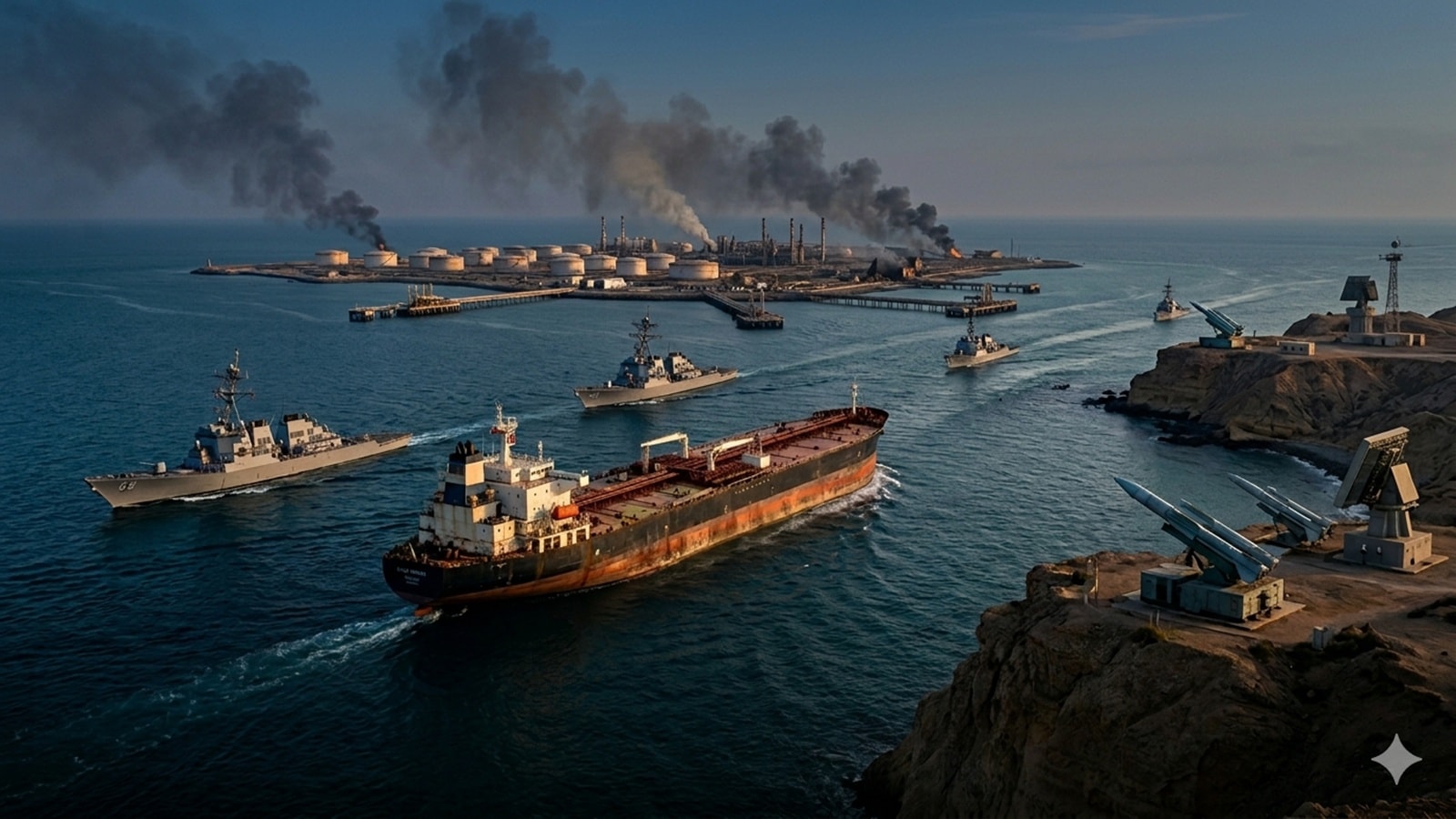
The lazy media consensus loves a neat failure narrative. When news outlets review the recent diplomatic friction in the Persian Gulf, they rely on a deeply flawed premise: that the objective of American foreign policy should be the absolute, uninterrupted stabilization of the Strait of Hormuz. They look at the 2026 war, the temporary spikes in energy markets, and the messy June memorandum of understanding signed in Versailles, and they declare it a catastrophic failure of American deterrence.
They are asking the wrong question.
The mainstream argument insists that by engaging in a high-stakes maximum pressure campaign—punctuated by the massive February strikes that eliminated top Iranian leadership—the United States somehow disrupted a functional status quo. They argue that the subsequent mine-laying, drone altercations, and shifting maritime protocols forced a bad compromise. This conventional analysis is a fantasy built on a fundamental misunderstanding of raw geopolitical leverage.
The Strait of Hormuz was never an open, peaceful highway that Washington accidentally broke. It is, and always has been, a geopolitical pressure valve. Maintaining it in a state of permanent, friction-free tranquility is not only an impossible task; it is an objective that actively works against American strategic interests.
The Myth of the Sacred Maritime Chokepoint
I have watched armchair strategists blow through oceans of ink mourning the end of total security in the Gulf. They treat the shipping lanes like a fragile corporate asset that the White House failed to insure. This perspective completely ignores the basic law of asymmetric conflict: a chokepoint is only useful to a rogue state if they can use it to blackmail the global economy without consequences.
For decades, the standard playbook for dealing with Tehran was built on fear. The West tolerated proxy warfare, ballistic development, and state-sponsored disruption because they feared that pushing the regime too hard would cause them to "close the Strait." This was a bluff that the policy establishment bought hook, line, and sinker.
When the United States launched its overwhelming military campaign early this year, it shattered that illusion. Yes, the immediate consequence was chaos. The regime retaliated by attacking oil infrastructure and attempting to enforce arbitrary toll routes. Energy markets experienced violent spikes.
But look at the structural reality left in the wake of that violence. The supreme leadership structure was dismantled in a single afternoon. The regime’s radar capabilities were degraded to the point where the U.S. Navy could quietly escort nearly a hundred tankers through the channel under the cover of night without effective resistance.
True stability is not the absence of tension. It is the absolute destruction of your opponent's capacity to threaten you. By forcing the issue, the administration dragged Iran's greatest asymmetric threat out into the open and systematically dismantled its operational effectiveness.
The Flawed Premise of the "Perfect Deal"
Critics of the June memorandum point to the ongoing 60-day negotiation window as proof of weakness. They complain that Iran is still trying to assert hegemonic control by demanding environmental fees and dictating specific channels to passing vessels. They look at the recent July skirmishes and claim the deal has no teeth.
This criticism relies on a textbook misunderstanding of international diplomacy. A memorandum of understanding with a heavily degraded adversary is not a peace treaty; it is a structured surrender mechanism masked as a bilateral agreement.
| Strategic Metric | The Appeasement Era | The Post-2026 Reality |
|---|---|---|
| Iranian Leverage | High (Implicit threat of total closure) | Minimal (Operational capacity shattered) |
| U.S. Naval Posture | Defensive patrolling and reactive escorting | Offensive blockades and pre-emptive targeting |
| Nuclear Enrichment | Unmonitored, rapid acceleration | Enforced pauses tied directly to economic performance |
| Global Market Response | Panic at every minor diplomatic incident | Rapid adaptation to localized maritime friction |
The competitor piece laments that the United States had to lift secondary sanctions and discuss the unfreezing of assets to get the shipping lanes moving again. They call this a concession. In reality, it is a tight leash. Tying economic relief exclusively to verifiable performance—such as the down-blending of highly enriched uranium stockpiles—while maintaining a naval blockade that can be re-imposed at a moment's notice is the definition of coercive diplomacy.
If you give an adversary a complete economic dead-end with zero diplomatic off-ramps, you force them into a corner where they have no choice but to launch a desperate, suicidal conflict. By providing a highly conditional, step-by-step path out of total collapse, you turn their remaining economic survival instincts into your primary tool of compliance.
Dismantling the Tanker War Obsession
Every history buff in Washington loves to cite the Tanker War of the 1980s as a cautionary tale. They point to the re-flagging of Kuwaiti ships and the protracted naval operations as proof that escalation in the Gulf is a quagmire.
The comparison falls apart under minimal scrutiny. During the Iran-Iraq War, the international community was dealing with a highly functional, well-funded state apparatus capable of sustained conventional operations. The 2026 reality is a deeply fractured regime operating on fumes, suffering from massive internal displacement, and missing its top command structure.
More importantly, the global energy architecture has fundamentally shifted. The assumption that a disruption in the Strait of Hormuz will permanently cripple the global economy is a legacy fear from a bygone era. Modern supply chains, alternative pipelines, and domestic production capabilities mean the global market adapts to Gulf volatility far faster than it did forty years ago. The dramatic drop in oil prices immediately following the June agreement—despite ongoing, localized friction—proves that the market has already priced in the geopolitical risk premium.
The idea that the United States must achieve a pristine, conflict-free waterway to protect global trade is a corporate luxury, not a strategic necessity. The primary objective was never to ensure that every commercial vessel enjoys an unmolested, untolled journey through the Gulf. The objective was to eliminate the regime’s ability to build a nuclear weapon and to break their regional proxy network. Everything else is secondary.
Actionable Order for Global Strategists
Stop evaluating national security through the lens of a corporate supply chain manager. If your investment strategy or geopolitical outlook is panicking over every minor drone report out of the Gulf, you are tracking the wrong metrics.
Do not look at the daily maritime traffic reports. Look at the enrichment facilities. Look at the enforcement of the 60-day down-blending benchmarks. The localized skirmishes in the channel are not a failure of deterrence; they are the dying gasps of an asymmetric strategy that no longer works. The United States didn't fail to secure the Strait of Hormuz. It exposed the fact that the Strait was never the regime’s to close.