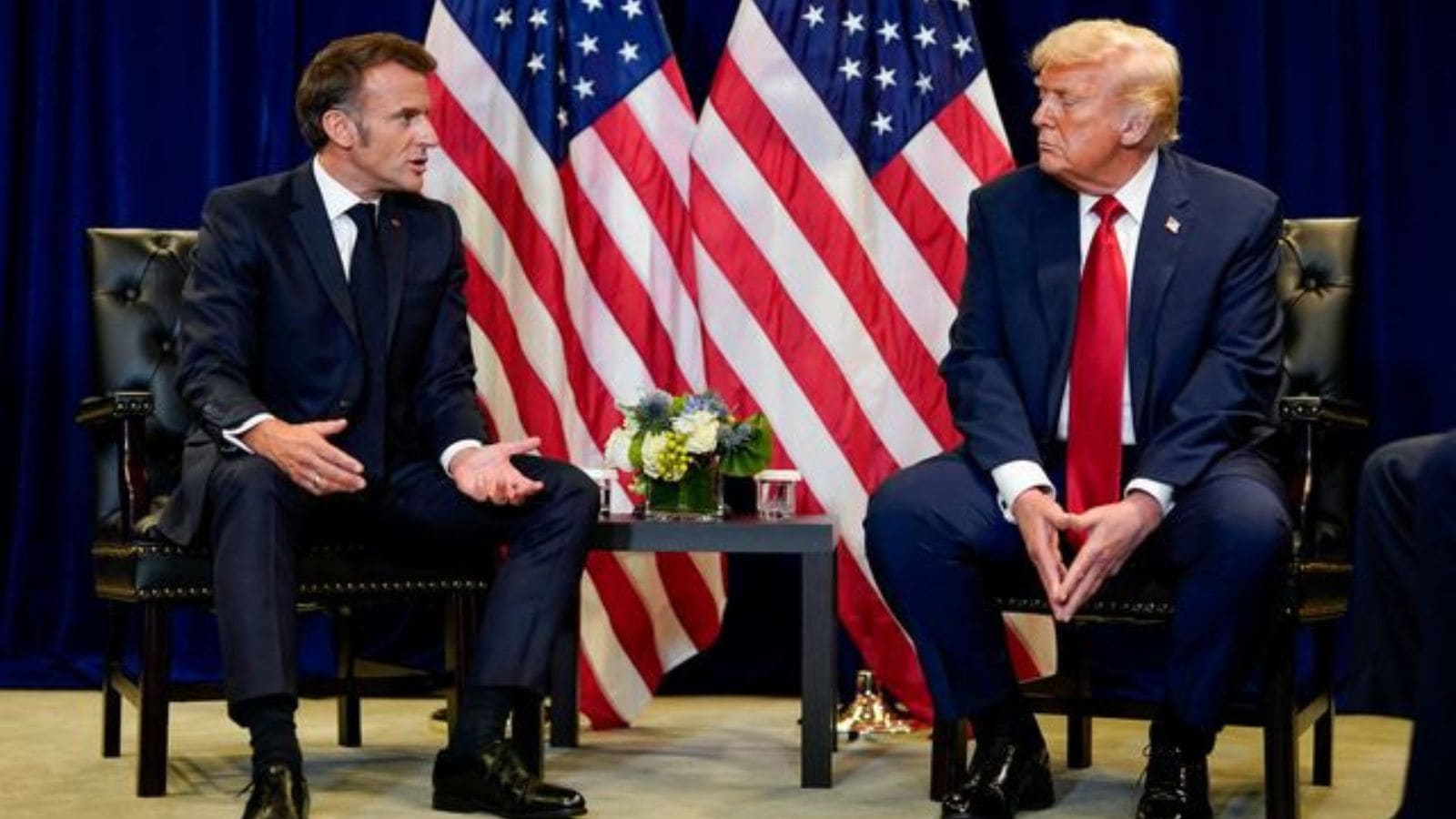
Emmanuel Macron is playing a dangerous game of pretend. Standing on the global stage, he laments "wasted time" and warns against the "suicide" of a trade war between the US and the EU. He frames the current tension with Donald Trump as a tragic misunderstanding between allies. He is wrong.
The mainstream media loves the narrative of the "unpredictable" American president versus the "stable" European technocrats. It is a comforting lie. The reality is far more brutal. The US and the EU are not having a spat; they are undergoing a fundamental structural divorce. Macron’s plea for unity is not a strategy—it is a desperate attempt to preserve a status quo that died a decade ago.
The Myth of the Level Playing Field
The "lazy consensus" in Brussels is that global trade works best when everyone follows the rules set by the World Trade Organization (WTO). This overlooks one inconvenient fact: nobody is following the rules.
While Europe obsesses over regulatory compliance and "fair competition," the US and China have moved into an era of raw industrial policy. The Inflation Reduction Act (IRA) was not a "threat"—it was a declaration that the US no longer cares about the WTO's feelings. It is a massive subsidy engine designed to vacuum capital out of Europe and into the American heartland.
Macron calls for "strategic autonomy," yet he shudders at the thought of actual conflict. You cannot have autonomy if you are terrified of the price. The US is moving toward a mercantilist model. If Europe continues to respond with polite letters and Davos-style panels, it will be stripped for parts.
Germany is the Anchor Not the Engine
Trump’s fixation on Germany isn’t just a personal grudge. It is a mathematical inevitability. For twenty years, the German economic model relied on three things:
- Cheap Russian energy.
- Limitless Chinese demand.
- An American security umbrella that cost them nothing.
All three are gone.
When Trump fumes about German cars, he is pointing at a trade surplus that is fundamentally extractive. Europe’s largest economy has been undercutting its neighbors and its allies by suppressing domestic wages to boost exports. It is a "beggar-thy-neighbor" policy dressed up in a Hugo Boss suit.
By defending the current EU-US trade dynamic, Macron is essentially defending Germany’s right to stagnate. The "wasted time" he mentions isn't about tariffs; it’s the time Europe has spent failing to build its own tech giants, its own energy independence, and its own defense.
The Tariff Fallacy
Economists will tell you that tariffs are a tax on the consumer. This is true in a vacuum. In the real world, tariffs are a tool of geopolitical leverage.
The "experts" argue that Trump’s 10% or 20% universal baseline tariff would wreck the global economy. They missed the nuance. The goal of these tariffs isn't necessarily to collect revenue; it is to force a total re-shoring of supply chains.
I have seen boardrooms from Stuttgart to Seoul freeze when these threats are made. They don't care about the 10% tax; they care about the uncertainty. That uncertainty is the point. It forces companies to build factories in Ohio instead of Saxony.
Europe’s mistake is thinking it can negotiate its way out of this with logic. You cannot use logic against a competitor who has decided that the "rules" were written by losers.
The High Cost of Regulatory Fetishism
Europe has become the world’s "Regulatory Superpower" because it has failed to be an "Innovation Superpower."
- The AI Act: While the US builds and China deploys, Europe drafts 500-page documents on ethics.
- GDPR: It didn’t stop Big Tech; it just made it harder for European startups to compete with them.
- Carbon Border Adjustment Mechanism (CBAM): A noble idea that, in practice, functions as a complex tariff that will likely backfire on European manufacturers who rely on cheap imported steel.
Macron wants to "protect" the European market, but you cannot protect a market that produces nothing the rest of the world is desperate to buy. Luxury bags and high-end cars will not sustain a continent of 450 million people in a world dominated by semiconductors and quantum computing.
The Coming Energy Divorce
We need to address the elephant in the room: the energy price gap.
Industrial electricity in the US is roughly one-third the price of electricity in Europe. No amount of "diplomatic cooperation" or "wasted time" talk fixes that. The US is now the world’s largest oil and gas producer. Europe is an aging customer with a shrinking wallet.
When Trump looks at Europe, he sees a museum. When Macron looks at the US, he sees a rogue protector. Both are looking at the past.
Imagine a scenario where the US moves to a "Fortress America" stance, decoupling not just from China, but also distancing itself from the high-cost, high-regulation mess of the Eurozone. In this scenario, the US uses its energy dominance to lure every remaining industrial heavy-hitter out of the Rhine valley.
That isn't a "threat." It's the current trajectory.
Stop Asking for Permission
People often ask: "How can the EU and US fix their relationship?"
That is the wrong question. The premise is that the relationship can be fixed. It can't. The interests have diverged too far. The US wants to win the 21st century by any means necessary. Europe wants to retire comfortably in a 20th-century world.
The unconventional advice? Europe needs to stop being "nice."
If Macron actually wanted strategic autonomy, he would stop complaining about Trump’s tweets and start building a European military-industrial complex that doesn't rely on American spare parts. He would slash the regulations that make it impossible to build a data center in France. He would admit that the "Green Deal" is a suicide pact if it isn't matched by massive, aggressive deregulation in other sectors.
The Hard Truth of Trade War
A trade war is coming. It doesn't matter who is in the White House. The "consensus" that we can go back to the 1990s era of globalization is a hallucination.
The US has realized that its middle class was gutted by the very "free trade" policies Macron is trying to save. Trump is the symptom, not the cause. The cause is a 30-year failure to recognize that global trade is a zero-sum game when your competitors (China) play by different rules and your allies (Germany) play for themselves.
The downside to my perspective? It’s ugly. It involves higher prices, fractured alliances, and a decade of volatility. But pretending it’s not happening—as Macron is doing—is how you end up as a footnote in someone else's history book.
Europe’s leaders are currently like passengers on a sinking ship complaining that the lifeboats are "unbalanced" and "too loud."
Stop talking about "wasting time" on tariffs. The time was already wasted.
Start building something that can survive the collision. Or get out of the way.