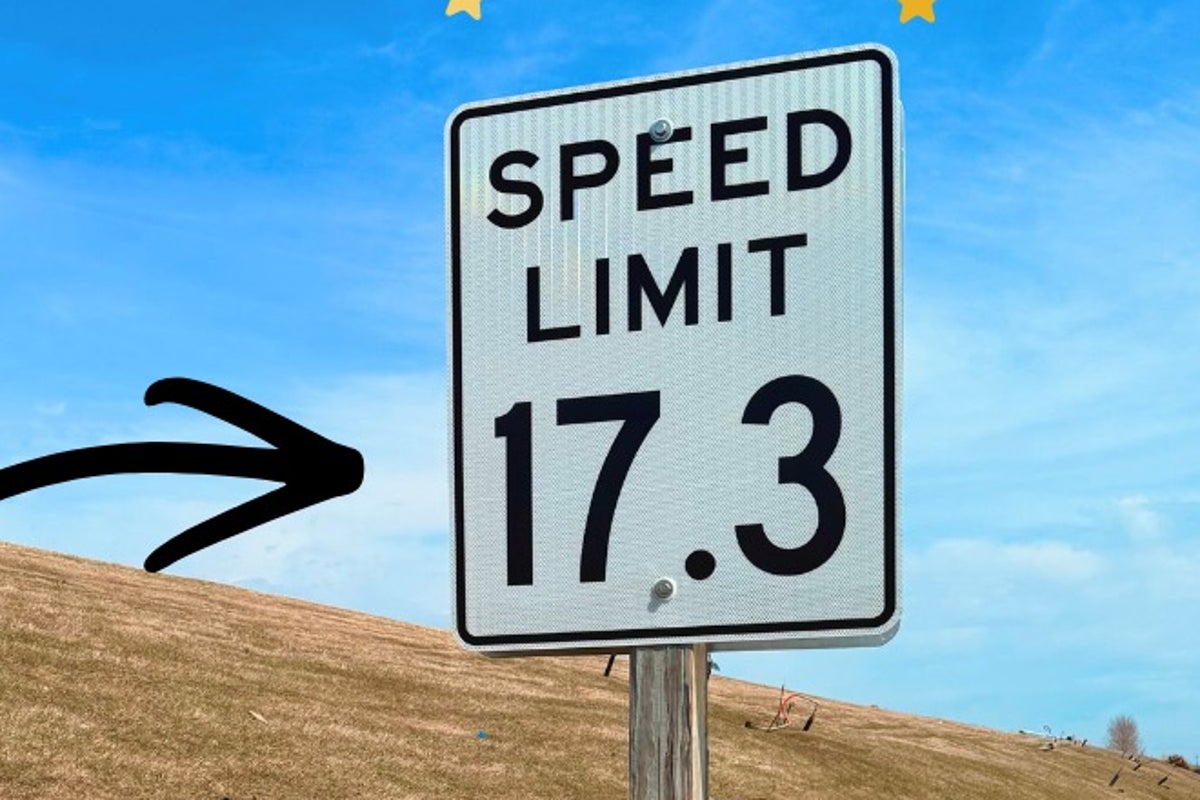
In the quiet village of Wind Point, Wisconsin, the local government decided to fight speeding with a mathematical curveball. They didn't just lower the limit. They added a decimal. Specifically, a section of Lighthouse Road now features signs posted at 19.5 mph. It is a figure that looks like a typo or a prank, but the intent is surgical. By breaking the standard five-mile-increment convention used across North America, officials are betting that the sheer oddity of the number will force drivers to snap out of their "autopilot" trance and check their speedometers.
The Psychological Trap of Standard Speed Limits
For decades, traffic engineering has relied on predictability. We see a white rectangle with "25" or "35" in bold black ink, and our brains process it as a suggestion rather than a hard ceiling. This is the "speed creep" phenomenon. Drivers typically allow themselves a five-to-ten-mile-per-hour buffer above the posted limit, assuming enforcement won't blink at a minor infraction.
Wind Point officials recognized that a 20 mph sign would likely result in cars hitting 27 mph. A 15 mph sign might feel unnecessarily restrictive, leading to frustration and aggressive passing. The 19.5 mph limit exists to disrupt the mental shortcuts drivers take. When you see a decimal point on a regulatory sign, your brain pauses. You wonder if it’s a joke. You wonder if the radar gun is calibrated to that exact half-mile. That split second of cognitive dissonance is exactly what the village wants.
Engineering Behavior Through Friction
Most road safety initiatives focus on physical barriers. Speed bumps, narrowed lanes, and roundabouts are effective, but they are expensive and often draw the ire of residents who hate the wear and tear on their suspension. Wind Point’s approach is a form of "psychological traffic calming." It creates mental friction without pouring a single yard of concrete.
The physics of a crash at 19.5 mph versus 25 mph are significant. Kinetic energy increases with the square of speed. A pedestrian hit by a car traveling at 20 mph has a much higher survival rate than one hit at 30 mph. By shaving off those few extra miles per hour and ensuring people actually stick to the number, the village is drastically reducing the lethality of the road.
Lighthouse Road is not a typical thoroughfare. It leads to the historic Wind Point Lighthouse, a destination that draws tourists, walkers, and cyclists who aren't always familiar with the neighborhood's rhythms. The mix of distracted sightseers and local commuters created a volatile environment. The decimal point acts as a visual speed bump that demands a specific, conscious action from the driver.
The Legality of the Half Mile
One might wonder if a 19.5 mph ticket would hold up in court. Traffic laws are typically written with broad strokes, and most state statutes grant local municipalities the power to set speed limits based on engineering and traffic investigations. While the Wisconsin Department of Transportation generally follows the Manual on Uniform Traffic Control Devices (MUTCD), which prefers multiples of five, local roads often have more leeway for "experimental" signage if it addresses a specific safety concern.
If a driver is cited for doing 26 in a 19.5 zone, they are technically 6.5 mph over the limit. In a standard 20 mph zone, that same speed might be dismissed as a minor margin of error. The decimal point removes the "rounding up" excuse. It signals that the authorities are paying attention to the details, which in turn suggests that their enforcement might be equally precise.
A Growing Trend of Granular Governance
Wind Point isn't the first place to experiment with non-traditional numbers, though they are among the most precise. Private communities and corporate campuses have long used limits like 14 mph or 17 mph to grab attention. However, seeing this strategy migrate to public municipal roads suggests a shift in how we view the "rules of the road."
We are moving away from a one-size-fits-all approach to traffic management. As data collection becomes more granular, the response to that data is becoming equally specific. If studies show that accidents at a particular intersection drop by 40% when speeds stay under 20 mph, but the natural flow of traffic tends toward 23 mph, the 19.5 mph sign becomes a tool of behavioral economics. It’s a "nudge" in the purest sense.
The Backlash and the Boredom
Not everyone is a fan of the decimal. Critics argue that it makes the law look like a gimmick. There is a risk that if these signs become too common, the novelty will wear off, and drivers will begin to ignore the decimals just as they ignore the zeros. There is also the "speedometer problem." Most analog speedometers are not marked with enough precision to distinguish between 19 and 20, let alone identify a half-mile increment.
This forces the driver to err on the side of caution. If you can't tell exactly where 19.5 is, you’ll likely hold it at 18. This effectively achieves a lower speed than a 15 mph sign ever could, because drivers don't feel like they are being slowed down to a crawl; they feel like they are participating in a specific, high-stakes technical requirement.
Why This Matters Beyond Wisconsin
The Wind Point experiment is a window into the future of urban planning. As autonomous vehicles and advanced driver-assistance systems (ADAS) become standard, speed limits will eventually be communicated digitally directly to the car’s computer. A computer doesn't care if a limit is 20 or 19.523; it simply obeys the data.
For the human drivers still behind the wheel, the 19.5 mph sign is a final, desperate attempt to reclaim their attention in an era of massive distraction. It is a reminder that the road is a shared space, not a high-speed vacuum. Whether it remains a local quirk or becomes a new standard for residential safety depends entirely on the crash data over the next few seasons.
If you find yourself on Lighthouse Road, don't look for the logic in the math. Look at the speedometer. The village isn't interested in being your math teacher; they just want you to slow down before you hit the lake. Keep your foot off the gas and watch for the point.