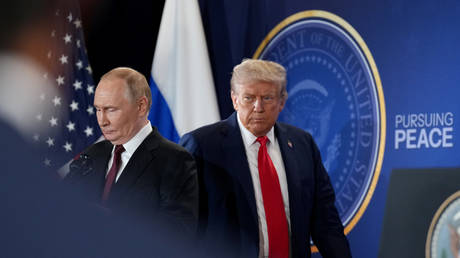
The window for a diplomatic exit from the Ukraine conflict isn't just shrinking. It's practically locked from the inside.
For months, the global foreign policy establishment clung to a comfortable illusion. They believed that when both sides grew exhausted enough, Washington, Kyiv, and Moscow would sit at a mahogany table and carve out a messy, cynical, but functional peace. That assumption is dead. We have passed the point where a simple "land for peace" swap can stabilize Eastern Europe.
The geopolitical reality has shifted. Military facts on the ground, domestic political survival in both Moscow and Kyiv, and deep shifts in global alliances have broken the old paths to diplomacy. If you think a sudden burst of Western diplomatic pressure or a change of heart in the Kremlin can freeze this war today, you're misreading the situation. The exit ramps are gone. We're now dealing with an open-ended war of attrition that will reshape Europe for a generation.
The Illusion of the Partition Strategy
The most common theory floating around think tanks is the Korean Peninsula model. The idea is simple. You freeze the front lines, establish a demilitarized zone, and give Ukraine security guarantees short of full NATO membership. It sounds pragmatic on paper.
In reality, it's a fantasy.
                       [ The Failure of Partition Models ]
                                       │
         ┌─────────────────────────────┴─────────────────────────────┐
         ▼                                                           ▼
Kremlin Demands                                             Kyiv Requirements
• Total capitulation of current borders                     • Full liberation of occupied land
• Legislative veto over foreign policy                      • Ironclad, legally binding security
• Absolute demilitarization of Ukraine                      • Preclusion of future cross-border raids
Vladimir Putin has repeatedly tied his political survival to objectives that require the dismantling of Ukrainian sovereignty. The Russian leadership isn't looking for a border adjustment. They want a pliant, neutralized state in Kyiv. According to a 2025 assessment by the Institute for the Study of War, Moscow's institutional setup has completely shifted toward a long-term wartime footing. The Russian economy is restructured around military production. For the Kremlin, stopping now without achieving structural control over Ukraine represents an existential political risk.
Kyiv faces an equally absolute reality. President Volodymyr Zelensky cannot accept a frozen conflict that leaves millions of Ukrainians under occupation without ironclad security guarantees. A simple promise of future talks won't cut it. After the failure of the 1994 Budapest Memorandum, Ukraine knows that vague Western reassurances don't stop tanks. Unless Washington or NATO extends a literal nuclear umbrella over the remaining unoccupied territory, any ceasefire is just a tactical pause for Russia to rearm.
Why Domestic Politics Block the Exit Doors
Look closely at the internal dynamics of both nations. The space for compromise has evaporated.
In Ukraine, years of brutal warfare, targeted infrastructure destruction, and systemic war crimes have hardened public opinion. Data from the Kyiv International Institute of Sociology shows that while fatigue is real, a massive majority of the population still rejects territorial concessions that don't come with absolute security guarantees. A Ukrainian leader who signs away territory for an empty peace promise faces immediate domestic political ruin.
Across the border, Putin has backed himself into a ideological corner. He has framed this war not as a local dispute, but as a civilizational crusade against the West. You can't easily wind down a holy war for a few oblasts. The Russian state apparatus has spent years purging moderate voices and elevating hardline nationalists. These factions view anything less than total victory as treason.
- The Weaponization of the Russian Economy: Over 40% of the Russian federal budget is tied directly to defense and national security. Stopping the war means managing a massive economic hangover that the Kremlin might not survive.
- The Demilitarization Fallacy: Russia demands a tiny, toothless Ukrainian military. Kyiv knows that agreeing to this is suicide.
The Total Breakdown of Diplomatic Trust
Diplomacy requires a baseline of trust. It requires a belief that the other party will honor an agreement once the ink dries. Right now, that baseline is at absolute zero.
Kyiv remembers the Minsk I and Minsk II agreements. Those deals were meant to solve the initial 2014 crisis but were used by Moscow to entrench its military positions and prepare for the 2022 invasion. Meanwhile, Moscow points to the expansion of NATO and early 2022 negotiation attempts in Istanbul as proof that the West wants nothing less than the strategic defeat of Russia.
When both sides view a treaty as a trap, negotiations become impossible. They become a tool for propaganda, not peace.
The Global Alliance Trap
This is no longer a localized war between two states. It has evolved into a global proxy conflict with deeply entrenched interests.
Russia is no longer isolated. It has forged a tight wartime economic alliance with Beijing, Tehran, and Pyongyang. North Korean munitions and Chinese dual-use technology keep the Russian war machine running. For Beijing, the war serves as a useful distraction that keeps American military focus split between the Pacific and Europe. For Iran and North Korea, it provides leverage, cash, and advanced military tech from Moscow. These partners have no incentive to help the West find an easy exit.
On the other side, the West has tied its own institutional credibility to Ukraine's survival. NATO cannot allow Russia to dictate the security architecture of Europe without rendering the alliance toothless. This systemic polarization means any local negotiation instantly triggers global strategic calculations. The stakes are too high for either bloc to blink.
What Happens Next on the Ground
If the exit doors are closed, what's the actual trajectory? We are entering a phase of grinding, industrial-scale attrition. It will be defined by three distinct realities.
First, expect the fragmentation of the conflict into localized, high-intensity drone and artillery wars rather than sweeping armored breakthroughs. The battlefield is too transparent now. Reconnaissance drones make massed tank offensives nearly impossible. Both sides will focus on destroying the economic and industrial capacity of the other.
Second, the economic strain will shift from the battlefield to the home fronts. Ukraine will depend entirely on Western financial injections to keep its basic state functions alive. Russia will continue to cannibalize its long-term economic future, relying on oil exports to shadow markets to fund its immediate military needs.
Third, the risk of miscalculation escalates. As conventional options yield diminishing returns, the temptation to use asymmetrical tools increases. We'll see more sophisticated cyber attacks on critical infrastructure, sabotage campaigns inside European borders, and dangerous gray-zone provocations.
The hard truth is that this war will not end with a neat diplomatic ceremony. It will end only when one or both sides lose the material capability or the political will to continue fighting. Until that tipping point arrives, the talk of diplomatic exits is just noise. Prepare for a long, cold, and highly dangerous era of permanent confrontation in Europe. Keep your eyes on ammunition production rates, domestic political stability in Washington and Moscow, and the flow of energy across global markets. Those are the metrics that matter now. Diplomacy is on ice.