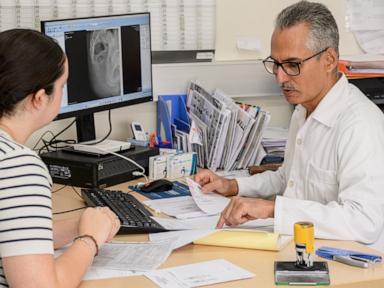
The hospital in Polistena, a small town tucked into the rugged toe of the Italian boot, should have been dead. For years, the story of healthcare in Calabria followed a grim, predictable script. Wards shuttered. Operating rooms gathered dust. Medical staff, exhausted by crushing shifts and starved of resources, packed their bags for the affluent hospitals of Milan or the steadier rhythms of private practice. Local residents faced a terrifying choice: travel hundreds of miles for basic treatment or pray they didn't get sick.
Then came the Cubans.
They arrived not with fanfare, but with stethoscopes and an assignment. In late 2022, Calabria’s regional government, driven by sheer desperation, bypassed the traditional channels of European recruitment and signed a deal to bring in hundreds of doctors from Havana. It was a lifeline for a collapsing system.
But medicine is rarely just about medicine.
Beneath the sterile lights of these resurrected Italian wards lies a fierce geopolitical friction point. Washington views Cuba’s international medical missions as a coercive, state-sponsored trafficking scheme, a mechanism for an authoritarian regime to pocket hard currency while keeping its brightest minds under lock and key. Yet, on the ground in Calabria, that abstract ideological battle line dissolves against the reality of an infant breathing again or a successful midnight appendectomy.
The Anatomy of an Emergency
To understand why a regional governor would risk the ire of Italy’s closest superpower ally, you have to look at the numbers. They are stark. Decades of national budget cuts and strict caps on healthcare spending left Calabria with a deficit of nearly 2,500 doctors. Emergency rooms were routinely staffed by single physicians working 36-hour shifts.
Consider a hypothetical, yet entirely accurate composite of the crisis: a mother rushes her feverish child into an emergency room at 2:00 AM, only to find a sign on the glass door stating that the pediatrician left at midnight and won't return until noon. That was Calabria.
Roberto Occhiuto, the center-right president of the region, found himself backed into a corner. He wasn't looking to make a socialist political statement. He was trying to stop his constituents from dying. When he announced the plan to hire nearly 500 Cuban doctors, the backlash was immediate. National medical associations protested. Critics warned of language barriers and differing medical standards.
The loudest objections, however, echoed from across the Atlantic.
The United States State Department has long classified Cuba’s medical brigades as a form of human trafficking. The critique rests on solid structural facts. The Cuban government retains a massive percentage of the salaries paid by foreign hosts—often upwards of 75 percent. The doctors themselves operate under strict surveillance, their passports frequently held by mission handlers, and those who choose to defect face an automatic eight-year ban from returning to their homeland to see their families.
It is a system built on coercion. Washington argues that by paying for these programs, foreign governments are directly funding a repressive apparatus.
The Human Friction
But walk into the hallways of the Santa Maria degli Ungheresi hospital today, and the view changes. The abstract debate over state-sponsored exploitation meets the human beings living it.
Language was supposed to be the first barrier. The regional government rushed the doctors through intensive Italian courses at the University for Foreigners in Reggio Calabria. Still, the nuances of medical terminology are notoriously difficult to translate.
Yet, healing has its own vocabulary.
Take the experience of the patients. Initially skeptical of doctors from a Caribbean island famed more for vintage cars and economic decay than cutting-edge European medicine, locals quickly noticed something different about the new arrivals. The Cubans practiced a brand of medicine that had largely vanished from the hurried, bureaucratic systems of Western Europe. They listened. They sat by the bedsides. Trained in a system that lacks advanced diagnostic machinery, Cuban physicians rely heavily on clinical observation, physical exams, and deep patient history.
They brought a human touch to a system that had become a cold assembly line of administrative neglect.
For the doctors themselves, the reality is a complex internal calculus. They are acutely aware of the geopolitical storm swirling around their white coats. They know exactly how much money their government takes from their paychecks. But they also know that the remaining fraction they receive in euros allows them to support their families back in Havana in ways that are utterly impossible on a standard island salary of fifty dollars a month.
They are simultaneously exploited and empowered. To view them merely as brainwashed tools of a regime or as simple mercenaries misses the agonizing middle ground of human survival. They are professionals navigating a world that forces them to barter their freedom for their family’s livelihood.
The Pressure and the Refusal
The pressure to shut the program down was not subtle. American diplomats raised concerns, pointing to international labor standards and the broader strategy of isolating the Cuban regime.
In a standard political landscape, a regional leader belonging to a conservative, pro-Western coalition would have bowed to the pressure. Italy relies heavily on its alliances within NATO and the European Union. Defying the United States over a labor dispute involving a communist island is generally bad for one's political health.
But Occhiuto held his ground.
His argument was devastatingly simple: ideological purity is a luxury of those who do not have to watch their hospitals close. He publicly dared his critics to find him 500 Italian doctors willing to work in the isolated, economically depressed towns of Calabria for the standard state wage.
Silence followed.
The local experiment proved so successful that the contract was extended. The Cuban doctors didn't just fill gaps; they stabilized the entire regional healthcare network. They became part of the community fabric, celebrated at local festivals and embraced by towns that realized these foreign physicians were the only reason their local clinic still had its lights on.
The Complicated Truth
This leaves us with a deeply uncomfortable truth, one that doesn't fit neatly into a social media post or a diplomatic memo.
Both things are true at once.
The Cuban medical mission is an exploitative revenue generator for a dictatorship that denies its citizens basic political freedoms. It uses human beings as geopolitical currency.
And.
The Cuban medical mission saved the healthcare system of a forgotten European region, providing high-quality, compassionate care to thousands of citizens who had been abandoned by their own government's austerity measures.
We want our moral narratives to be clean. We want villains to do entirely evil things and heroes to be entirely unblemished. But the global economy doesn't work that way. Instead, the desperation of an Italian region met the desperation of Cuban professionals, creating a sanctuary of healing in the middle of a geopolitical battlefield.
As twilight falls over Polistena, the waiting room of the local hospital is crowded but quiet. A doctor in a crisp white coat, speaking a melodic blend of Spanish and Italian, gently reassures an elderly man clutching his chest. The global superpowers can argue about trafficking, sovereignty, and embargoes in the grand marble halls of Washington and Geneva. Here, under the fluorescent lights, success is measured in a steady pulse, a lowered fever, and the simple fact that the doors are still open.