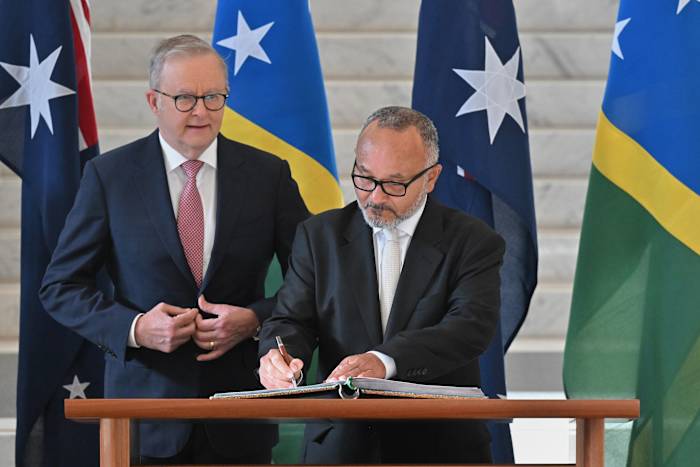
The mainstream foreign policy establishment is having a collective meltdown over Jeremiah Manele. When the Solomon Islands Prime Minister signaled a review of the nation’s secretive 2022 security pact with Beijing, Canberra and Washington breathed a sigh of relief. The talking heads immediately spun a neat, comfortable narrative: Honiara is finally waking up to Chinese debt-trap diplomacy, realizing the errors of its ways, and crawling back to the warm embrace of traditional Western partners.
They are completely wrong.
This isn’t a democratic awakening. It is a masterclass in post-colonial leverage.
The lazy consensus treats Pacific Island nations as passive objects on a geopolitical chessboard—helpless victims trapped between Washington’s indifference and Beijing’s aggression. Analysts look at the 2022 security deal through a pure Cold War lens, assuming that a review means a reversal.
I have spent years analyzing regional trade flows and defense agreements in Oceania. If you think the Solomon Islands is about to kick China out and hand the keys back to Australia, you do not understand how modern statecraft works in the Global South. Manele isn’t retreating from China. He is bidding up the price.
The Mirage of the Western Pivot
Let’s dismantle the premise of the Western celebration. The assumption is that by reviewing the security treaty, the Solomon Islands is signaling a return to the "rules-based order."
What rules-based order? To Honiara, the traditional arrangement meant decades of being ignored by the West, interrupted only when Australia needed to dump peacekeeping troops during domestic crises like the RAMSI intervention. Western aid historically came with a mountain of bureaucratic red tape, lecture series on governance, and very little concrete infrastructure.
China changed the game not because its intentions were pure, but because its checks cleared faster. When former Prime Minister Manasseh Sogavare switched diplomatic recognition from Taiwan to Beijing in 2019, it wasn't an ideological conversion. It was a business decision.
When a small nation reviews a contract with a dominant supplier, it rarely means they want to cancel the contract. It means they want a better deal. Manele is a career diplomat. He knows that the mere threat of looking at the fine print sends shockwaves through Canberra and Washington. By publicly announcing a review, he accomplishes two things simultaneously:
- He placates domestic critics who feared Sogavare was turning the country into a Chinese vassal state.
- He forces Australia and the United States to increase their financial and diplomatic counter-offers.
It is a classic shakedown. And it is working beautifully.
The Flawed Premise of People Also Ask
Look at the standard questions dominating public discourse right now. The premises are fundamentally broken.
Is China planning a military base in the Solomon Islands?
This is the wrong question. Beijing does not need a formal, heavily fortified naval base in Guadalcanal to project power. That is 20th-century thinking. In the modern era, influence is secured through dual-use infrastructure, digital networks, and elite capture.
When Huawei builds the submarine cable infrastructure or Chinese state-owned enterprises manage local ports, the strategic objective is already achieved. A formal military base creates a massive target and invites direct conflict. Commercial dominance, backed by a vague security pact that allows Chinese police to quell local riots, provides all the strategic access Beijing requires without any of the international blowback.
Will Australia lose its influence in the Pacific?
Australia cannot lose what it did not effectively maintain. For decades, Canberra treated the Pacific as its "backyard"—a patronizing term that accurately reflects the neglect the region felt.
The current panic forces Australia to actually compete. We are seeing a massive surge in Australian financing for Pacific infrastructure, telecommunications, and maritime security. The paradox of the Solomon-China pact is that it made the Solomon Islands more valuable to Australia than it ever was before.
The Economics of Geopolitical Arbitrage
To understand why the West keeps losing the narrative in the Pacific, you have to understand the mechanics of geopolitical arbitrage.
Imagine a scenario where a small town has only one grocery store. The store owner can charge high prices and offer terrible service because the townspeople have no alternative. Suddenly, a massive supermarket chain opens across the street. The townspeople don't necessarily love the corporation, but they suddenly have options. The original store owner is forced to upgrade their facilities, lower prices, and treat the locals with respect.
The Solomon Islands is that small town. For decades, the West was the only store around. China's entry created a competitive market.
| Partner | Traditional Western Approach | Modern Chinese Approach | The Manele Strategy |
|---|---|---|---|
| Primary Tool | Conditional Aid & Governance Seminars | Hard Infrastructure & Direct Cash | Playing both sides to maximize inflows |
| Speed | Slow, heavily audited, bureaucratic | Rapid deployment, opaque terms | Demanding Western speed without Western lectures |
| Security Focus | Regional stability and democratic norms | Regime protection and asset security | Balancing local police training between both powers |
Manele’s review is an optimization strategy. He wants Chinese cash for infrastructure, but he wants Australian funding for policing to avoid a domestic civil war. He is diversifying his portfolio.
The Risks of the Double Game
This strategy is not without severe dangers. I have watched developing states attempt this exact balancing act only to watch it collapse under the weight of their own institutional weakness.
The downside to geopolitical arbitrage is that you are playing with fire. The Solomon Islands lacks the robust institutional safeguards to prevent deep-seated corruption when billions in foreign capital start sloshing around a tiny economy. The risk isn't that Chinese tanks roll down the streets of Honiara. The risk is that the state machinery becomes so thoroughly corrupted by foreign money—from any source—that it ceases to function for its own citizens.
Furthermore, domestic instability in the Solomon Islands is deeply entrenched. Malaita, the country's most populous province, has historically been deeply pro-Western and anti-Beijing. The central government’s pivot to China exacerbated these internal ethnic and regional fractures, culminating in the 2021 riots. Manele’s review is a desperate attempt to patch over these domestic fault lines before they fracture the country again.
Stop Asking for Permission
If Western policymakers want to actually counter Chinese influence in the Pacific, they need to stop crying foul every time a sovereign nation signs a treaty they don't like.
The Western approach is broken because it is reactive. Washington only opens embassies and sends high-level delegations after Beijing signs a deal. This signals to every other Pacific nation that the fastest way to get America's attention is to fly to Beijing and shake hands with Xi Jinping.
Stop treating the Solomon Islands' security review as a victory. It is a warning shot. Honiara is telling the world that its loyalty is entirely up for sale to the highest bidder, and the auction has just entered its second round.