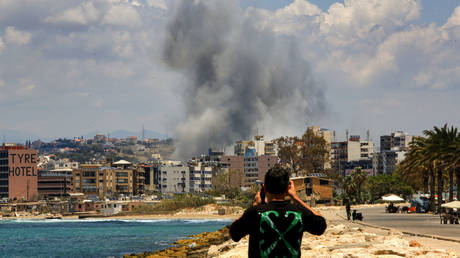
Western diplomats are stuck in a time loop. The latest demand from UK Foreign Minister Yvette Cooper, flanked by an anxious chorus of European leaders, follows an exhausting, predictable script. Israel seizes dominant terrain—this time the historic Beaufort Ridge—and the West collectively gasps, typing furious condemnations on social media about how the military advancement "must end."
It is a masterpiece of lazy consensus. This standard geopolitical script assumes that a fragile truce is always superior to a conclusive military outcome. It treats stability as something you can simply wish into existence through strongly worded press releases, while entirely ignoring the structural reality on the ground.
I have watched international bodies spend billions over two decades financing monitoring missions and peacekeeping frameworks that accomplished exactly zero disarmament. The conventional wisdom says that stopping the fighting right now preserves the "space for diplomacy." That is a fundamental misunderstanding of how power works in the Levant. In reality, the premature imposition of a nominal truce does not foster peace; it merely subsidizes the next war.
The Fallacy of the Premature Truce
The core flaw of Western diplomacy in the region is the obsession with the status quo ante. When British officials demand that all sides respect the framework brokered in Washington, they are treating a broken mechanism like a sacred text. The nominal ceasefire announced on April 17 was never a functional reality. It was an artificial pause that allowed non-state armed actors to regroup while tying the hands of a conventional state military.
Look at the mechanics of the conflict. Israel’s push across the Litani River and the capture of Beaufort Castle are not random acts of territorial aggression. They are direct responses to systemic violations of previous agreements. The Western consensus views these advancements as a "dangerous escalation" that threatens regional stability. The contrarian, brutal reality is that a decisive military campaign is often the only mechanism capable of forcing a genuine political transition.
Consider what happened when the state of Lebanon was left to its own devices under previous international mandates like UN Security Council Resolution 1701. For twenty years, the international community relied on the Lebanese Armed Forces and a UN peacekeeping contingent to maintain a weapon-free zone in the south. Instead, the area became one of the most heavily fortified non-state military zones on earth. The Western insistence on halting operations precisely when a decisive shift becomes possible ensures that the underlying security threat is never actually resolved.
Dismantling the De-escalation Premise
The most frequent question asked by international observers is straightforward: Why can't both sides just stop shooting and talk?
The premise of this question is broken. It assumes that both parties are conventional state actors with identical incentives. They are not. One side is a sovereign state trying to secure a northern border so tens of thousands of displaced citizens can return home. The other is a heavily armed, Iran-backed militia whose entire raison d'être is perpetual conflict, operating completely outside the control of the central government in Beirut.
When the UK Foreign Office demands that a non-state militia simultaneously halt attacks and disarm via a diplomatic track, it ignores twenty years of failed diplomacy. Armed factions do not hand over their arsenals because a European minister posted a statement on X. They disarm only when they are materially broken or when the domestic political cost of holding weapons becomes entirely unviable.
By demanding an immediate halt to Israeli operations, Western diplomacy inadvertently protects the very infrastructure it claims it wants dismantled. It creates a sanctuary for cross-border militancy under the guise of humanitarian concern. If you freeze the conflict while a highly capable militia retains its launch pads, rocket stockpiles, and underground command centers, you are not creating peace. You are simply setting the timer for a larger explosion three or five years down the road.
The Cost of Strategic Indecision
There is a distinct downside to rejecting the Western consensus. Allowing a military campaign to reach a conclusive finish line means enduring severe short-term instability. The humanitarian toll is real, infrastructure is damaged, and the immediate economic shock waves rattle regional markets. I have seen international strategies collapse because leaders lacked the stomach to endure the ugly, volatile phase required to achieve structural change.
But the alternative is worse. The alternative is a permanent state of low-intensity attrition that drains economic productivity, paralyzes the Lebanese state, and subjects northern Israeli communities to permanent insecurity.
The current Lebanese administration under President Joseph Aoun has expressed a desire to assert state sovereignty and limit non-state armed groups. That political will did not emerge from a vacuum. It emerged because the previous military balance of power was shattered. The domestic political landscape in Beirut shifted only after the militia's leadership structure was dismantled and its military invincibility was exposed as a myth.
Redefining the Diplomatic Framework
The current Western playbook is built on an obsolete model of conflict resolution. To achieve actual stability, the international community needs to completely invert its approach.
| Old Diplomatic Playbook | New Realist Framework |
|---|---|
| Demand an immediate, unconditional freeze of all frontline movements. | Allow the establishment of a verifiable, hard security buffer zone. |
| Rely on paper promises of disarmament from non-state actors. | Condition financial reconstruction aid on the physical absence of militia infrastructure. |
| Treat the nominal Lebanese state as a passive bystander. | Empower the central government by demanding it enforce a total monopoly on violence. |
Instead of demanding that Israel stop its advance, Western capitals should be leveraging the shifts on the battlefield to dictate terms to the political establishment in Beirut. The message should be clear: international financial support and reconstruction aid will not flow until the Lebanese state deploys its own army to the southern border and actively prevents the return of independent armed factions.
Using military leverage to force political concessions is a basic tenet of classical diplomacy, yet contemporary Western statesmen treat it like a historic anomaly. They prefer the clean comfort of an ineffective ceasefire over the messy reality of a definitive settlement.
Stop trying to revive a dead truce. The nominal April 17 agreement is gone, and no amount of diplomatic scolding will bring it back. If the United Kingdom and its European partners genuinely want to protect Lebanese sovereignty and secure the region, they must stop demanding an immediate end to the operations that are currently breaking the status quo. True stability is not achieved by freezing a conflict at its most volatile point; it is achieved by allowing a decisive shift in power to create an entirely new reality.