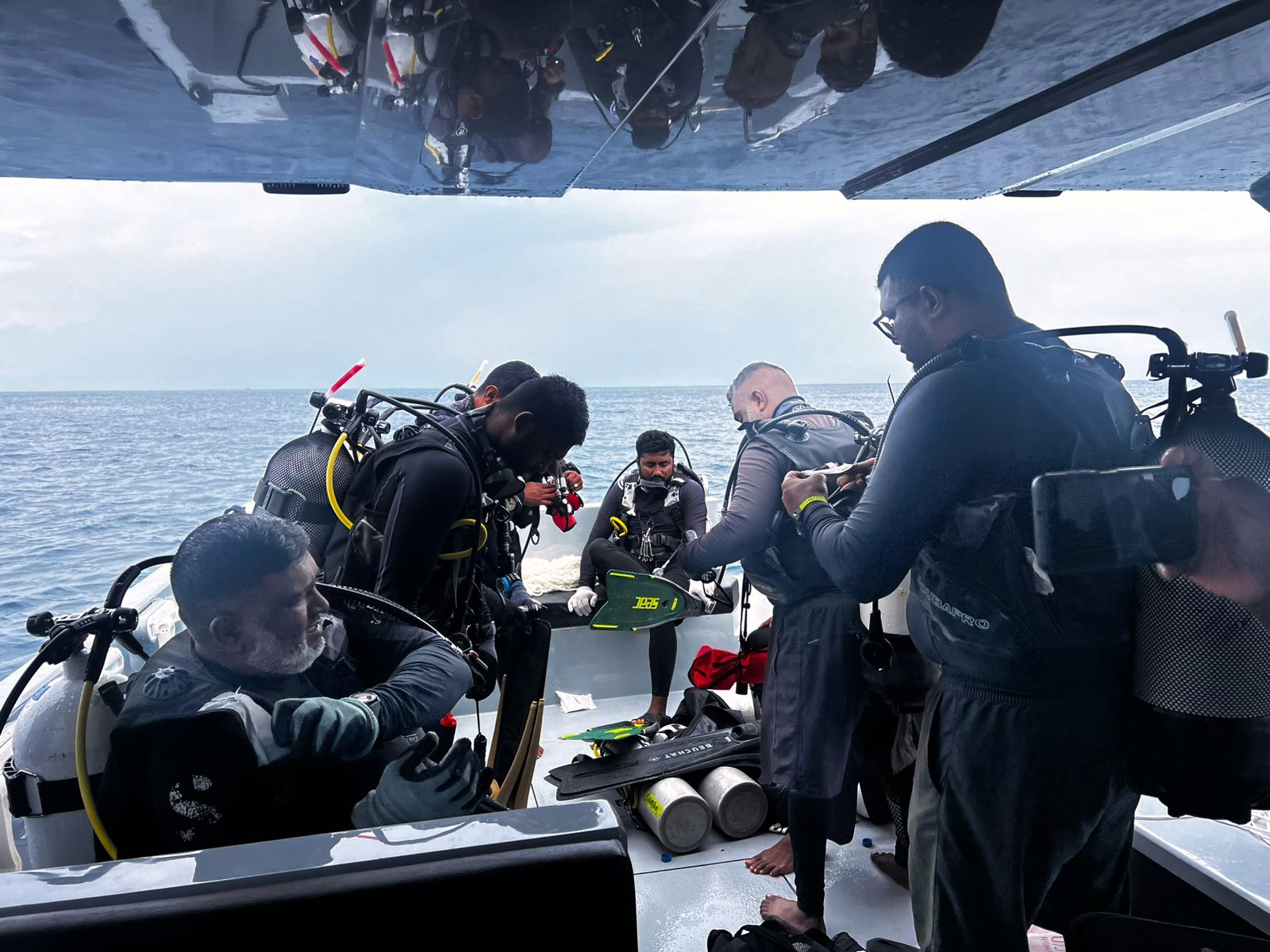
The light is the first thing to go. When you descend into the indigo depths of the Indian Ocean, the sun does not set so much as it dissolves. At ten meters, the reds and oranges of the surface world vanish, leaving you in a kingdom of muted teals and bruised purples. By the time you reach thirty meters, the water feels heavy—not just against your skin, but against your mind. It is a quiet, crushing weight that demands total presence.
Four Italian divers went looking for that weight in the Maldives. They were not novices. They were men who understood the rhythm of their own breath, the hiss of the regulator, and the mechanical reliability of their pressure gauges. They traveled to the Ari Atoll, a place where the water is so clear it feels like flying, to visit the "Fish Head" caves.
They never came back up.
Standard news reports tell us they were found dead in a sea cave. They give us the names: Ciro Maniaci, Andrea Sghinolfi, and two others whose lives were reduced to a tragic headline. But a headline cannot explain the terrifying mathematics of a cave dive gone wrong. It cannot describe the moment the silt rises or the way time stretches when the air begins to thin. To understand how four experienced men perish together in a paradise, you have to understand the invisible borders of the underwater world.
The Siren Song of the Overhead Environment
Scuba diving is generally a sport of verticality. If you have a problem, you swim up. But the moment a diver swims under a rock ledge or into a limestone cavern, the ceiling becomes a physical barrier. The surface is no longer a few kicks away; it is a labyrinth.
Imagine a room where the floor is covered in flour. Now imagine entering that room in total darkness, moving only by the light of a small torch. If your fin kicks are too aggressive, or if your buoyancy wavers by a few inches, that "flour"—the fine, powdery silt on the cave floor—erupts. Within seconds, the water turns from crystal to milk. Visibility drops to zero. You cannot see your hands. You cannot see your gauges. Most importantly, you cannot see the exit.
This is likely where the story of the four Italians began its descent into tragedy. In a cave, panic is the primary killer. When the silt rises, the heart rate spikes. A human being in a state of calm breathes roughly fifteen liters of air per minute. A human being in the grip of a cold, watery terror can consume four times that amount.
The Nitrogen Fog
There is a secondary, more insidious enemy at forty meters: nitrogen narcosis. Jacques Cousteau famously called it "the rapture of the deep." It feels like a warm, drunken haze. It makes you feel invincible, even as your reflexes slow and your logic begins to fray.
Consider a hypothetical diver in this group—let's call him Marco. At thirty-five meters, inside a cramped cave, Marco sees the silt rising. His lizard brain screams at him to find the light. But the nitrogen in his blood is whispering that everything is fine. He forgets to check his buddy. He forgets the "Rule of Thirds"—a sacred law of cave diving where you use one-third of your air to enter, one-third to exit, and one-third for emergencies.
When one person panics in an enclosed space, the energy is infectious. Divers are trained to "Stop, Breathe, Think, and Act." But when you are squeezed into a limestone throat in the Maldives, surrounded by three friends who are also struggling, the "Think" part of that equation becomes an agonizingly slow process.
The Search for the Lost
The Maldivian Coast Guard and local dive instructors were the ones who finally broke the silence of the cave. Finding four bodies in a single location tells a specific, haunting story. It suggests they stayed together. They didn't scatter. In their final moments, they likely huddled, sharing what little air remained in their tanks until the needles touched zero.
There is a particular kind of silence that exists in a dive tank when the air runs out. It is not a sudden stop; it is a gradual hardening of the breath. The regulator becomes difficult to pull from. You draw in, and the machinery resists. It is the sound of the ocean finally reclaiming its space.
Recovery divers described the scene as one of grim stillness. The caves at Ari Atoll are beautiful, teeming with grey reef sharks and clouds of fusiliers. They are vibrant monuments to life. Yet, tucked away in the shadows of the reef, the cave had become a tomb for four men who simply wanted to see what was around the next corner.
The False Security of Paradise
The Maldives is marketed as a playground. We see the overwater bungalows and the turquoise lagoons, and we forget that the ocean is an apex predator. It does not care about your certifications or your expensive gear. It is a medium that is fundamentally hostile to human lungs.
The tragedy of the Italian four is a reminder that the line between an adventure and a catastrophe is thinner than a nylon dive line. Often, it isn't one big mistake that kills a diver. It is a "calamity chain"—a series of tiny, manageable problems that link together until they are unbreakable. A slipped mask. A silt-out. A minor technical failure. A moment of narcosis. Individually, they are hiccups. Together, they are a death sentence.
The Empty Boat
There is a specific image that lingers for those who work in the Maldives dive industry. It is the sight of a dhoni—a traditional Maldivian boat—bobbing on the surface with four sets of shoes, four towels, and four dry bags sitting on the deck. The sun is shining. The water is sparkling. The boat captain watches the bubbles, waiting for them to break the surface.
He waits for an hour. Then two.
The bubbles stop.
The surface of the water returns to a perfect, unbroken mirror. It hides everything. It hides the panic, the struggle, and the final, quiet realization that the air is gone.
We often talk about the "depths" as if they are a different world. We treat the ocean as a place to be conquered or a backdrop for a vacation. But the ocean is a mirror. It reflects back our own limits. It reminds us that for all our technology and our bravado, we are air-breathers who are only ever borrowing time when we slip beneath the waves.
The four Italians left behind families in a distant Mediterranean summer. They left behind a story that will be told in dive shops from Male to Milan—not as a dry statistic, but as a cautionary tale of the weight that waits for us when we stop respecting the dark.
The Maldives will remain beautiful. The Fish Head caves will continue to draw the brave and the curious. But for those who know the story, the blue will always look a little colder. The silence will feel a little heavier. And every time a regulator draws air, there will be a prayer for the four who found the end of the line in the heart of the reef.