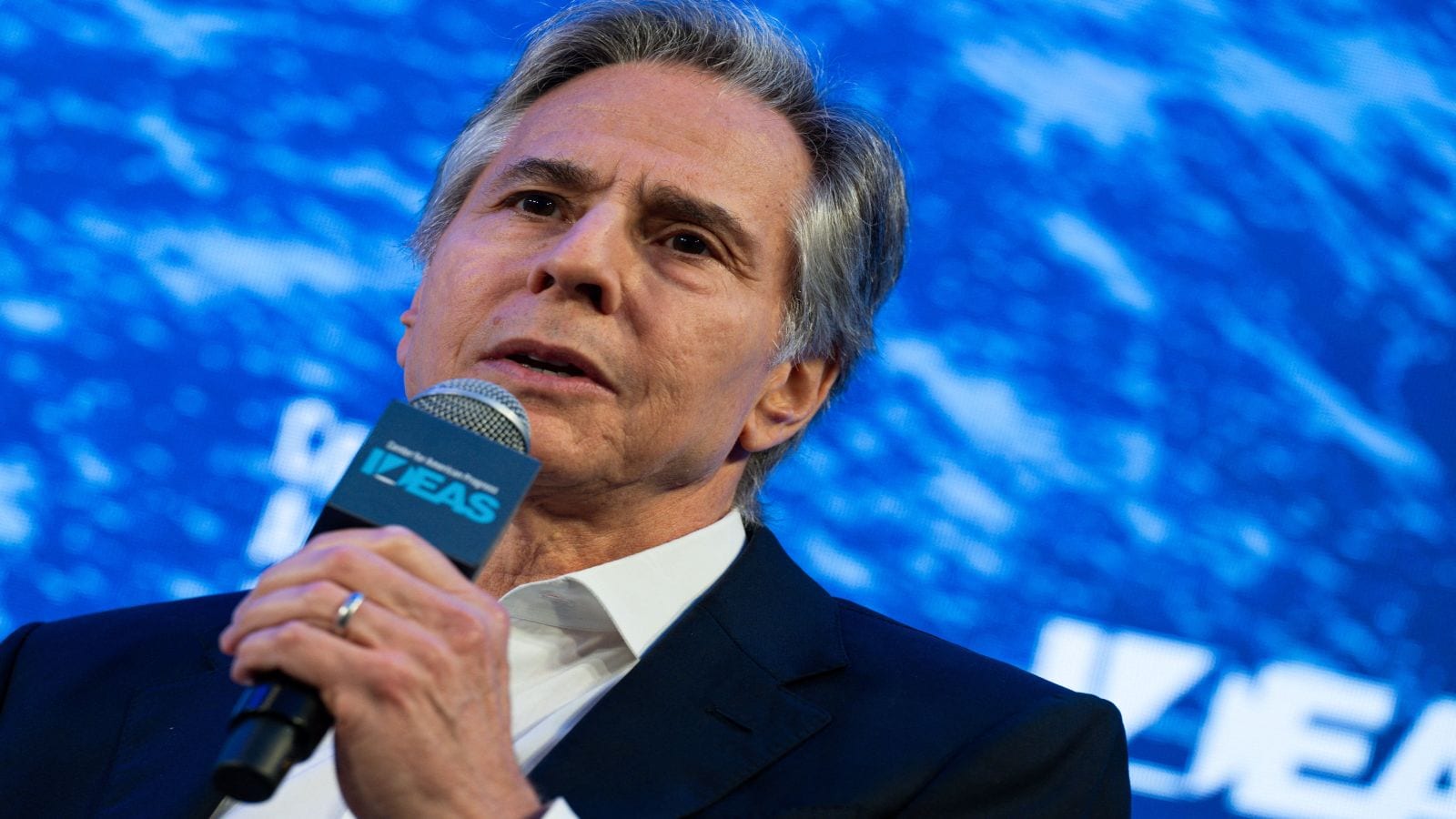
Antony Blinken stood on a stage in New Delhi in mid-November 2026 and delivered a message that sounded deceptively simple on the evening news, yet carried a sharp warning aimed straight at the White House. Speaking at the Hindustan Times Leadership Summit, the former U.S. Secretary of State declared that the United States must respect India's right to defend itself and maintain an uncompromising zero tolerance towards terrorism. Standard wire reports treated the remarks as routine diplomatic boilerplate. They missed the real story. Blinken was not merely reciting a stale talking point from his tenure under President Joe Biden; he was publicly indicting a resurgent temptation in Washington to re-hyphenate South Asia, soften scrutiny on Islamabad's military establishment, and treat New Delhi's security concerns as negotiable bargaining chips.
Diplomats rarely speak without a target. When a former top American envoy flies to India during a period of renewed friction between the Trump administration and New Delhi—and amid visible warmth between Washington and Pakistani leadership—every syllable is weighed on a jeweler's scale. Blinken's intervention exposes a deep, structural fault line in American foreign policy that refuses to heal.
The Architecture of a Deliberate Warning
To understand why Blinken chose the November 2026 summit in New Delhi to draw a hard line on counterterrorism and self-defense, you have to look at the diplomatic weather surrounding the event. In conversation with Jawed Ashraf, chairman of the India Trade Promotion Organisation, Blinken did something few former secretaries of state do so explicitly on foreign soil. He drew an uncompromising boundary between America's two historic relationships on the subcontinent.
India, Blinken stated, is a global force whose partnership with the United States is driven by worldwide challenges, technology cooperation, and shared strategic interests. Pakistan, by contrast, represents a strictly regional relationship centered on localized issues.
That distinction is not academic semantics. For decades, New Delhi's primary complaint against Washington was "hyphenation"—the Cold War habit of viewing India and Pakistan as twin halves of a single regional file, forcing every American gesture toward New Delhi to be balanced by a concession to Rawalpindi. Over the past quarter-century, successive Republican and Democratic administrations dismantled that framework. Yet by late 2026, anxieties in South Block had spiked again over perceived closeness between President Donald Trump's administration and Pakistani leadership, alongside lingering trade friction and unresolved security grievances.
Blinken stepped into that vacuum with surgical precision. By pairing zero tolerance towards terrorism directly with India's right to defend itself, he legitimized New Delhi's doctrine of cross-border deterrence while warning current U.S. policymakers against reverting to transactional diplomacy with Pakistan.
Twenty Years of Expedience and the Afghanistan Blind Spot
The most revealing moment of Blinken's New Delhi appearance had nothing to do with polite diplomatic praise. It was a rare, unvarnished admission of institutional failure in Washington.
Blinken acknowledged that for years, the United States went easy on the Pakistani military's stranglehold over its own government because Washington needed Islamabad's logistical and intelligence cooperation for the war in Afghanistan. Expedience overruled principle. American officials routinely swallowed doubts about militant sanctuaries, double-dealing intelligence networks, and civil-military imbalances because supply routes through Karachi and Khyber kept NATO forces running.
That era ended with the U.S. withdrawal from Afghanistan in 2021, which Blinken noted finally freed Washington to recalibrate its approach.
Yet habits in foreign policy bureaucracies die slowly. Even without a land war in Afghanistan, factions inside Washington's national security establishment periodically rediscover a familiar urge: using Pakistan as a convenient pressure valve or regional fixer—whether for counterterrorism intelligence on Islamic State Khorasan, backchannel messaging in West Asia, or leverage during trade negotiations with India. Blinken's critique was a direct warning against falling back into that trap. You cannot preach zero tolerance for terror in global forums while quietly overlooking state-tolerated militancy whenever a regional crisis makes Islamabad temporarily useful.
The Nuclear Tightrope Nobody Wants to Walk
Here is the uncomfortable gray area that Blinken himself could not escape, even while championing India's right to strike back.
Backing India's right to defend itself sounds clean at a podium. On the ground along the Line of Control, it is anything but. Blinken immediately paired his endorsement of Indian self-defense with an urgent call for diplomacy to prevent a wider conflict between two nuclear-armed neighbors.
That dual message captures the permanent dilemma of South Asian crisis management:
- Deterrence versus escalation: Since the 2016 surgical strikes and the 2019 Balakot airstrikes, New Delhi has established a clear doctrinal threshold. Major terror attacks traced to Pakistani soil will trigger kinetic retaliation, not merely dossiers and diplomatic demarches.
- Washington's dual role: When a crisis erupts, New Delhi expects Washington to publicly validate its right to retaliate against terror infrastructure, while simultaneously expecting American diplomats to lean on Islamabad to absorb the blow without climbing the nuclear escalation ladder.
- The credibility gap: If Washington appears overly cozy with Pakistan's military leadership beforehand, New Delhi stops trusting American crisis diplomacy. Indian planners begin to assume Washington will demand restraint from India rather than accountability from Pakistan.
By stating publicly that the U.S. must respect India's self-defense rights, Blinken was trying to preserve American credibility as an honest broker before the next crisis hits—not after missiles are already in the air.
Why Silicon and Semiconductors Matter More Than Speeches
While headlines zeroed in on terrorism and Pakistan, Blinken spent substantial breath pointing to the real ballast keeping the U.S.-India relationship upright through political turbulence: technology cooperation.
Semiconductors, artificial intelligence, and space exploration have replaced traditional defense sales as the primary structural glue between Washington and New Delhi. During his time in office, Blinken helped shepherd the Initiative on Critical and Emerging Technology, designed to link American capital and research labs with Indian engineering scale and manufacturing ambition. By late 2026, with both nations negotiating the first tranche of a bilateral trade agreement and navigating supply chain disruptions triggered by wider global conflicts, that technological interdependence has become too large for either capital to easily unwind.
This explains why Blinken also weighed in on India's enduring defense ties with Russia. Rather than lecturing New Delhi—a tactic that repeatedly backfired during the early years of the Ukraine war—Blinken acknowledged the historical depth of Indo-Russian relations and focused instead on expanding American alternatives. You do not pull India away from legacy Russian hardware by wagging a finger; you do it by co-producing jet engines, sharing sensor architectures, and integrating supply chains so deeply that strategic alignment becomes organic.
The Domestic American Undertow
A veteran observer of Washington knows that foreign policy speeches delivered abroad are almost always written with one eye on domestic politics back home. Blinken's remarks came just days after the November 2026 U.S. midterm elections, a political inflection point that reshaped congressional oversight and forced both parties to reassess how America engages abroad.
The bilateral relationship between the United States and India has enjoyed rare bipartisan consensus on Capitol Hill for over two decades, stretching from George W. Bush's civil nuclear deal through Barack Obama's Indo-Pacific pivot, Trump's first-term Quad revival, and Biden's technology pacts. Still, consensus is not autopilot. Trade friction, tariff disputes, visa restrictions, and diverging views on crises from Iran to Ukraine constantly test the hull.
When Blinken warns that Washington must not view India through a Pakistan lens, he is speaking directly to a younger generation of policymakers and political appointees who did not live through the painful decades of Cold War estrangement. Institutional memory in Washington has a notoriously short half-life. Lessons learned at great cost in the 1990s and 2000s—specifically, that treating democratic India and military-dominated Pakistan as strategic equivalents poisons ties with New Delhi without ever buying genuine cooperation from Rawalpindi—have to be re-taught every few election cycles.
What Standard Coverage Misses About South Asia's New Reality
Most mainstream summaries of Blinken's summit appearance reduce the event to a simple binary: former official supports India, criticizes terror. That framing misses three hard realities shaping South Asia right now.
First, India no longer asks for permission to retaliate. When Blinken says the U.S. must respect India's right to defend itself, he is acknowledging a fait accompli. India's military modernization, indigenous missile capabilities, and intelligence reach mean New Delhi will act when provoked regardless of whether the State Department issues a supportive press release. American backing determines the diplomatic fallout afterward, not whether India pulls the trigger.
Second, Pakistan's regional integration remains locked behind its own internal choices. Blinken pointed out in New Delhi that Pakistan stands to gain enormously by integrating economically with the rest of South Asia, provided its leadership makes basic structural decisions. With Pakistan's economy chronically dependent on external bailouts and its western border destabilized by militant blowback, the old strategy of bleeding India through proxy groups has bankrupted the state without altering the territorial status quo in Kashmir. Yet the Pakistani military establishment remains structurally unwilling to surrender its monopoly over foreign and security policy.
Third, the global context has grown far more dangerous. Blinken's comments on India came alongside stark warnings about escalating military conflict involving Israel and Iran, stalled nuclear diplomacy, and rising instability across West Asia. In an era when Washington is stretched across multiple theaters—managing war in Europe, confrontation in the Middle East, and strategic competition with China in the Indo-Pacific—America cannot afford an unforced error in South Asia. Alienating a global force like India to chase short-term tactical favors from Islamabad would be strategic malpractice of the highest order.
The Hard Truth Behind Zero Tolerance
"Zero tolerance towards terrorism" is one of the most overworked phrases in modern statecraft. Every leader endorses it at multilateral summits; almost every major power compromises on it when national interests collide.
For decades, Western capitals drew an unspoken line between terrorists who threatened New York or London and militants who targeted Mumbai, Srinagar, or Parliament House in New Delhi. Intelligence sharing was selective. Financial sanctions moved slowly. Diplomatic pressure on state sponsors evaporated the moment those sponsors offered transit corridors or counterterrorism favors elsewhere.
Blinken's blunt insistence in New Delhi—that zero tolerance means zero tolerance, period, and that India's right to defend itself must be respected without qualification—was an effort to close that moral and strategic loophole for good. Whether the current administration in Washington heeds that warning, or slips back into the comfortable illusions of regional balancing, will determine whether the U.S.-India partnership fulfills its promise or stalls in mutual suspicion.
The real test of Washington's policy will not be measured at leadership summits in New Delhi, but in the first tense hours after the next cross-border attack.