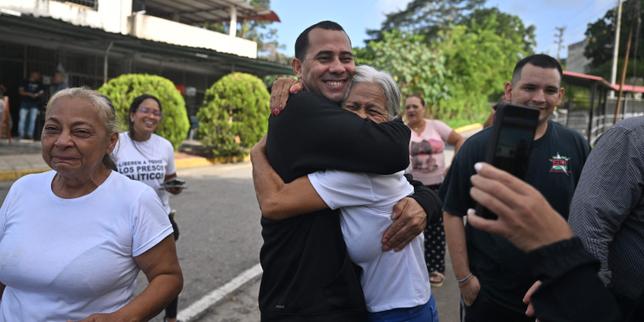
Every single major outlet ran the same stock footage this week. Smiling faces behind chain-link fences. Relatives weeping into megaphones. Banners celebrating freedom. The standard narrative writes itself: tyranny yields, goodwill returns, and the political prisoners walk into the sunlight.
It makes for compelling television. It also displays a profound misunderstanding of how autocratic survival actually works.
I have watched foreign policy analysts, human rights organizations, and casual observers fall into the exact same trap for decades. They look at a high-profile release and see a humanitarian concession. They mistake a tactical chess move for a white flag.
Stop buying the script.
The images of the liberation of political prisoners in Venezuela are not a sign of a regime crumbling under moral pressure. They are a display of operational flexibility. Dictatorships do not empty cells because they found religion; they empty cells because human capital in a concrete box stops generating leverage.
Let us dismantle the lazy consensus piece by piece.
The Currency of Captivity
To understand why these releases are a masterclass in authoritarian PR rather than a capitulation, you have to look at what political prisoners actually represent on a balance sheet.
Amateur observers think prisons are filled to keep dissenters quiet. That is a secondary benefit. Primarily, prisoners are currency. They are non-perishable assets traded in backroom diplomatic markets for sanctions relief, diplomatic recognition, or international breathing room.
When a regime locks up thousands of dissidents during a disputed election cycle, they are inflating their portfolio. They are buying heavy political inventory at a low price. But inventory costs money to maintain, and holding it indefinitely triggers international penalties that squeeze the national treasury.
So what do you do when sanctions bite too hard and you need liquidity? You liquidate a fraction of your portfolio.
You release a few dozen high-profile names. You flood the global media with heartwarming reunion videos. You let foreign diplomats claim a diplomatic victory so they can justify easing economic restrictions back home. And the best part? You keep the judicial machinery intact so you can refill the cells whenever a new wave of protests threatens your grip on power.
To call this a liberation is to confuse a revolving door for an exit.
The Myth of Moral Deterrence
Human rights groups love to talk about international pressure. They brief committees, draft sternly worded condemnations, and host panels detailing the atrocities of the Sebin and Dgcim detention centers.
I respect the documentation work. But let us be brutally honest: no dictator ever lost sleep over a PDF report published in Geneva.
The conventional wisdom argues that if you yell loud enough, shame will eventually force a regime to back down. This is a comforting fairy tale for people who have never negotiated with actors operating completely outside the social contract. Shaming requires a baseline of shared values or a desire for international legitimacy. When a state has already burned its international reputation to the ground, shame is like throwing water on a grease fire.
Imagine a scenario where a bank robber holds twenty hostages in a vault. Halfway through the standoff, he lets three elderly hostages go because he wants to free up space and reduce the immediate heat from the SWAT team outside. Do the reporters outside start cheering that the bank robber has experienced a moral awakening? Do they declare the crisis solved?
No. Because the gun is still loaded, the vault is still locked, and the robber is simply managing his risk profile.
Yet, when Caracas plays this exact playbook, the global press corps treats it like the fall of the Berlin Wall. The cognitive dissonance is staggering.
The Revolving Door Economics
Let us look at the mechanics of how these releases function as a cyclical valve.
Every major political crisis in Venezuela follows a predictable rhythm.
- An election or economic shock triggers mass unrest.
- The state responds with a sweeping wave of arbitrary detentions, sweeping up activists, journalists, and random bystanders to maximize terror.
- Domestic resistance is effectively atomized through fear.
- Once the immediate existential threat to the regime passes, international actors begin demanding concessions as a precondition for talks.
- The regime selects a batch of prisoners who have served their purpose as terror symbols and trades them for economic oxygen.
Notice what is missing from that cycle? Structural reform.
The laws criminalizing dissent remain on the books. The judges who rubber-stamp arbitrary arrests remain in their chambers. The intelligence apparatus remains funded, armed, and operational.
When you praise a regime for letting people go whom they should never have kidnapped in the first place, you are participating in a Stockholm syndrome economy. You are thanking the kidnapper for giving you back your coat on your way out of the basement.
The Danger of Cheap Optics
Why does this matter beyond geopolitical wonkery? Because cheap optics have real-world consequences for the people still inside.
When international media frames a selective prisoner release as a major breakthrough, it relieves pressure on the apparatus maintaining the dictatorship. Foreign governments looking for an excuse to resume oil purchases or normalize trade relations leap at the narrative. They point to the freed prisoners and declare that engagement is working.
Meanwhile, hundreds—sometimes thousands—of lesser-known political prisoners remain forgotten in the shadows, their names unglamorous enough to be excluded from high-level diplomatic barter. They pay the price for the regime's public relations coup.
By celebrating the release as a systemic victory, the international community validates the state's hostage-taking business model. It teaches autocrats a simple lesson: lock people up when you need leverage, let a few out when you need cash, and the world will happily applaud your humanitarian spirit.
What Real Change Looks Like
If we want to stop playing this cynical game, we have to change how we talk about these events.
Real change does not look like a tearful reunion at an airport gate while the secret police watch from unmarked SUVs.
Real change looks like the dismantling of military courts trying civilians. It looks like independent prosecutors arresting the architects of systemic torture. It looks like ironclad institutional guarantees that make arbitrary detention legally impossible, not just diplomatically inconvenient for a Tuesday afternoon.
Until those structural levers are smashed, every prison gate that swings open is just making room for the next batch. Stop calling it liberation. It is merely inventory management.