The coffee in the press filing room of the Marriott Marquis in Manhattan always tasted like burnt copper and institutional resignation. Outside, the autumn wind whipped scraps of plastic bags across Seventh Avenue, but inside, the air was thick with the distinct, electric musk of anticipation mixed with quiet dread. Reporters adjusted their microphones, checked their notebooks, and traded nervous glances. They were waiting for Donald Trump, and everyone in the room knew the rules of the game were about to shift again.
For years, the dance between political figures and the press corps has followed a predictable, albeit strained, choreography. Questions are asked. Evasions are offered. Headlines are written. But on this particular New York visit, the choreography was abandoned entirely.
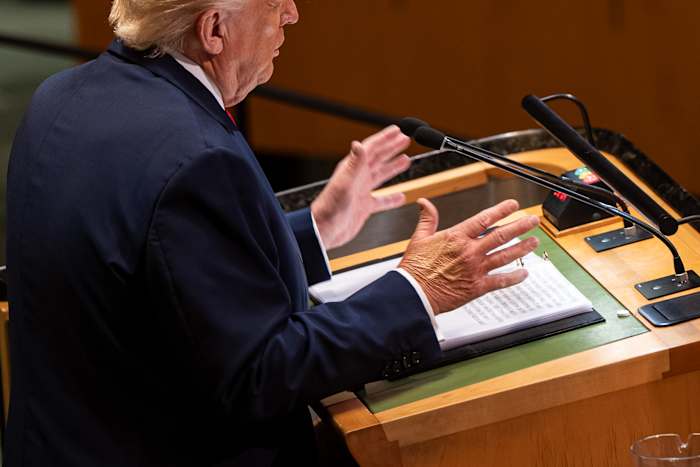
Let us be clear about what actually happened, stripped of partisan spin. During his swing through the city, the campaign restricted access for specific news organizations—CNN, Politico, and a prominent digital outlet. When asked about the exclusion, about the predictable chorus of outrage from media watchdogs and civil liberties advocates, Trump did not blink. He smiled a characteristic, knowing grin and delivered a line that hung in the air long after the microphones were switched off:
"They never boycott me."
It was a statement dripping with a raw, unfiltered confidence that exposes a profound truth about modern media consumption. Think about that dynamic for a moment. In a traditional business model, if a customer is barred from the store, they walk away. They take their wallet elsewhere. They issue a public boycott to punish the merchant.
Yet, in the ecosystem of contemporary politics, the opposite happens. The locked door does not repel the excluded; it magnetizes them. The barred outlet does not look away; it leans in closer, straining to catch every muffled word through the heavy oak door.
Consider a hypothetical editor sitting in a gleaming glass tower miles away from the press conference. For years, that editor has published rigorous, stinging investigative pieces detailing every misstep, every controversy, and every policy failure of the former president. The newsroom feels a righteous sense of duty. They are holding power to account. They are the watchdogs barking in the dark.
Then, the press credentials are revoked.
What is the immediate internal calculation in that newsroom? Does the editor spike the story? Do they decide that, out of solidarity or pride, they will simply ignore the candidate entirely for the rest of the election cycle?
Of course not.
The economic and psychological reality of our information age makes that impossible. The metrics flash red on the dashboard. Readers demand to know what was said. Advertisers want the traffic. The very act of restriction turns the excluded journalist into the ultimate insider, hungering for the details of the room they were forbidden to enter. The boycott is structurally impossible because the currency of our era is attention, and Trump remains the undisputed master of minting it.
This brings us to the deeper, more unsettling mechanism at play. Why does the public tolerate, and in many cases relish, these flashpoints between a politician and the press?
To understand this, we have to look past the political theater and examine the human need for friction. For decades, political coverage operated under a thin veneer of polite consensus. Politicians appeared on Sunday morning talk shows. Journalists asked sharp questions with arched eyebrows. Everyone nodded along to the script. It was orderly. It was predictable. And it was profoundly boring to a public that felt increasingly disconnected from the levers of actual power.
When a political figure turns to a major news network and essentially says, You are not playing by fair rules, so you do not get a seat at my table, something psychological shifts in the minds of the audience. To his supporters, it is an act of defiance against an establishment they believe has stacked the deck. It is David refusing to kowtow to Goliath, even when Goliath owns the printing presses. To his detractors, it is an authoritarian impulse, a chilling preview of how information might be managed in the future.
Both interpretations miss the underlying machinery. This is not just about ego or censorship. It is a calculated restructuring of authority.
When you restrict access, you change the nature of the information itself. News ceases to be a neutral transmission of facts and transforms into contraband. And human beings have a deeply rooted, almost primal attraction to contraband. We want what is forbidden. We lean toward the whisper behind the closed door rather than the press release handed out to a thousand smiling faces in a sterile auditorium.
Let us trace how this plays out in real time.
A reporter from an excluded outlet stands on the sidewalk outside the venue. They are shivering slightly in the crisp New York air. They hold a smartphone, broadcasting live to hundreds of thousands of concurrent viewers. They are reporting not on the substance of the speech inside, but on the exclusion itself.
Think about the brilliant, perverse efficiency of that moment.
The campaign gets wall-to-wall coverage of the event, amplified by the very networks that were barred from attending. The excluded network gets record-breaking viewership because the drama of being locked out is inherently more compelling than a standard policy speech. Everyone wins, except for the quiet, steady pursuit of objective, boring truth.
We have engineered an environment where conflict is the only currency that clears the market.
There is a historical echo here that we ignore at our peril. Throughout history, whenever institutional trust erodes, the arbiters of information lose their monopoly on reality. In earlier eras, this led to underground pamphlets and coffeehouse gossip sheets. Today, it leads to fragmented information bubbles where every faction has its own private set of facts, its own villains, and its own narrative arc.
When a politician tells a room full of reporters that they can banish them without consequence, he is speaking a hard truth about the digital landscape. He understands that institutions no longer hold the keys to the kingdom. The gatekeepers have been bypassed by the algorithm, and the algorithm thrives on friction. Every time a major network expresses shock and moral outrage over restricted access, the digital tollbooth clicks open. More eyes arrive. More revenue flows.
It is a closed loop, self-sustaining and dizzyingly fast.
We find ourselves trapped inside this loop because we have forgotten how to sit quietly with uncertainty. We crave the high-stakes drama of the conflict. We want to know who won the news cycle, who got banned, who got the last word, and who is winning the war for the cultural narrative.
As the Manhattan evening deepened, the cameras packed up. The cables were coiled into thick, heavy black loops. The reporters hurried back to their bureaus to file their pieces, their fingers flying across keyboards, fueled by adrenaline and the urgent pressure of the 24-hour cycle.
Inside the grand ballroom, the chairs were empty. The air conditioning hummed quietly against the wood-paneled walls. But the echo of that single sentence remained suspended in the space, a challenge thrown down to a media landscape that cannot look away, no matter how hard it tries.
They never boycott him. Because to boycott him would mean turning off the screens, walking away from the drama, and staring into the quiet, unstructured void of a world that no longer cares about the old rules. And that is the one thing nobody in the room is prepared to do.