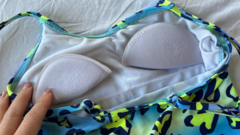
The fluorescent lights of the department store hummed with a low, medicinal frequency. Sarah stood in the middle of the children’s apparel section, a place that should have felt like a sanctuary of primary colors and soft cotton. Instead, she felt a cold knot of nausea tightening in her chest. She was holding a swimsuit designed for a seven-year-old girl. It wasn't the color—a standard tropical pink—that stopped her breath. It was the cut. High-legged, deep-v neckline, and padded cups.
Padding. For a second grader.
She looked at her own daughter, Maya, who was currently preoccupied with trying to see if she could fit her entire shoe into a floor drain. Maya was a whirlwind of scraped knees, tangled hair, and an obsession with pill bugs. She was a child. But the garment in Sarah’s hand belonged to a different world entirely. It was a costume for a role Maya wasn't ready to play, a miniature version of a poolside siren.
This isn't just about one angry mother in a shopping mall. It is about a silent, systemic shift in how we manufacture the physical identity of children. We are witnessing the aggressive "adultification" of the playground.
The Architecture of the Gaze
When we talk about clothing, we often focus on aesthetics. We talk about what’s "cute" or "fashionable." But clothing is architecture. It dictates how a body moves, how it is viewed, and how the person inside that body perceives their own utility. A pair of overalls says: Run, climb, get dirty, be a tool of your own curiosity. A "bikini" for a toddler, complete with hip-high cutouts and decorative ties that serve no functional purpose, says something else: Be looked at.
The industry calls this "mini-me" styling. It sounds innocent. It suggests a daughter wanting to wear her mother’s heels or a son donning a clip-on tie to look like dad. But the transition from mimicking professional or social roles to mimicking sexualized ones is a chasm, not a step.
Consider the hypothetical case of a brand manager—let's call him Mark. Mark isn't a villain in a darkened room. He is a man looking at a spreadsheet. He sees that "adult-style" swimwear for children has a 30% higher conversion rate on Instagram than traditional, full-coverage suits. He sees that influencers are dressing their children in these "aesthetic" outfits because they rack up likes and shares. The algorithm doesn't have a moral compass. It rewards the "thumb-stop" moment. And nothing stops a thumb faster than something that looks slightly out of place, slightly "mature," slightly shocking.
The market responds to the data. The data reflects our collective gaze. We are, quite literally, coding the loss of childhood into the supply chain.
The Invisible Stakes of the Sandbox
Psychologists have long warned about the "Self-Objectification Theory." It suggests that when children are taught to view themselves through the eyes of others—to prioritize how they look over how they feel or what they can do—their mental health takes a measurable hit.
Think about the physical sensation of wearing a garment that requires constant adjustment. A strap that slips. A neckline that reveals too much if you bend over to pick up a seashell. A child shouldn't have to manage their own modesty while trying to build a sandcastle. When we put kids in "sexy" swimwear, we are tethering them. We are giving them a mental load they aren't equipped to carry. They stop being the protagonist of their play and start being the prop in a photo.
Statistically, the rise in "sexualized" children's clothing correlates with an earlier onset of body dissatisfaction. We used to see these issues emerge in mid-adolescence. Now, pediatricians see them in seven-year-olds. The mirror is becoming a judge before it has even finished being a curiosity.
The Narrative of Progress and Its Lies
There is a frequent counter-argument: It’s just clothes. Don’t make it weird. You’re the one sexualizing it by complaining.
This is a clever bit of gaslighting. It ignores the history of design and the intentionality of the fashion industry. Design is never accidental. Every stitch, every cutout, and every fabric choice is a decision made by an adult for a profit. To suggest that a thong-cut swimsuit for a child is "neutral" is to deny the reality of human biology and social signaling.
We have spent decades fighting for the right of women to be seen as more than objects. We have marched for the idea that a woman’s worth is not tied to her hemlines. How tragic, then, that we are backsliding by imposing those very pressures on people who still believe in Santa Claus.
Sarah put the pink swimsuit back on the rack. She felt a strange sense of mourning. It wasn't just for the loss of a shopping trip; it was for the loss of a boundary. The world is in a hurry to turn children into consumers, into influencers, into adults. It is a one-way street. You can never go back to the time when you didn't know your body was a product.
The Weight of the Choice
The real battle isn't happening in the halls of Parliament or in the boardrooms of fast-fashion giants. It happens in the quiet moments between a parent and a child in a dressing room. It happens when we decide which brands to fund with our hard-earned money.
Resistance looks like choosing the boring, functional rash guard over the "trendy" cutout. It looks like telling our daughters they are strong and fast before we tell them they are pretty. It looks like demanding that retailers treat children like the developing, vulnerable, wonderful humans they are, rather than miniature billboards for adult desires.
Sarah walked away from the "mini-me" section and found a rack of simple, brightly colored trunks and shirts in the back corner. They were covered in cartoon sharks. They were sturdy. They were modest. They were, quite simply, for kids.
As she watched Maya chase a rogue shopping cart, Sarah realized that the most radical thing a parent can do in the modern age is to keep the world small for just a little while longer. To let a child be a body in motion, a mind in wonder, and nothing more.
The sun was setting outside, casting long, distorted shadows across the parking lot. In the distance, a billboard showed a young girl posing with a pout that belonged on a runway in Milan. The shadow of the billboard stretched across the pavement, cold and dark, reaching toward the playground nearby. Sarah gripped her daughter's hand tighter, feeling the small, sticky warmth of it, a reminder of the fragility of the line we are currently treading.