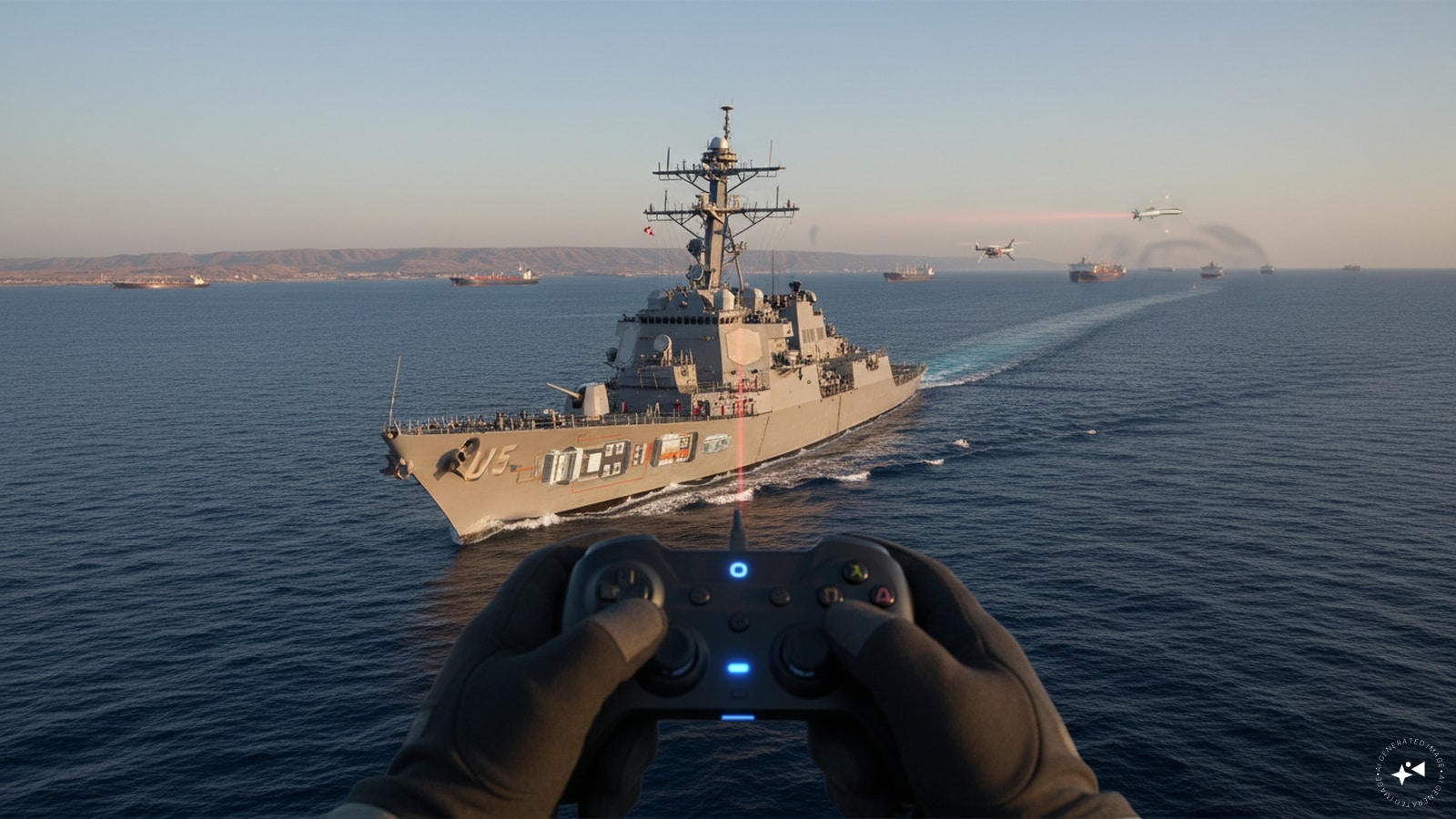
Every tech blogger and defense pundit spent the last week losing their minds over a single viral headline. The U.S. military is allegedly using Xbox-style controllers to shoot down drones with lasers in the Strait of Hormuz. The breathless commentary writes itself: military procurement has finally caught up to Gen Z. We are living in a sci-fi movie. Real life has officially become a video game.
It is a fantastic story. It is also entirely missing the point.
I have spent the last fifteen years watching defense contractors burn billions of dollars trying to make hardware look like consumer electronics while ignoring the actual bottlenecks of directed energy warfare. The lazy consensus says that adopting a commercial off-the-shelf gamepad proves the Pentagon is becoming agile, modern, and intuitive.
The reality is far uglier. When your multi-million-dollar counter-drone laser requires an ergonomic plastic input device originally designed to play Halo, you are not innovating. You are admitting that your custom-engineered command and control architecture is so bloated, unresponsive, and user-hostile that a thirty-dollar plastic shell from Microsoft is the only thing standing between a $50,000 drone swarm and a catastrophic naval strike.
Let us dismantle the myth of the video game controller in the combat zone.
The Ergonomic Fallacy
The core argument for consumer gamepads in military applications usually revolves around intuitive muscle memory. The theory goes like this: eighteen-year-old recruits grew up playing Xbox or PlayStation, so dropping them behind a console layout eliminates training friction. They already know how to track moving targets with twin thumbsticks.
This sounds plausible in a PowerPoint deck delivered to a congressional budget committee. It collapses the moment you hand that controller to an operator wearing heavy NBC-rated gloves in ninety-degree humidity while a guided motorboat circles a destroyer at thirty knots.
Consumer gamepads are engineered for comfort on a living room couch, not durability in a salt-spray environment. Their potentiometers drift after a few hundred hours of heavy use. Their plastic chassis flexes under high-stress grip compression. More importantly, analog thumbsticks are fundamentally ill-suited for precision laser designation at sea.
A laser weapon does not care about your video game muscle memory. When you are painting a carbon-fiber drone chassis miles away across the Persian Gulf, a tiny twitch of a thumbstick translates into an angular deflection that sweeps the beam right off the target. Directed energy requires micro-radian precision. Thumbsticks introduce slop, dead zones, and nonlinear acceleration curves that engineers spend millions of dollars trying to filter out through software filters.
If you need a gamepad to shoot down a drone, your targeting software is doing the heavy lifting to compensate for terrible hardware ergonomics. And if that software fails, you are left steering a classified weapon system with the same mechanism a teenager uses to play Fortnite.
The Real Bottleneck Is Not the Input Device
The media loves the controller because it is a tangible, easily digestible symbol. It gives the public a human-scale anchor for a terrifyingly complex topic. But focusing on the joystick ignores the catastrophic thermal and power management hurdles that actually plague tactical lasers.
A directed-energy weapon system operating in the Strait of Hormuz faces environmental brutalism. Ambient temperatures regularly exceed 110 degrees Fahrenheit. Salt air wreaks havoc on optical lenses. High-power solid-state lasers generate immense waste heat, requiring cooling systems that draw massive amounts of shipboard power.
I have spoken with engineers who worked on early deployment directed energy prototypes. They will tell you off the record that the least of their worries was what the button layout looked like. You could wire a literal cardboard box with toggle switches if the underlying beam director had stable stabilization algorithms and sufficient power reserves.
Fixating on the Xbox controller is like praising a Ferrari for having a really nice steering wheel while the engine block is on fire. The input device is downstream of every real engineering challenge in the program.
The Procurement Paradox
Why does this keep happening? Because traditional defense procurement is broken beyond repair.
When the Department of Defense tries to design a custom human-machine interface for a new weapon system, the process takes seven years, three design reviews, twelve congressional subcommittees, and results in a five-pound monstrosity of milled aluminum and proprietary switches that costs forty thousand dollars a unit. It feels like an artifact from 1984 because it was designed by committee in 2017.
Desperate operators, tired of waiting for defense primes to deliver usable gear, walk down to the local electronics exchange, buy a commercial controller, splice it into an open-source USB interface board, and jury-rig it to the console.
We call this agility. We should call it an indictment.
The fact that service members have to resort to off-the-shelf gaming peripherals to make a cutting-edge laser system operable highlights the total disconnect between defense acquisition and the warfighter. It proves that our multi-billion-dollar military-industrial complex cannot build a better joystick than a company in Redmond that makes consoles for basement entertainment centers.
What Real Innovation Looks Like
If we want to secure maritime choke points against asymmetric drone threats, we need to stop romanticizing tactical DIY projects.
Real innovation in directed-energy control looks like predictive AI cueing that tracks autonomous drone swarms without human intervention until the final engagement authorization. It looks like neural-interface tracking, gaze-directed targeting, or robust contextual HUDs that remove manual tracking entirely from the operator's workflow.
A human thumbing a plastic joystick to keep a laser beam steady on a jittery drone is a stopgap measure, not a revolution. As drone swarms grow faster, cheaper, and more numerous, manual tracking—even with an ergonomic controller—will become as obsolete as a musket volley.
Stop celebrating the military for raiding the local Best Buy. Start asking why the people building our national defense can't design a better interface than a toy.