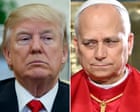
Donald Trump is currently locked in a unprecedented theological and geopolitical feud with Pope Leo XIV, accusing the first American-born pontiff of "endangering" millions of Catholics by opposing U.S. military action in Iran. This is not merely a spat over foreign policy; it is a fundamental collision between a President who frames war as a divine mandate and a Pope who views that same conflict as a "delusion of omnipotence." As Secretary of State Marco Rubio prepares for a high-stakes meeting at the Apostolic Palace this week, the rift has moved beyond diplomacy into a raw struggle for moral authority over the world's 1.4 billion Catholics.
The Nuclear Pretext and the Papal Pivot
The immediate flashpoint is the 2026 Iran war. Trump has consistently justified the military campaign—launched alongside Israel in late February—as a preemptive strike to prevent Tehran from acquiring nuclear weapons. In a recent exchange with radio host Hugh Hewitt, the President sharpened his rhetoric, claiming the Pope "thinks it's just fine for Iran to have a nuclear weapon."
The reality is more nuanced and far more dangerous for the administration’s narrative. The Vatican has not endorsed an Iranian bomb. Instead, Pope Leo XIV has maintained the Holy See’s long-standing opposition to nuclear proliferation while simultaneously stripping away the "just war" justifications the White House has relied upon. By calling the conflict a "diplomacy based on force," Leo has effectively excommunicated the administration’s strategic logic from the realm of Christian morality.
God and the Machine
What makes this confrontation unique in the history of U.S.-Vatican relations is the domestic religious landscape. For decades, the "Catholic vote" was a coveted but predictable demographic. Today, it is a battlefield. Trump has successfully courted conservative evangelicals who frame the war in apocalyptic terms—Defense Secretary Pete Hegseth recently urged prayers for victory "in the name of Jesus Christ."
But Leo XIV, a product of the politically savvy Chicago archdiocese, is not playing the role of the quiet diplomat. Unlike his predecessor Francis, who often used metaphorical language, Leo has named Trump directly. When the President threatened on social media that the "whole [Iranian] civilization will die tonight," the Pope did not send a private cable. He stood in St. Peter’s Square and called the threat "truly unacceptable."
The administration has responded by attempting to delegitimize the Pope’s very office. Trump has suggested that Leo’s election was a political maneuver by the Church to install an "American counterweight" to his presidency. This isn't just a critique of policy; it is an assault on the institutional integrity of the papacy, intended to signal to American Catholics that they can—and perhaps should—choose their Commander-in-Chief over their Holy Father.
The Rubio Mission
The upcoming meeting on May 7 between Marco Rubio and the Vatican represents a desperate attempt to patch a sinking diplomatic ship. Rubio, a devout Catholic, finds himself in the impossible position of bridging the gap between his faith's leader and his political patron. The Vatican has promised "frank" discussions, but the air is thick with tension.
Internal reports suggest the relationship reached a nadir after a closed-door "lecture" at the Pentagon where U.S. officials reportedly used language that Vatican insiders interpreted as a veiled military threat against the Holy See. While the White House denies this, the mere existence of such a narrative shows how far the "special relationship" has fallen.
A Fractured Faithful
The fallout is already visible in the pews. Recent polling shows Trump losing ground with Catholic voters, falling to 48% support as the human cost of the Iran war becomes impossible to ignore. The administration’s use of AI-generated religious imagery—including an image of Trump depicted as Christ—has backfired, alienating even some of the President's staunchest religious allies.
The President is betting that nationalism will trump theology. He is counting on a segment of the Catholic population that feels the Church has moved too far toward "woke" globalism. Leo XIV is betting on the opposite: that the ancient moral weight of the Church can still restrain the impulses of a superpower.
This is no longer a debate about the Strait of Hormuz or centrifuge counts in Natanz. It is a struggle to define what it means to be a person of faith in an age of total war. The President claims to be protecting Catholics by neutralizing a foreign threat; the Pope argues that the President is destroying the moral fabric that makes the faith worth protecting in the first place.
The silence coming from the Apostolic Palace following Trump's latest "endangering" accusation is not a sign of retreat. It is the quiet before a different kind of storm. As Leo XIV prepares for a strategic pivot toward the Global South, the American President may find that while he can command an army, he cannot so easily command a conscience.