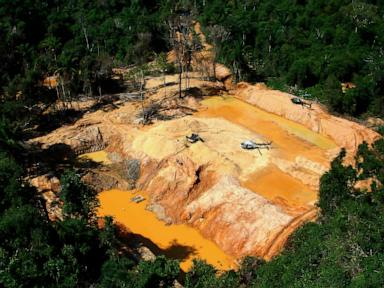
The Amazon rainforest in Brazil is facing an unprecedented ecological assault, driven not by traditional logging or cattle ranching, but by a modern gold rush that has increasingly targeted protected Indigenous territories. Recent geospatial analysis and satellite monitoring reveal that wildcat gold mining, locally known as garimpo, has expanded at its fastest rate ever on officially demarcated Indigenous lands. Behind these alarming numbers lies a complex web of economic desperation, illicit supply chains, and political vulnerabilities that continue to threaten both vulnerable populations and fragile ecosystems.
To understand why illegal gold extraction is accelerating inside these protected boundaries, one must look at the global market forces at play. Gold prices have remained exceptionally high over recent years, driven by global economic uncertainty and institutional buying. For impoverished rural communities surrounding the Amazon basin, the lure of striking gold provides an immediate, tangible escape from joblessness and poverty. A single successful find can yield months of local wages, creating a powerful incentive that easily overrides federal environmental regulations and remote enforcement efforts.
The mechanics of this expansion rely on sophisticated logistical networks that operate far from the public eye. Heavy machinery, industrial fuel, and mercury are flown or barged into remote jungle airstrips, often constructed illegally within or adjacent to Indigenous reserves. Once the ore is extracted, it undergoes a process of laundering. Because raw gold can be easily bought and sold with minimal documentation in certain domestic markets, illegally mined gold is routinely mixed with legal production, effectively erasing its origins before it enters international supply chains or finds its way into global financial reserves.
This illicit activity takes a devastating toll on local communities. Indigenous groups such as the Yanomami and Munduruku have borne the brunt of this invasion. River systems are routinely polluted with toxic mercury used to amalgamate gold, poisoning fish populations that serve as a primary food source for native populations. Furthermore, the influx of outside miners brings violence, organized crime syndicates, and diseases against which isolated communities have little natural immunity. Healthcare access in these remote regions is sparse, leaving local residents to cope with severe public health crises driven entirely by unauthorized resource extraction.
Enforcement remains a persistent challenge for federal authorities. The Brazilian Amazon spans an area larger than Western Europe, making constant aerial or ground surveillance nearly impossible with existing government budgets. Corruption at local levels further complicates policing efforts, as illegal mining syndicates often co-opt regional officials or intimidate local law enforcement. When federal sweeps do occur, miners frequently abandon their equipment temporarily, only to return once enforcement personnel withdraw to urban centers.
Addressing this crisis requires more than just reactive crackdowns on remote riverbanks. True disruption of illegal gold mining depends heavily on supply chain transparency and financial accountability. Implementing stringent tracking measures for gold from the mine to the refinery, alongside severe penalties for institutions that purchase unverified precious metals, represents the most viable path toward choking off the capital that fuels the expansion. Until the financial incentives for illicit extraction are dismantled, the remote frontiers of the Brazilian Amazon will remain ground zero for a relentless ecological and humanitarian conflict.


