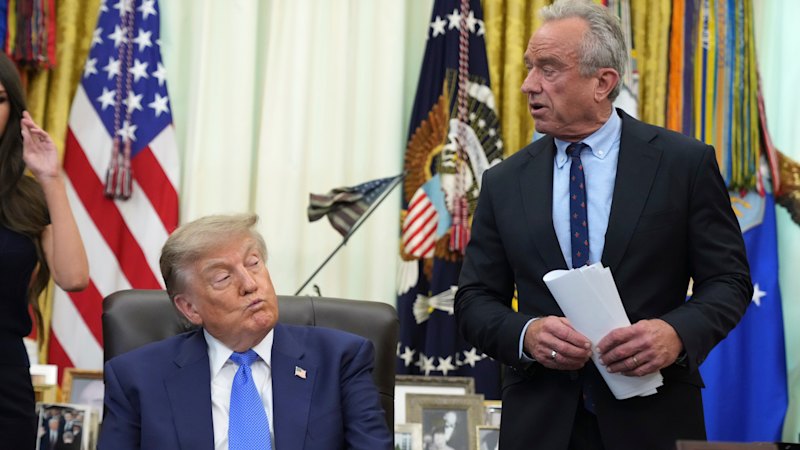
You take your toddler to the pediatrician expecting a routine checkup, a quick jab, and a lollipop. Now, the White House wants to completely rewrite that script. President Donald Trump signed an executive order targeting the long-standing U.S. childhood vaccination schedule.
If you are a parent trying to make sense of the noise, you are not alone. The executive order pushes for sweeping changes, including splitting up combination shots like the measles, mumps, and rubella (MMR) vaccine and spreading out visits. It is a move heavily influenced by Health Secretary Robert F. Kennedy Jr., and it has instantly reignited a fierce national debate over public health, parental choice, and medical science.
What the Executive Order Actually Changes
Let us look past the political headlines and break down what the directive dictates. The administration's order targets the foundational framework of American pediatric medicine.
Key directives include:
- Splitting the MMR Shot: The order calls for breaking the combined measles, mumps, and rubella vaccine into three separate injections administered during distinct medical visits.
- Overhauling Schedules: Recommendations for specific shots like hepatitis B, COVID-19, and influenza are scaled back or shifted.
- Spacing Out Visits: The policy promotes the theory that children receive too many inoculations at once, advising that one-year-olds should spread visits out across multiple appointments.
- State Pressures: The White House directs the Department of Justice to challenge state laws regarding vaccine exemptions and encourages individual states to alter school mandates.
It sounds simple on paper. In practice, it hits immediate roadblocks. Single-dose measles, mumps, and rubella vaccines have not been manufactured or licensed for children in the United States since 2008. Pharmaceutical companies would need to reformulate and seek FDA approval for these products, a process that takes years.
The Core Conflict Over Public Health and Autism
The administration ties these changes directly to rising public concerns about autism. Trump stated during the signing that the new schedule aims to address chronic health issues and autism rates.
Here is where the scientific community draws a hard line. Decades of extensive, peer-reviewed global research show no link between childhood vaccines—including the MMR shot—and autism. Major medical institutions, including the American Academy of Pediatrics and the American College of Physicians, have strongly condemned the order. They argue that separating combination shots forces children to endure unnecessary extra needle pricks and leaves them vulnerable to preventable diseases during the extended gaps between visits.
Dr. Bill Cassidy, a Republican senator and a trained physician, pointed out the practical flaw immediately. Breaking up vaccines means kids need more individual appointments and shots to achieve the exact same immunity. Instead of reducing stress for families, it multiplies financial copays, administrative friction, and time off work.
Can the Federal Government Change State Vaccine Laws?
Parents often wonder if a presidential directive changes what their local school district requires. The short answer is no.
The federal government lacks direct authority to mandate or ban school vaccination requirements. That power rests entirely with individual state governments. While the executive order encourages states to rewrite their laws and leans on the Department of Justice to pressure states over exemptions, school entry requirements remain governed locally. If your state requires proof of specific immunizations for kindergarten entry, a federal executive order does not automatically void that mandate.
Practical Steps For Parents Right Now
Navigating conflicting guidance from political figures and medical professionals is exhausting. If you have an upcoming pediatrician appointment, keep these practical realities in mind.
Talk openly with your child's pediatrician instead of relying on social media summaries or White House fact sheets. Pediatricians base their schedules on real-world data tracking infectious disease outbreaks. If you face scheduling choices, weigh the practical burden of multiple copays and increased infection windows against abstract political debates. Stick to proven medical science to protect your family.