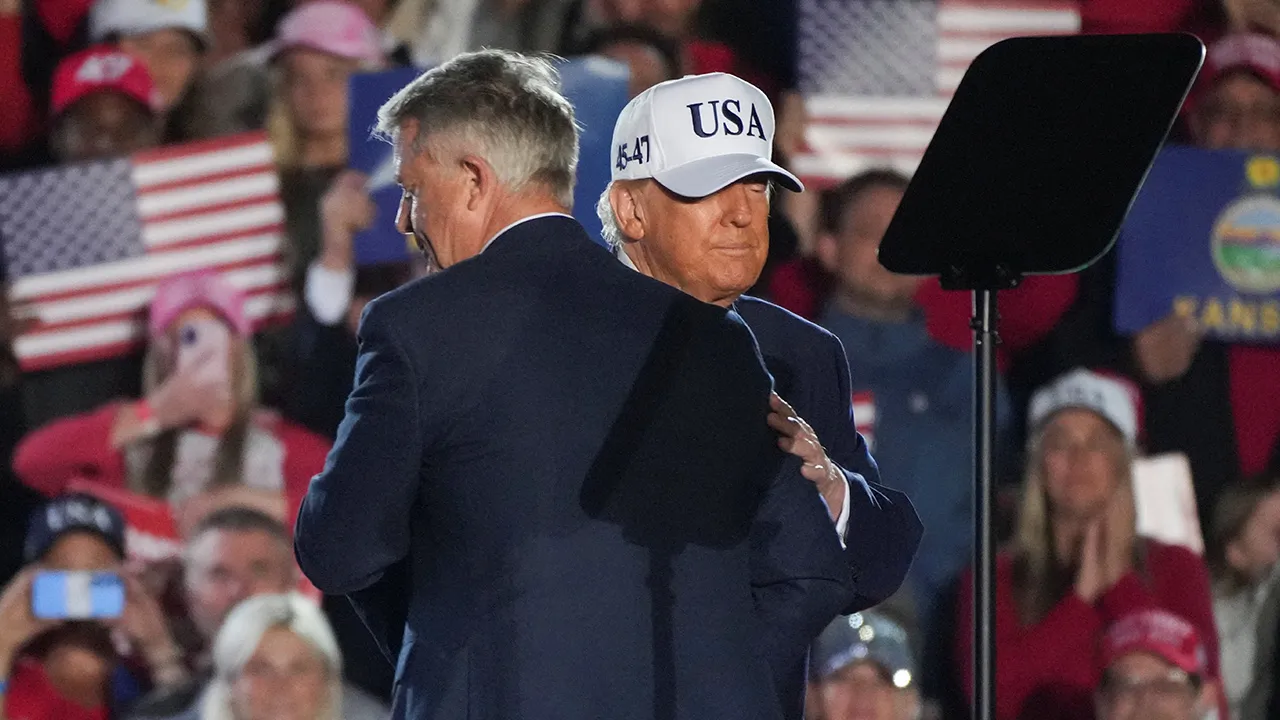
When President Donald Trump casually tells reporters that the United States still has "one or two targets" left in Iran, Washington stops breathing for a second. Oil traders hit refresh on their terminals. Defense analysts start pulling up satellite imagery of the Persian Gulf.
I've watched Washington's messaging on Tehran for over a decade, and this exact brand of calculated ambiguity isn't an accident. It's a pressure tactic designed to keep adversaries guessing while avoiding a formal commitment to full-scale war.
Right now, everyone is trying to figure out whether those "one or two targets" represent a literal military strike package sitting on a desk at the Pentagon or pure psychological warfare. Honestly, it's probably both. Understanding what's actually on the table requires looking past the cable news panic and examining the hard military and economic realities in the region.
Why Trump's "One or Two Targets" Comment Rattled Markets
Markets hate uncertainty more than bad news. When the President of the United States implies that military action against Iran isn't finished, energy markets immediately price in a risk premium.
Within hours of similar statements in the past, Brent crude has jumped several dollars a barrel simply because shipping insurers get nervous about the Strait of Hormuz. Nearly 20 percent of the world's petroleum passes through that narrow chokepoint. You don't even need a missile launch to disrupt global supply chains—you just need the credible threat of one.
Trump understands this dynamic better than most politicians. During his first term, he built a foreign policy doctrine around unpredictability, often called the "madman theory" of international relations. By keeping the exact nature of the remaining targets vague, he forces Tehran to spend money, move air defenses, and burn political capital preparing for an attack that might never come.
It's cheap deterrence. A single off-the-cuff remark at a press gaggle costs the U.S. taxpayer nothing, yet it forces the Islamic Revolutionary Guard Corps (IRGC) into a defensive crouch across thousands of miles of territory.
What the Pentagon Actually Considers High-Value Targets in Iran
If we take the statement literally, what are the "one or two targets" left on a U.S. strike list? Military planners at U.S. Central Command (CENTCOM) don't throw darts at a map. Every potential target is categorized by strategic impact, civilian casualty risk, and the likelihood of triggering an uncontrollable regional war.
Over the past few years, U.S. and allied operations have already degraded several layers of Iran's regional proxy infrastructure and air defense networks. When a commander-in-chief says only one or two major targets remain, they're usually pointing toward crown-jewel assets that haven't been touched yet because the escalation cost was previously too high.
Nuclear Enrichment Facilities Like Fordow and Natanz
You can't talk about Iranian targets without mentioning the nuclear program. Natanz is Iran's primary uranium enrichment site, much of it buried beneath reinforced concrete. Fordow is even harder to reach, tunneled deep into a mountain near Qom.
Taking out Fordow isn't a job for standard cruise missiles. It requires the GBU-57 Massive Ordnance Penetrator—a 30,000-pound "bunker buster" bomb that only the B-2 Spirit stealth bomber can carry.
Striking these sites would set Iran's nuclear timeline back by years, if not a decade. Yet doing so almost guarantees an all-out regional conflict, including massive ballistic missile barrages against U.S. bases in Iraq, Syria, and the Gulf states. That's why these sites remain the ultimate card in Washington's deck rather than an immediate first strike.
Critical Oil and Export Infrastructure at Kharg Island
If the goal is to cripple the Iranian regime without triggering a nuclear fallout crisis, military planners look straight at Kharg Island. Roughly 90 percent of Iran's crude oil exports flow through this tiny island in the northern Persian Gulf.
Destroying the loading terminals and storage tanks on Kharg Island wouldn't require a massive, prolonged air campaign. A single night of precision strikes could sever the regime's primary financial lifeline overnight.
The catch? Tehran has repeatedly warned that if it can't export oil, nobody in the Gulf will. An attack on Kharg Island carries a massive risk of retaliatory strikes against Saudi, Emirati, or Qatari energy facilities—something the White House desperately wants to avoid when domestic gas prices are a top political issue.
IRGC Command and Drone Manufacturing Hubs
The third realistic option involves the factories and command centers fueling Iran's asymmetric warfare capabilities. Over the last few years, Iranian Shahed drones and ballistic missiles have reshaped conflicts from Ukraine to the Red Sea.
Targeting the domestic production lines—facilities in places like Isfahan or Shiraz—directly degrades Tehran's ability to arm groups like Hezbollah and the Houthis. These strikes are easier to calibrate. They send an unmistakable message to the IRGC leadership without necessarily pushing the Iranian population to rally around the flag the way an attack on national oil infrastructure might.
The History Behind U.S. Deterrence and Escalation with Tehran
To read the current moment accurately, you have to look at the pattern established over the last several years. Neither Washington nor Tehran actually wants a conventional ground war. Both sides know how catastrophic that would be.
Instead, they've engaged in a high-stakes game of calibrated escalation. Look back at January 2020, when Trump ordered the strike that killed Qasem Soleimani, the head of the IRGC's Quds Force. Many experts predicted World War III. Instead, Iran launched a telegraphed ballistic missile strike on Al Asad Air Base in Iraq that caused traumatic brain injuries to U.S. troops but zero fatalities, allowing both sides to step back from the brink.
We saw a similar dynamic play out during the direct missile and drone exchanges between Iran and Israel in 2024. Both sides demonstrated reach and capability, yet both carefully calibrated their strikes to leave an off-ramp available.
Trump's "one or two targets" line fits squarely into this playbook. He's signaling to Tehran that the United States still holds escalation dominance—the ability to inflict pain at a level Iran can't match—while keeping the door open for a diplomatic deal or quiet de-escalation.
What Most Analysts Miss About Washington's Iran Strategy
Most commentary on cable news treats U.S.-Iran relations like a binary choice between total appeasement and full-scale invasion. That framing is lazy and completely misses how modern coercive diplomacy actually works.
Here's what the pundits overlook:
- Domestic politics drive the timeline. Every White House statement on Iran is filtered through domestic economic concerns, particularly inflation and energy costs. A strike that spikes gas prices before an election cycle is a non-starter unless Iran crosses a glaring red line, like killing American personnel or testing a nuclear device.
- Allied pressure matters more than people admit. Gulf Arab states like Saudi Arabia and the UAE have spent the last few years repairing diplomatic ties with Tehran. They don't want their gleaming skyscrapers and desalination plants caught in the crossfire of a U.S.-Iran slugfest. Behind closed doors, regional partners consistently urge Washington to keep a lid on kinetic operations.
- Sanctions enforcement is the real weapon. While headlines focus on aircraft carriers and stealth bombers, the Treasury Department's crackdown on Iran's "ghost fleet" of oil tankers often hurts the regime far more consistently than a one-off airstrike.
When Trump mentions remaining targets, he isn't just talking to Ayatollah Ali Khamenei. He's also talking to European allies, Beijing (which buys the vast majority of discounted Iranian crude), and domestic voters who want to see strength without getting dragged into another endless Middle Eastern war.
How to Watch for Real Escalation vs. Political Theater
If you're trying to separate genuine military preparation from routine political posturing, ignore the loudest voices on social media and watch the concrete indicators instead.
First, keep an eye on pentagon force posture movements. You can't hide the deployment of B-2 bombers to Diego Garcia, the arrival of additional THAAD missile defense batteries in the Middle East, or the surging of aerial refueling tankers to bases in Qatar and the UAE. When those assets move, the threat is operational, not rhetorical.
Second, watch diplomatic evacuations and travel advisories. Before any major U.S. strike in the region, the State Department quietly draws down non-essential personnel from embassies in Baghdad, Beirut, and Erbil. If embassy staff are staying put, a massive strike isn't imminent.
Third, track maritime insurance rates and naval advisories issued by the UK Maritime Trade Operations (UKMTO). Commercial shipping companies have the best real-time intelligence on the water because billions of dollars in cargo depend on it. When tankers start rerouting away from the Strait of Hormuz, you know the threat level has genuinely spiked.
Pay attention to those physical signals over the next few weeks, because in the Middle East, what the military actually moves always matters more than what politicians say at a microphone.