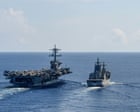
Deploying a third United States aircraft carrier strike group to the Middle East represents a structural shift from routine forward presence to high-intensity crisis deterrence, tripling localized naval aviation sortie capacity and expanding regional ballistic missile defense coverage. Standard media coverage reduces this maneuver to a raw headcount of incoming personnel—typically citing the arrival of "thousands more troops." That framing obscures the actual strategic reality. A Carrier Strike Group (CSG) is not a troop transport mechanism; it is a sovereign, mobile, multi-domain combat network designed to solve specific geometric, logistical, and escalatory problems that land-based forces cannot address without diplomatic friction.
When Washington orders a third carrier into the U.S. Central Command (CENTCOM) area of responsibility, military planners are executing a calculated modification of the regional force balance. Understanding this deployment requires stripping away journalistic generalizations and examining the operational architecture of a three-carrier posture, the defensive and offensive mechanics it unlocks, and the severe logistical exhaustion it imposes on the broader naval fleet.
The Architecture of a Carrier Strike Group
To evaluate the impact of a third carrier, one must first define the unit of measurement. A single Nimitz-class or Gerald R. Ford-class aircraft carrier does not sail alone. It operates as the centerpiece of a Carrier Strike Group, an integrated task force comprising approximately 6,000 to 7,500 sailors and aviators.
The kinetic core of this formation rests on four distinct components:
- The Capital Ship: A nuclear-powered supercarrier capable of steaming indefinitely without refueling, carrying roughly 65 to 75 fixed-wing and rotary-wing aircraft. This includes strike fighters (F/A-18E/F Super Hornets or F-35C Lightning IIs), electronic warfare platforms (EA-18G Growlers), airborne early warning and control aircraft (E-2D Advanced Hawkeyes), and anti-submarine helicopters.
- The Carrier Air Wing (CVW): The offensive and defensive aviation arm. A single wing executes cyclic operations—launching and recovering waves of aircraft roughly every 90 minutes during sustained combat conditions.
- Surface Combatants: Typically one Ticonderoga-class guided-missile cruiser and a squadron of two to four Arleigh Burke-class guided-missile destroyers. These vessels carry the Aegis Combat System and Vertical Launching Systems (VLS) loaded with Standard Missiles (SM-2, SM-3, SM-6) for air and ballistic missile defense, alongside Tomahawk Land Attack Missiles (TLAMs).
- Subsurface and Logistics Elements: Often accompanied by a nuclear-powered fast-attack submarine (SSN) for intelligence, surveillance, and strike capabilities, supported by combat logistics force ships providing aviation fuel (JP-5), ordnance, and dry stores.
Adding a third CSG does not merely add 7,000 personnel to a static base. It introduces an entire floating airbase and air-defense network that operates in international waters, completely insulated from the host-nation basing restrictions that constrain land-based U.S. Air Force squadrons in the Persian Gulf and Levant.
The Operational Logic of Tri-Carrier Presence
Under normal steady-state conditions, the Pentagon maintains zero or one aircraft carrier in the Middle East, prioritizing the Indo-Pacific and European theaters. Escalating to two carriers signals acute crisis management, allowing one group to operate in the Eastern Mediterranean while the second patrols the Red Sea, Gulf of Oman, or Arabian Sea. Moving to three carriers crosses a distinct operational threshold.
Persistent 24/7 Strike and Defensive Coverage
A single carrier air wing cannot sustain continuous, around-the-clock high-tempo flight operations indefinitely without exhausting its flight deck crew and maintenance personnel. A single ship operates on a 12-to-16-hour flight window, leaving gaps where regional air coverage must be handed off to land-based tankers and fighters.
With three carriers distributed across adjacent maritime basins—such as the Eastern Mediterranean, the Red Sea, and the Gulf of Oman—CENTCOM achieves unbroken 24-hour tactical aviation coverage. While one carrier conducts maintenance and crew rest cycles, two remain actively launching and recovering aircraft. This eliminates temporal vulnerabilities that regional adversaries routinely exploit to launch coordinated drone or missile salvos.
Multi-Axis Ballistic Missile Defense
The proliferation of medium-range ballistic missiles (MRBMs) and one-way attack drones across state and non-state actors in the Middle East has altered naval defensive geometry. Land-based Patriot and THAAD batteries protect fixed high-value installations, yet they remain stationary and vulnerable to saturation attacks.
Tripling the number of Aegis-equipped cruisers and destroyers introduces dozens of mobile, overlapping radar domes and hundreds of additional VLS cells into the theater. By positioning surface combatants along predicted missile flight corridors—specifically in the northern Red Sea and Eastern Mediterranean—naval forces create a layered interception screen. Destroyers equipped with SM-3 and SM-6 interceptors can engage exo-atmospheric and terminal-phase ballistic threats long before they reach coastal population centers or inland military bases.
Elimination of Diplomatic Veto Points
Land-based airpower in the Middle East relies heavily on bilateral basing and overflight agreements with regional partners. During acute geopolitical crises, host nations frequently restrict offensive combat sorties launched from their soil to avoid retaliatory strikes against their own critical infrastructure.
Aircraft carriers bypass this diplomatic bottleneck entirely. Because the flight deck constitutes sovereign U.S. territory operating in international waters, Washington retains unilateral authority to launch defensive interceptions, intelligence-gathering flights, or retaliatory strikes without seeking foreign diplomatic clearance. Deploying a third carrier guarantees that U.S. strike capacity cannot be neutralized by regional political hesitation.
The Three Pillars of Maritime Coercion
Strategic theorists categorize naval deployments not merely by their warfighting utility, but by their signaling value. A tri-carrier posture operates across three distinct coercive mechanisms.
- Deterrence by Denial: By saturating the regional airspace with E-2D Hawkeye radar planes, F-35C sensors, and Aegis destroyers, the U.S. degrades an adversary's confidence that a massed missile or drone strike will penetrate defenses. When the probability of successful attack drops below a critical threshold, the strategic incentive to initiate a strike diminishes.
- Deterrence by Punishment: Three carrier air wings, combined with submarine-launched and surface-launched Tomahawk cruise missiles, represent enough precision-guided strike capacity to systematically dismantle an adversary's integrated air defense network, naval assets, and hardened command-and-control nodes within the opening hours of a conflict. This signals immediate, overwhelming escalation dominance.
- Alliance Reassurance: Regional partners facing direct cross-border threats evaluate U.S. commitment through physical hardware rather than diplomatic rhetoric. The visible arrival of multiple capital ships anchors regional coalitions, discouraging partners from hedging toward rival great powers or making premature concessions under duress.
The Hidden Cost Function of Over-Deployment
While mainstream reports focus on the immediate projection of power into the Middle East, operational planners inside the Pentagon view a three-carrier deployment as a severe stress test on the global naval enterprise. The U.S. Navy maintains an active fleet of 11 nuclear-powered aircraft carriers. Due to rigid maintenance and training cycles, only a fraction of that fleet is deployable at any given moment.
The Optimized Fleet Response Plan Breakdown
Naval readiness follows the Optimized Fleet Response Plan (OFRP), a 36-month cycle dividing a carrier's life into four phases: Maintenance, Basic Training, Integrated Training, and Sustainment/Deployment. Under strict adherence to this model, roughly three to four carriers are deployed globally at any single time, while two to three are held in surge-ready status.
Concentrating three carriers in a single combatant command—CENTCOM—consumes up to 75 percent of the Navy's immediately available global carrier capacity. This creates immediate downstream consequences across two critical dimensions:
- Global Opportunity Cost: Every carrier extended or diverted to the Middle East represents a carrier absent from the Western Pacific or the North Atlantic. Strategic competitors in East Asia monitor these deployments closely, recognizing that a heavy U.S. naval commitment in the Levant or Persian Gulf reduces the surface and aviation deterrence available in the South China Sea and Taiwan Strait.
- The Maintenance Bow Wave: Extending a carrier deployment beyond its scheduled seven-to-eight-month window—a frequent necessity when maintaining a three-carrier presence—delays its entry into dry dock for nuclear refueling or complex overhaul. Because shipyard capacity in the United States is strictly finite, delaying one ship's maintenance pushes back the entire subsequent schedule, creating a compounding readiness deficit that takes years to resolve.
Munitions Expenditure vs. Industrial Replenishment
Beyond hull fatigue, high-tempo maritime defense in the Middle East exposes a profound economic asymmetry. Adversaries utilize low-cost unmanned aerial vehicles and legacy ballistic missiles costing tens of thousands to a few hundred thousand dollars. Intercepting those threats from an Arleigh Burke-class destroyer requires firing SM-2, SM-6, or Evolved SeaSparrow Missiles (ESSM) priced between $2 million and $4.3 million per unit.
Sustaining a three-carrier posture in an active threat environment accelerates VLS magazine depletion. Because warships cannot reload VLS cells at sea under current operational configurations, ships must rotate out of the combat zone to regional ports to rearm. Simultaneously, annual defense industrial production rates for advanced interceptors remain tightly constrained, meaning intense defensive operations draw down strategic stockpiles faster than domestic factories can replenish them.
Distinguishing Empirical Reality from Strategic Assumptions
Evaluating the ultimate effectiveness of a tri-carrier deployment requires separating verifiable operational facts from untested strategic hypotheses.
Known Operational Facts:
- Three CSGs provide roughly 200+ tactical aircraft and approximately 12 to 15 Aegis surface combatants, representing the highest concentration of U.S. maritime firepower in the region since major combat operations in 2003.
- The deployment eliminates reliance on regional airbases for immediate defensive counter-air and retaliatory strike missions.
- Prolonged deployment of three carriers directly degrades U.S. Navy readiness metrics for the subsequent 18 to 24 months due to deferred maintenance and crew fatigue.
Educated Strategic Hypotheses:
- Hypothesis A (Escalation Control): The overwhelming presence of three carrier groups will compel regional state actors to restrain proxy forces, fearing direct regime-threatening retaliation.
- Hypothesis B (Asymmetric Adaptation): Rather than deterring conflict, a massive conventional naval presence will incentivize adversaries to avoid direct naval confrontation and instead shift toward gray-zone tactics, cyber operations, or dispersed, low-signature ground attacks that carrier air wings cannot effectively target.
History demonstrates that aircraft carriers are unmatched instruments for high-intensity conventional warfare and rapid crisis response, yet they remain blunt tools against decentralized insurgencies or low-cost asymmetric attrition.
Managing the Force Posture Transition
Pentagon leadership cannot treat a three-carrier Middle East deployment as a sustainable baseline; doing so risks breaking the Navy's long-term maintenance cycle and leaving the Indo-Pacific dangerously under-resourced. To extract maximum strategic value without hollowing out the fleet, defense planners must execute a disciplined transition strategy.
First, CENTCOM must establish strict operational triggers for de-escalating from three carriers back to a single-carrier baseline, tying the departure of the surging carrier groups to measurable reductions in regional ballistic missile launch readiness rather than open-ended political stabilization. Second, the Navy must accelerate the integration of unmanned surface vessels and land-based regional air-defense networks—such as shared Gulf Cooperation Council radar architectures—to assume the persistent surveillance and low-tier drone interception burden currently borne by high-end Aegis destroyers. Finally, defense acquisition officials must prioritize multi-year procurement contracts to expand solid-rocket motor and interceptor manufacturing capacity, ensuring that naval magazines can be replenished without cannibalizing war reserve stocks designated for peer competition in the Pacific.


