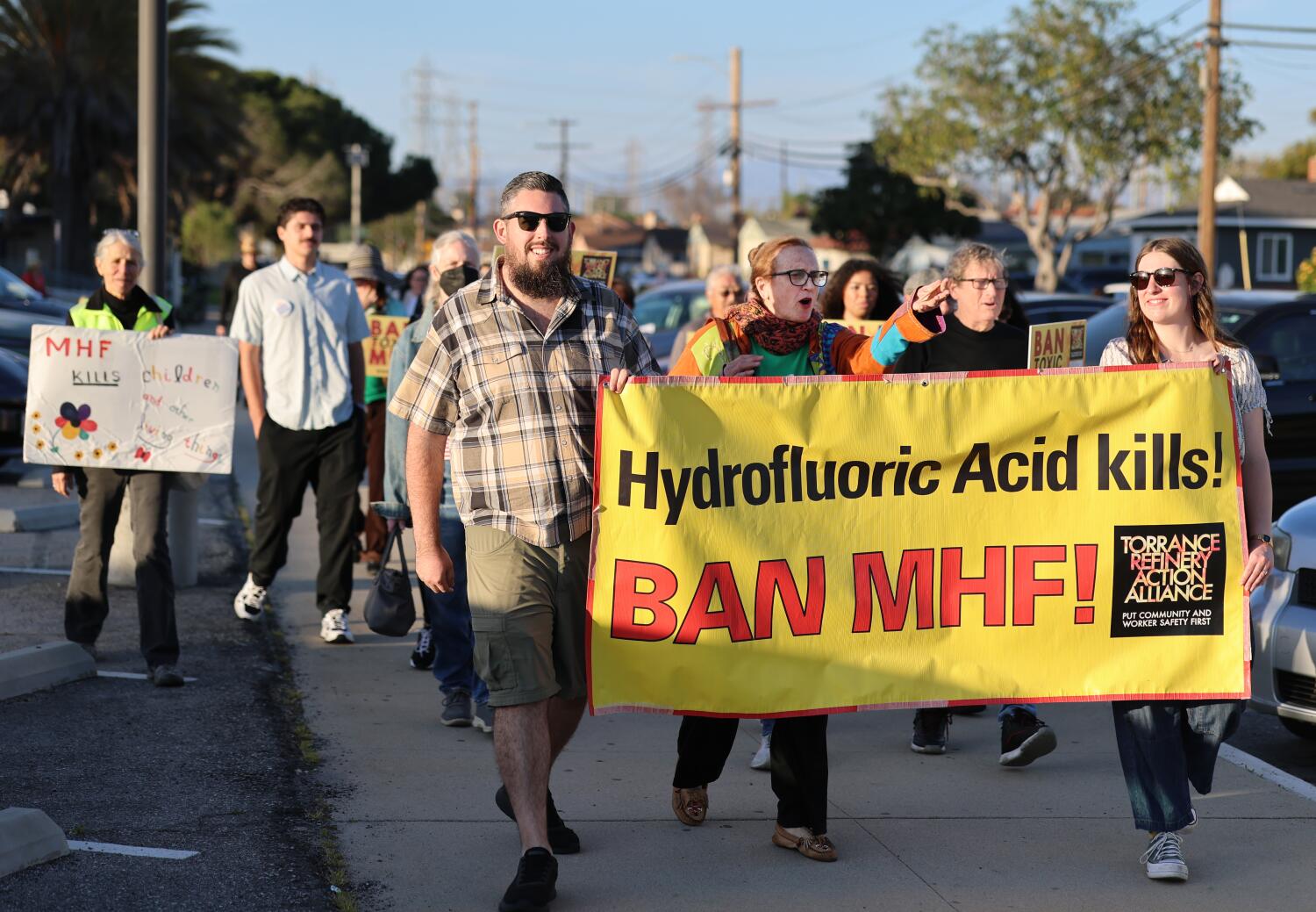
Torrance residents are done waiting for a disaster that hasn't happened yet but feels inevitable. For years, the shadow of the Torrance Refining Company has loomed over South Bay backyards, not just as an industrial neighbor, but as a potential source of a catastrophic chemical release. The focus of this community's anxiety is Modified Hydrofluoric Acid (MHF). It's a chemical so volatile and dangerous that locals frequently refer to it as "flesh-eating." They aren't exaggerating for the sake of drama. If you've lived in Torrance or Wilmington long enough, you know the sound of the refinery sirens. You know the "shelter in place" drills. But most importantly, you know that a major accident involving MHF could turn a Tuesday afternoon into a regional emergency with thousands of casualties.
The push to ban MHF isn't a new whim. It’s a sustained, decade-long battle led by groups like the Torrance Refinery Action Alliance (TRAA). These aren't just activists. They're engineers, teachers, and parents who've done the math. They've seen the near-misses. The 2015 explosion at the then-ExxonMobil refinery is the ghost that still haunts these meetings. That blast sent a 40-ton piece of equipment flying, nearly striking a tank containing tens of thousands of pounds of HF. Had that tank ruptured, we wouldn't be talking about "potential" risks. We'd be talking about a history-altering tragedy.
Why Modified Hydrofluoric Acid Is Different
When people talk about industrial chemicals, they often get lost in the alphabet soup of regulations. Let’s keep it simple. Hydrofluoric acid (HF) is used in the alkylation process to create high-octane gasoline. It’s effective. It’s also terrifying. If HF escapes into the atmosphere, it doesn't just puddle on the floor. It forms a dense, ground-hugging toxic cloud. This cloud moves with the wind, reacting violently with moisture—including the moisture in your eyes, lungs, and skin. It eats through tissue and decalcifies bone.
The "Modified" part of MHF is supposed to be the safety net. The refinery adds a chemical additive intended to reduce the volatility of the acid, theoretically preventing it from vaporizing into a massive cloud if a leak occurs. But here’s the kicker. Many independent experts and community members don't buy it. They argue the "modification" hasn't been proven effective in a real-world, high-pressure release scenario. Basically, it’s a band-aid on a chainsaw wound.
Most refineries across the country have already moved away from this. Out of nearly 150 refineries in the United States, only a small fraction still use HF or MHF. Many have switched to safer alternatives like sulfuric acid or new solid-acid catalyst technologies. These alternatives aren't perfect, but they don't threaten to wipe out an entire zip code if a pipe bursts.
The 2015 Near Miss Changed Everything
You can't understand the current anger in Torrance without looking at February 18, 2015. An explosion in the refinery's electrostatic precipitator was powerful enough to register as a magnitude 1.7 earthquake. The debris—massive chunks of steel—landed mere feet from the MHF tanks. The U.S. Chemical Safety Board (CSB) investigated and didn't pull any punches. Their report made it clear that the city dodged a bullet.
Since that day, the trust between the refinery and the public has been non-existent. Residents watched as the facility changed hands to PBF Energy, but the core issue remained. Every flare-up, every plume of black smoke, and every "unplanned maintenance" event triggers a wave of PTSD for the community. You see it on social media groups and at City Council meetings. People are tired of being told "it's safe" by companies that have a financial interest in keeping the status quo.
The Economic Argument Against Safety
The refinery usually counters the ban movement with a predictable narrative. They talk about jobs. They talk about gas prices. They claim that forcing a transition to a different alkylation method would cost hundreds of millions of dollars and potentially lead to the plant's closure. This is a classic "your wallet or your life" argument.
It’s true that retrofitting a refinery isn't cheap. Estimates suggest it could cost upwards of $100 million to $300 million to switch to sulfuric acid or a newer technology. But let's look at the flip side. What's the cost of a mass evacuation of the South Bay? What's the cost of treating thousands of people for chemical burns? The liability for a major MHF release would dwarf the cost of a retrofit. From a purely cold, business perspective, staying with MHF is a massive gamble.
How Local Government Is Dropping The Ball
For years, the South Coast Air Quality Management District (SCAQMD) was the primary battleground. Residents showed up to meeting after meeting, demanding a phase-out of MHF. In 2019, it looked like there might be a breakthrough, but the agency eventually opted for a "voluntary" agreement with the refineries instead of a hard ban. This was a gut punch to the activists.
Voluntary agreements are effectively toothless. They allow refineries to implement enhanced safety measures—like water spray curtains and better sensors—without actually removing the lethal chemical from the equation. It’s like putting a better lock on a cage containing a tiger. The lock is nice, but the tiger is still there, and it only needs one mistake to get out.
Torrance city officials have been caught in the middle. Some have been vocal advocates for a ban, while others worry about the tax revenue and political fallout. But the momentum is shifting. More residents are getting educated. The "flesh-eating" label has stuck because it’s a visceral, accurate description of what this chemical does. You can't PR your way out of that kind of imagery.
Real World Solutions Exist Right Now
The most frustrating part for Torrance residents is that the technology to replace MHF isn't some futuristic dream. It exists. Refineries in Utah and even other parts of California use sulfuric acid. While sulfuric acid is still a hazardous chemical, it doesn't vaporize into a traveling death cloud. It stays liquid at atmospheric pressure, making it much easier to contain.
Even more promising is ionic liquid alkylation. This is a newer, even safer process that has been successfully implemented at large scales, such as at the Chevron refinery in Salt Lake City. The industry knows how to do this. They just don't want to pay for it.
If you're a resident or someone who works in the area, you don't have to just sit there and wait for the sirens. The Torrance Refinery Action Alliance is still the primary engine for change. They focus on legislative pressure at the state level, bypasssing local boards that have proven too timid to act.
Taking Action Beyond The Headlines
Waiting for the refinery to "do the right thing" is a losing strategy. Companies answer to shareholders, not neighbors. The only way this chemical leaves Torrance is through relentless, uncomfortable pressure on elected officials.
Check your local zoning maps and emergency evacuation routes. Most people don't even realize they're in the "kill zone" for an MHF release until they see the maps produced by the TRAA. If you live within a several-mile radius of the 190th Street facility, you are part of this story whether you want to be or not.
Don't just watch the news. Show up to the Torrance City Council meetings. Join the mailing lists for the SCAQMD. Demand that the state legislature treat MHF as the public health crisis it is. The 2015 explosion was a warning shot. We've had over a decade of warnings. At some point, the luck runs out.