Three words.
That is all it took from a podium in Islamabad to turn a routine diplomatic press briefing into a mirror reflecting seventy-nine years of shared grief, stubborn pride, and the quiet ache of people who can see their ancestral villages from across a barbed-wire fence yet cannot walk the dusty road to reach them.
"If he wishes."
When Pakistan’s Foreign Office spokesperson uttered that brief, carefully measured reply in response to a reporter’s question about whether Punjab Chief Minister Bhagwant Mann would be granted a visa to visit Nankana Sahib, the room moved on within seconds. Diplomats do this for a living. They compress centuries of friction into syllables light enough to float over microphones without detonating a headline war. Yet for anyone who has ever stood along the zero line in Punjab—or watched an elderly grandparent press a trembling palm against an old black-and-white photograph of a house in Lahore or Jalandhar—those three words landed with the weight of an anvil.
To understand why a simple visa question aimed at an Indian Chief Minister carries so much electricity, you have to step away from the sterile fluorescent lights of foreign ministries and walk into the heat of the Punjab plains.
The Weight of an Unstamped Passport
Consider a hypothetical scenario that plays out in real life thousands of times every single year.
Picture an eighty-two-year-old retired schoolteacher living in a modest brick home in Ludhiana. His knees ache when the monsoon humidity rolls in, and his eyesight has narrowed to blurred shapes, yet he can still draw from memory the exact curve of the canal behind his childhood home in Sheikhupura, forty kilometers west of Lahore. Every November, as Guru Nanak Jayanti approaches, he lays his neatly pressed turban beside a stack of photocopied forms. He is not asking to redraw borders. He is not asking to rewrite treaties. He is simply asking for a stamp in a dark blue booklet that lets him bow his head at Gurdwara Janam Asthan in Nankana Sahib before his breath runs out.
Now zoom out from that kitchen table in Ludhiana to the office of the Chief Minister in Chandigarh.
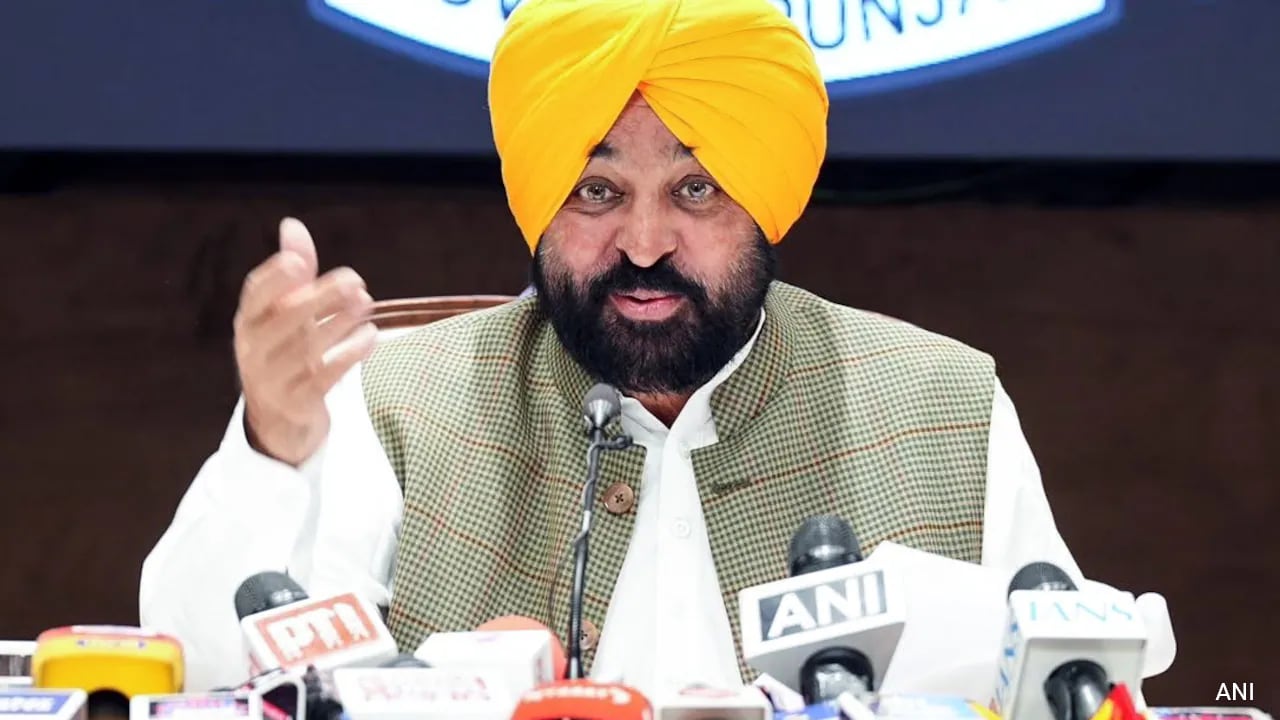
Bhagwant Mann is not merely an administrator managing crop procurement, power subsidies, and state budgets. As the elected head of Indian Punjab, he occupies a chair haunted by geography. Half of the historical soul of the region he governs lies on the other side of the Radcliffe Line. The birthplace of Guru Nanak Dev Ji—the founder of Sikhism whose teachings of universal brotherhood form the bedrock of Punjabi identity—sits in Nankana Sahib, in Pakistan’s Punjab province. Kartarpur Sahib, where the Guru spent his final eighteen years plowing fields and sharing communal meals, stands just four kilometers from the Indian border, visible on clear winter mornings with the naked eye from Dera Baba Nanak in Gurdaspur.
When reporters asked Islamabad about Mann’s prospects of receiving a Pakistani visa for religious pilgrimage, they were probing a nerve that never truly stops throbbing. In the strict grammar of bilateral diplomacy, a sitting Chief Minister of an Indian state cannot simply pack an overnight bag and board a flight to Lahore. Protocol stacks upon protocol. First, the traveler must express an official desire to visit. Second, New Delhi’s Ministry of External Affairs must grant political clearance—a step that routinely turns into a quiet tug-of-war depending on the temperature of India-Pakistan relations that week. Only then does the formal visa application land on a desk in Islamabad.
So when Pakistan’s Foreign Office replied, "If he wishes," it was executing a classic diplomatic sidestep—and simultaneously opening a door just wide enough to let the light of public scrutiny pour through.
A History Written in Ink and Barbed Wire
I have spent years reporting along the borders of South Asia, and if there is one truth that hits you faster than the afternoon dust in Amritsar or Wagah, it is that paperwork here is never just paper. A visa form in this part of the world is a psychological obstacle course.
Think of India-Pakistan visa diplomacy like two neighbors living in a divided ancestral mansion who only communicate by sliding notes under a locked oak door. Neither wants to be the first to jiggle the handle for fear of looking eager, yet both know the roof leaks over the exact same courtyard.
When Islamabad says, "If he wishes," the subtext translates cleanly for anyone fluent in South Asian statecraft: The ball is not in our court. We have not closed the gate, nor have we received an application to open it. If the Chief Minister applies through proper channels—and if New Delhi lets him come—we will consider it.
To appreciate how loaded that posture is, look back at the architecture governing religious travel between the two countries. In 1974, seven years before the internet and three years after a devastating war, India and Pakistan signed the Protocol on Visits to Religious Shrines. That agreement, later expanded, remains the legal lifeline allowing thousands of Sikh and Hindu pilgrims from India—and Muslim pilgrims from Pakistan—to cross the border in organized jathas (groups) for major religious festivals.
Under this framework, Pakistan regularly issues thousands of visas for Baisakhi in April and Guru Nanak Jayanti in November. On paper, the mechanism looks orderly. In practice, every pilgrimage season is a high-wire act suspended over politics.
Remember what happened in 2018 and 2019 when the Kartarpur Corridor finally broke ground and opened. For decades, devotees stood on an elevated viewing platform on the Indian side of the border, peering through binoculars at the white domes of Gurdwara Darbar Sahib across the Ravi River. When the corridor opened in November 2019—allowing Indian passport holders to cross visa-free for a day trip using an Electronic Travel Authorization—grown men wept openly as they stepped onto the marble courtyard. Politics briefly yielded to devotion.
Yet even that triumph carried asterisks. Political leaders from Indian Punjab—including former Chief Ministers Amarinder Singh and Charanjit Singh Channi, alongside Navjot Singh Sidhu—found their own travel plans scrutinized like military maneuvers. Who was invited? Who was denied clearance by New Delhi? Who stood next to whom in front of Pakistani cameras? Every handshake became ammunition in domestic television studios.
Bhagwant Mann steps into this exact minefield.
Why One Man’s Visa Becomes Everyone’s Symbol
Let us be candid about why this specific question refuses to fade into background noise. Politics in Punjab—on both sides of the border—is intensely personal.
For Bhagwant Mann, who rose from satirical comedy stages to Parliament and eventually to the Chief Minister’s chair on a wave of anti-establishment frustration, a pilgrimage to Nankana Sahib carries immense symbolic weight. Millions of voters in Indian Punjab view Nankana Sahib not as a foreign destination, but as home’s spiritual center. When a Chief Minister visits, he does not go merely as a private citizen; he carries the collective longing of an entire state.
At the same time, Mann operates inside a delicate federal reality. Foreign policy in India belongs exclusively to the Union government in New Delhi. Even a sitting Chief Minister requires diplomatic clearance from the Ministry of External Affairs before traveling abroad, and visits to Pakistan face the highest level of scrutiny in South Block. In past years, requests by state ministers and opposition leaders to join official jathas have occasionally stalled without public explanation, caught between security assessments and diplomatic frost.
Islamabad knows this dynamic intimately.
By offering a calm, non-committal "If he wishes," Pakistan’s diplomatic establishment avoided two traps at once. Had they issued an outright refusal, they would have handed critics ammunition to accuse Islamabad of obstructing Sikh religious sentiment—a narrative Pakistan works tirelessly to counter by highlighting its restoration of gurdwaras and expansion of pilgrimage facilities. Conversely, had they issued an unsolicited, effusive public invitation, New Delhi could have dismissed it as political grandstanding aimed at driving a wedge between Punjab’s state government and the central government.
Instead, three neutral words shifted the spotlight squarely onto Chandigarh and New Delhi. Does Bhagwant Mann wish to go? Will he formally apply? And if he does, will the doors on both sides swing open?
What Happens Behind the Curtain of a Pilgrimage Visa
Most people outside the region assume getting a visa to visit a shrine is like booking a holiday ticket: fill out an online form, pay a fee, upload a photo, wait a week.
If only it were that simple.
Let me pull back the curtain on how an ordinary pilgrim’s journey actually unfolds, because the friction experienced by a Chief Minister is simply a magnified version of what everyday citizens endure.
First comes the security vetting. Every applicant on a group pilgrimage list undergoes background checks by state police and central intelligence agencies in India before the list is even forwarded to the Pakistani High Commission in New Delhi. A spelling discrepancy between a passport and an Aadhaar card, an outdated address, or an unexplained delay at a local police station can quietly drop a name from the manifest.
Second comes the diplomatic ping-pong. Because relations between New Delhi and Islamabad have remained frozen at the level of chargés d'affaires—with neither country stationing a full High Commissioner in the other’s capital since 2019—routine consular processing operates with skeleton staffing. Every batch of 3,000 pilgrim visas requires intense administrative coordination under tight deadlines. Sometimes visas arrive at the High Commission in New Delhi mere hours before the special trains or buses are scheduled to depart from Amritsar. Families sit by their packed suitcases, phones glued to their palms, waiting to learn whether their names made the final stamped batch.
Third comes the invisible emotional toll. I recall speaking with a middle-aged shopkeeper from Patiala who had applied three consecutive times to visit Punja Sahib in Hasan Abdal. Twice his application stalled in paperwork limbo. On the third attempt, his visa arrived forty-eight hours before departure. When he returned across the Attari-Wagah border a week later, he brought back nothing expensive—just a small plastic bottle of water from the shrine’s sarovar (sacred pool) and a handful of soil wrapped in a clean cotton handkerchief for his eighty-nine-year-old mother, who was too frail to travel.
"I didn't see enemies," he told me quietly, his voice cracking over a cup of roadside tea. "I saw grandmothers who spoke my exact dialect of Punjabi, asking me if the mango trees in our old village still bore fruit."
That is the human reality sitting underneath every dry press briefing. When diplomats debate protocol, ordinary people count the seasons they have left.
The Economics and Quiet Power of Open Gates
There is another layer to this story that rarely makes the evening news panels, where shouting matches drown out nuance: the sheer practical transformation that occurs whenever border movement actually happens.
Look at what the Kartarpur Corridor achieved in a few short years despite pandemic closures and political chill. A quiet agricultural pocket along the Ravi River suddenly saw new roads, modern passenger terminals, local transport businesses, and renewed cultural exchange. In Pakistan’s Narowal district, hospitality and infrastructure around Gurdwara Darbar Sahib expanded dramatically. In Indian Punjab’s Gurdaspur district, pilgrim traffic breathed fresh life into local commerce.
Imagine, for a moment, what sustained, predictable religious and cultural travel between Lahore and Amritsar—two cities separated by barely fifty kilometers, closer than Manhattan is to parts of New Jersey—would do for the everyday lives of forty million people across both Punjabs.
Historians often point out that prior to 1947, Lahore and Amritsar functioned almost like twin organs of a single body. Families lived in one city and worked in the other; artists, poets, and traders moved back and forth on morning trains without thinking twice. Partition severed that artery overnight, leaving behind two cities that still share the same food, the same music, the same humor, and the same monsoon sky, yet remain separated by one of the most heavily fortified borders on earth.
Every time a high-profile figure—whether a Chief Minister, a writer, or a cricket team—triggers a conversation about crossing that line, it briefly punctures the illusion that this separation is effortless or natural. It reminds both capitals that millions of citizens on either side view the neighbor not as an abstraction on a strategic map, but as the custodian of their own family history.
Where Uncertainty Lives
I will admit something that analysts rarely say out loud: nobody knows with certainty how the next chapter of this visa question will unfold.
South Asian diplomacy has a habit of defying neat predictions. A sudden thaw can produce historic breakthroughs in a matter of weeks—think of the 2004 cricket series or the unexpected 2019 Kartarpur inauguration—just as swiftly as a single border incident or election cycle can lock every window shut for years.
Right now, the equation rests on three moving parts:
- Personal and Political Will in Chandigarh: Whether Bhagwant Mann decides to formally request political clearance to lead or join a pilgrimage jatha to Nankana Sahib, weighing the spiritual resonance among his constituents against the inevitable political commentary at home.
- Strategic Calculus in New Delhi: How the Ministry of External Affairs evaluates any formal request at a time when India has maintained a firm stance against normalizing bilateral engagement without tangible security assurances from Islamabad.
- Follow-Through in Islamabad: Whether Pakistan’s Foreign Office turns its open-ended "If he wishes" into swift consular facilitation if an application actually lands on its desk.
Until those three gears align, those three words remain suspended in midair—part invitation, part deflection, and wholly revealing of how two nations dance around the ties they cannot sever.
The View From the Fence
Late in the afternoon, just before the sun drops behind the mustard fields along the border in Punjab, the light turns a deep, molten gold.
If you stand near Dera Baba Nanak on the Indian side and look west across the tall river grass, you can see the white marble domes of Kartarpur Sahib catching the last rays of daylight. Birds rise from the fields on one side of the fence, arc effortlessly over the concertina wire, and settle into the trees on the other side without ever showing a passport, filling out a form in triplicate, or waiting for a spokesperson at a podium to utter three cautious words.
Somewhere between Ludhiana and Nankana Sahib, an old man folds his hands as the evening ardas begins, praying not for geopolitics to make sense, but simply for one small blue stamp before winter turns to spring.