The ink dries in seconds. That is the part nobody films.
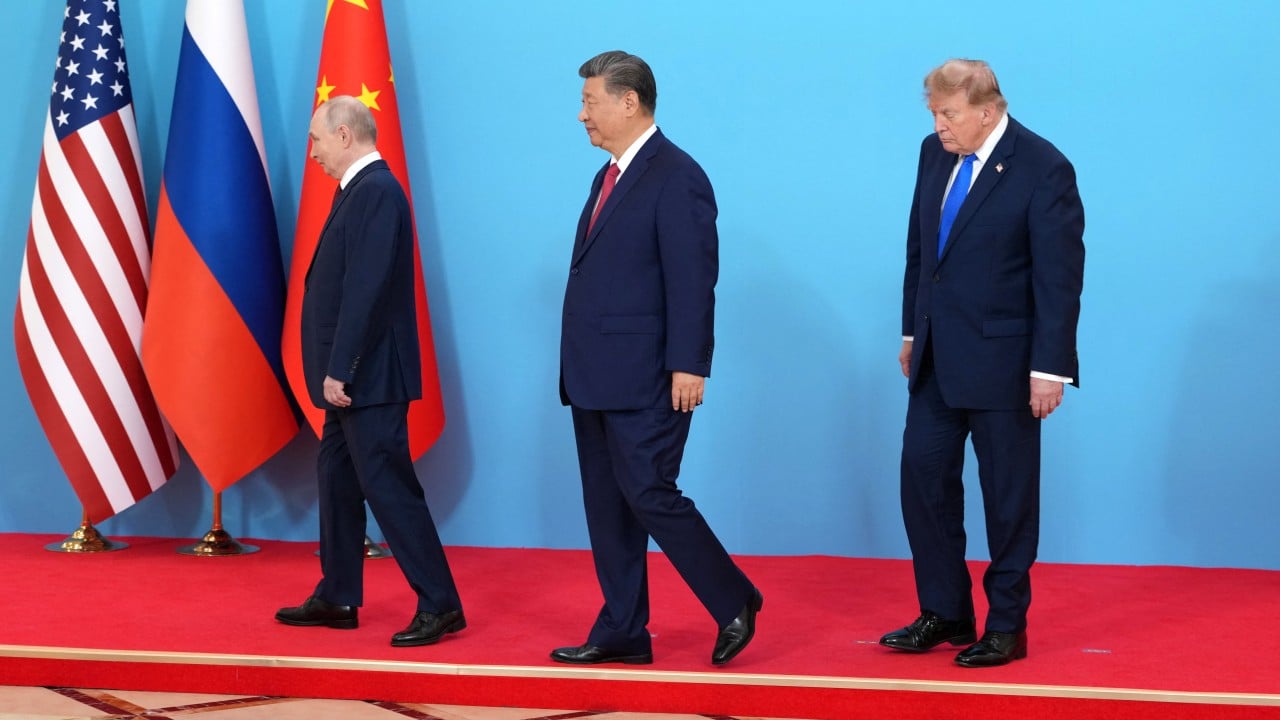
When three of the most powerful men on earth—Xi Jinping, Donald Trump, and Vladimir Putin—sit at a polished mahogany table and press heavy fountain pens to thick cotton paper, the cameras capture the flash of the strobes, the stiff half-smiles, and the choreographed handshakes. Diplomatic analysts and pundits immediately label it theater. They call it a photo op. They dissect the angle of a lapel, the duration of a grip, or the exact seating arrangement, concluding that declarations signed under bright lights rarely survive the flight home.
Yet to understand what a trilateral peace declaration actually means, you have to step away from the press briefing room and look at the invisible machinery that shifts the moment those pens lift off the page.
Consider a hypothetical scenario—one playing out in quiet variations across kitchens and shipping ports from Eastern Europe to the South China Sea. Imagine a woman named Elena, a logistics coordinator in a Baltic port city, staring at a freight manifest at three in the morning. For months, her job has consisted of rerouting grain shipments around naval blockades, watching insurance premiums double overnight, and calculating the exact probability of a localized skirmish freezing an entire trade corridor. Across the globe, in a mid-sized manufacturing town in Ohio, a factory floor manager named Marcus watches raw material costs climb while export orders stall, caught in the crossfire of retaliatory tariffs and military posturing. Neither Elena nor Marcus sits in the room with Xi, Trump, or Putin. Neither of them gets to vote on the phrasing of a joint communiqué. Yet every comma in that document dictates whether Elena’s ships dock on time and whether Marcus keeps his third shift running through the winter.
When observers dismiss a summit declaration as mere pageantry, they miss the fundamental mechanics of international signaling. In high-stakes geopolitics, words are not descriptions of reality; they are constraints placed upon future behavior.
The Architecture of a Promise
To grasp why a "peace declaration" between Washington, Beijing, and Moscow carries weight beyond public relations, it helps to think of great-power diplomacy not as a friendship, but as a high-wire act without a net.
For years, the prevailing wisdom in foreign policy circles held that the world was sliding irreversibly into rigid, hostile blocs. Analysts pointed to expanding military budgets, semiconductor export controls, proxy conflicts, and broken arms-control treaties as proof that dialogue had become obsolete. According to historical patterns studied by international relations scholars—most notably the security dilemma frameworks documented during the Cold War—when major powers stop talking, minor misunderstandings escalate into catastrophic miscalculations. A radar lock in international airspace or an unannounced naval exercise stops looking like routine training and starts looking like a prelude to invasion.
A joint peace declaration interrupts that momentum. It does not erase deep-seated rivalries, nor does it magically resolve territorial disputes or ideological friction. To pretend otherwise would be naive. Having watched decades of diplomatic breakthroughs stall in implementation phases, anyone paying close attention knows that skepticism is a healthy reflex. Treaties get broken. Memoranda get reinterpreted.
But look closely at what happens when leaders publicly bind their personal prestige to a shared text.
In political science, this is known as "audience costs." When a leader makes a quiet, backchannel promise, they can walk away from it tomorrow with minimal domestic embarrassment. When Xi, Trump, and Putin stand side by side and issue a formal declaration committing to de-escalation, crisis communication, and strategic stability, they raise the political price of sudden aggression. Each leader has tied their own credibility—both at home and among allies—to the survival of that framework.
It is like three rivals pouring concrete around the foundations of their respective houses at the same time. The concrete does not make them neighbors who borrow sugar from one another, but it makes it significantly harder for any one of them to suddenly bulldoze the property line without tearing up their own driveway in the process.
Why Skeptics Misread the Room
Whenever a summit produces broad principles rather than a thousand-page technical treaty, critics inevitably complain about the lack of enforcement mechanisms. "Where are the verification protocols?" they ask. "Where are the binding penalties?"
That critique misunderstands how breakthroughs actually begin.
History shows that detailed, verifiable agreements almost never emerge out of thin air. Before negotiators can spend eighteen months arguing over satellite inspections, tariff schedules, or troop withdrawal coordinates, their bosses have to create the political permission for those conversations to happen at all. During the late 1980s, early summits between American and Soviet leadership were widely mocked by hardliners in both capitals as hollow spectacles devoid of immediate concessions. Yet those initial joint statements—declaring simply that a nuclear war cannot be won and must never be fought—altered the bureaucratic incentives inside both governments. Suddenly, diplomats and military planners were tasked with finding off-ramps rather than preparing for collision.
A trilateral declaration involving the United States, China, and Russia operates on an even more complex plane. Bilateral diplomacy is a two-body problem; adding a third major power introduces triangular dynamics where every concession or warning echoes in two directions simultaneously.
Think about the specific anxieties driving each capital toward that table:
- Washington faces the exhausting arithmetic of overextension—trying to deter simultaneous crises across multiple theaters while managing domestic economic pressures and supply chain vulnerabilities.
- Beijing relies on predictable global trade routes and stable export markets to sustain domestic growth, making prolonged geopolitical volatility an expensive drag on its long-term economic ambitions.
- Moscow, locked in grinding military and economic friction with the West, seeks diplomatic recognition, relief from isolation, and a seat at the table where the rules of the emerging international order are drafted.
None of these motivations require altruism. In fact, the most durable diplomatic arrangements in history have never been built on trust; they have been built on overlapping self-interest. When three powers realize that the cost of unchecked escalation outweighs the potential gains of unilateral pressure, a peace declaration becomes a mutual off-ramp.
The Invisible Shockwaves in Everyday Markets
If you want to know whether a summit is more than a photo op, stop listening to television commentators and start watching bond yields, shipping insurance rates, and commodity futures.
Markets are ruthless lie detectors. Traders do not care about diplomatic adjectives; they care about risk probabilities. When geopolitical tension spikes, capital flees toward safe havens, energy prices surge, and companies hoard inventory "just in case," driving up prices for ordinary consumers thousands of miles away from any conflict zone.
Consider what happens next when a credible trilateral framework enters the bloodstream of the global economy. Even a modest reduction in the perceived risk of direct great-power confrontation lowers the invisible "fear tax" embedded in global commerce. Insurers recalibrate risk models for maritime transit. Central banks gain breathing room as energy and food supply chains stabilize. Tech and manufacturing firms—caught for years in a dizzying web of compliance rules and decoupling threats—suddenly see a narrow window of predictability in which to plan capital investments.
Returning to our hypothetical logistics coordinator, Elena, and factory manager, Marcus: a declaration signed in a distant capital does not instantly clear a backlog of containers or rewrite trade law overnight. For weeks, maybe months, nothing on the surface appears to change. The cranes still move at the same speed. The factory floor still hums at the same frequency.
Then, slowly, the friction eases. A maritime corridor stays open through the winter. A planned round of punitive tariffs gets quietly shelved while working groups meet behind closed doors. A direct military-to-military hotline, reactivated under the terms of the declaration, prevents a routine naval encounter from spiraling into a three-day market panic.
Silence, in international affairs, is rarely empty. Usually, it is the sound of a crisis that never happened.
The Fragility Beneath the Ink
Still, honesty demands admitting how fragile this moment really is.
A declaration is an opening bid, not a finished bridge. Between the applause of a summit and the reality of lasting peace lies a minefield of bureaucratic resistance, domestic political pressures, and hardline spoilers in every capital. In Washington, partisan divisions can turn any diplomatic outreach into a political liability overnight. In Moscow and Beijing, entrenched security establishments view every compromise through the lens of historical grievance and strategic vulnerability.
There is also the acute anxiety of smaller nations watching from the sidelines. For countries in Eastern Europe, East Asia, and the Middle East, a grand bargain among superpowers always carries a haunting historical echo: the fear that major powers might stabilize their own relations by trading away the security or sovereignty of smaller neighbors. Any declaration that ignores the agency of the nations living along geopolitical fault lines risks sowing the seeds of deeper instability later on.
That tension—between the relief of great-power restraint and the fear of backroom spheres of influence—is why these moments feel both hopeful and unsettling at the exact same time. We want the giants to stop throwing stones, yet we worry about where they will decide to sit down.
What Remains After the Cameras Leave
Ultimately, calling a summit a "photo op" is an easy, cynical posture. Cynicism always sounds sophisticated because it insulates the speaker from disappointment; if you predict failure from the start, you never have to risk being wrong.
Diplomacy, however, is not judged by the perfection of its opening ceremony. It is judged by the alternative.
Before those three pens touched the page, the trajectory of global politics pointed steadily toward deeper fragmentation, higher military alert levels, and an acceptance that conflict between major powers was merely a matter of time. A formal declaration does not guarantee peace, nor does it erase the profound ideological and strategic chasms separating Washington, Beijing, and Moscow. What it does is alter the baseline. It establishes a written standard against which future actions will be measured, creates bureaucratic channels where only silence existed before, and reminds the world that catastrophe is a choice rather than a destiny.
Long after the flags are folded, the banquet tables cleared, and the pundits move on to the next news cycle, the real test of that document will not be found in a television studio. It will be found in the quiet hum of a cargo ship cutting undisturbed through dark water at night, carrying grain toward a harbor that no longer has to brace for impact.