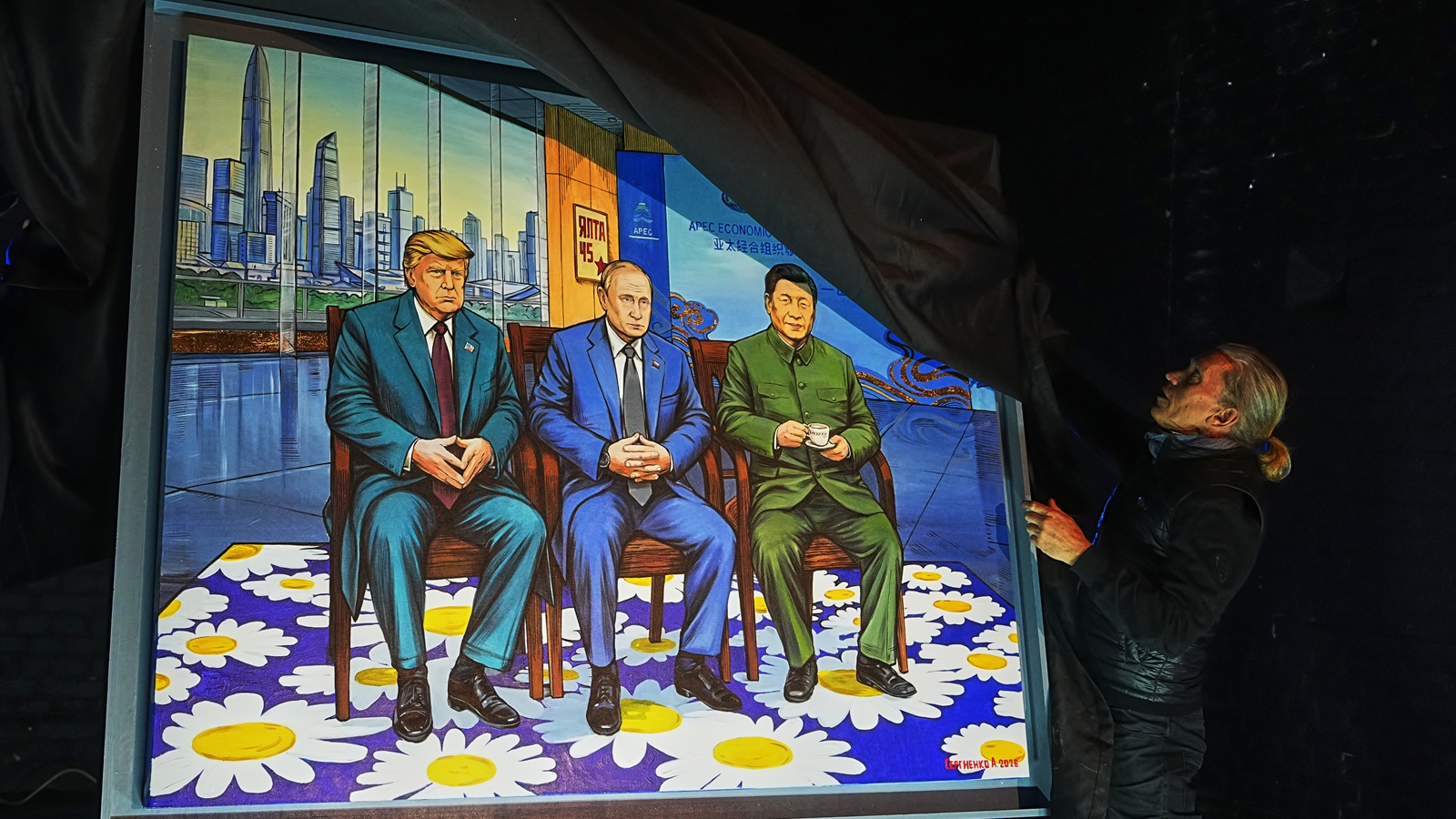
The tea in a high-level diplomatic anteroom never tastes like tea. It tastes like old paper, recycled air, and the metallic tang of unspoken threats.
If you have ever sat across a polished mahogany table while men in dark wool suits quietly trade away the future of a country you love, you know the specific silence that precedes a signature. It is not peaceful. It is the sound of a heavy door clicking shut from the outside. In February 1945, three exhausted men sat in a whitewashed palace on the Crimean coast, surrounded by the smell of damp wool and tobacco smoke, and drew lines across a map of Europe with colored pencils. They called it Yalta. To Franklin D. Roosevelt, Winston Churchill, and Joseph Stalin, it was the pragmatic architecture of post-war peace. To a family in Warsaw, Tallinn, or Prague, it was the quiet realization that their street, their language, and their children's futures had just been handed over as a bargaining chip to keep the big powers from shooting at each other. Meanwhile, you can find related developments here: The Night the Sky Above Manama Turned to Static.
Eighty-one years later, the whispers have returned. Diplomatic corridors from Washington to Brussels and Tokyo are buzzing with speculation that Donald Trump, Xi Jinping, and Vladimir Putin are eyeing a historic trilateral summit in Beijing—a gathering foreign policy analysts and European commentators are already calling a "new Yalta."
Wait. To see the full picture, check out the detailed article by USA Today.
Before we dismiss that phrase as historical hyperbole, look at the table being set.
The Ghost in the Ballroom
To understand why the mere rumor of a Trump-Xi-Putin summit sends a cold shiver down the spines of diplomats in smaller capitals, you have to strip away the flags and the motorcades. Imagine a hypothetical afternoon inside Beijing's Great Hall of the People. Outside, the air is crisp, and the red banners snap sharply in the wind. Inside, three leaders sit without the usual chorus of multilateral allies—no European Union commissioners, no NATO secretary-general, no Ukrainian or Taiwanese envoys waiting in the wings.
According to diplomatic observers and international relations scholars analyzing the potential summit, the appeal of such a meeting for the three principals is obvious. It is pure, unfiltered great-power realism. For years, international politics operated under the assumption that global rules were written by broad coalitions, enforced by international law, and underpinned by American security guarantees. Yet analysts note that Donald Trump has consistently favored direct, bilateral or personal deal-making over sprawling alliances, viewing traditional multilateral frameworks as costly burdens on the United States. Vladimir Putin, meanwhile, has spent over two decades arguing that the post-Cold War order humiliated Russia and that sovereign nations should be divided into natural spheres of influence. And Xi Jinping, presiding over the world's second-largest economy and a rapidly modernizing military, has long advocated for a "multipolar" world where Beijing sits as an equal co-architect of global rules rather than a junior partner in a Western-led system.
Put those three worldviews in one room, and the math changes overnight.
When three superpowers decide to settle their differences directly, they rarely pay the bill out of their own pockets. They pay with the sovereignty of the countries caught in between. That is the invisible stake of a Beijing summit. It is not merely a photo opportunity or a trade negotiation; it is a fundamental question about who gets to decide whether a smaller nation lives free or lives on a leash.
What Does a Sphere of Influence Actually Feel Like?
We use sanitized, academic words to describe geopolitics. We talk about "security architectures," "buffer zones," and "spheres of influence." Those phrases sound like harmless geometry until you live inside one of the shapes.
Consider a hypothetical scenario to make the abstract concrete. Picture Marta, a twenty-nine-year-old software engineer living in Vilnius, Lithuania, or perhaps a younger counterpart in Taipei. She does not wake up thinking about grand strategy. She wakes up thinking about her mortgage, her aging parents, and whether the local startup she works for will secure its next round of funding. Her entire adult life has been built on a quiet, invisible foundation: the belief that borders cannot be redrawn by force, and that if a larger neighbor threatens her home, a coalition of democracies will stand in the doorway.
Now imagine Marta turning on her morning news to see footage of three leaders shaking hands in Beijing, announcing a "grand bargain" to stabilize the globe.
What would be on that table? Foreign policy experts who warn against a new Yalta point to three interlocking flashpoints: the war in Ukraine, the future of Taiwan, and the security perimeter of Eastern Europe. In a transactional framework, everything becomes currency. Moscow wants recognition of its territorial gains in Ukraine and a permanent halt to NATO expansion—effectively locking neighbors like Ukraine, Georgia, and Moldova into a Russian sphere of influence. Beijing wants Washington to step back from its military support for Taiwan and lift technological and tariff restrictions, clearing the path for Chinese dominance in the Indo-Pacific. Washington, under an "America First" doctrine, might seek an end to expensive foreign entanglements, a massive bilateral trade agreement with China, nuclear arms control concessions, or cooperation on stabilizing global energy markets.
If those pieces are traded against one another, Marta's world tilts on its axis before she even finishes her coffee. Nobody fired a shot at her apartment building. Nobody crossed her border. Yet the invisible shield above her head just vanished, traded away in a room thousands of miles away to buy temporary quiet between giants.
It is terrifying. Honestly, even for those of us who have spent years watching diplomatic cables and parsing treaty language, the sheer speed with which decades-old alliances can be re-evaluated feels disorienting. You start wondering which promises are written in stone and which ones were only ever written in pencil.
Why Now? The Convergence of Three Pressures
Why would a summit of this magnitude materialize now, after years of intensifying rivalry between Washington, Beijing, and Moscow? Historians and political scientists point out that great-power summits rarely happen out of sudden affection; they happen when three separate domestic pressures collide at the exact same moment.
First, look at Moscow. Years of grinding attritional warfare in Ukraine have strained the Russian economy, depleted vast stockpiles of Soviet-era armor, and left the Kremlin heavily dependent on Chinese trade and diplomatic cover. According to economic analysts tracking Russian wartime finances, high interest rates, labor shortages, and Western sanctions have created long-term structural pain beneath the surface of wartime spending. For Putin, sitting in Beijing as an equal partner alongside the American and Chinese presidents offers the ultimate prize: international legitimacy, an exit ramp from isolation, and the chance to formalize a settlement in Ukraine without conceding defeat.
Second, look at Beijing. Xi Jinping faces his own set of domestic headwinds. China's economy has wrestled with a prolonged property sector slump, local government debt, demographic contraction, and the biting impact of tariffs on its export engine. Foreign policy observers note that hosting a historic trilateral summit in Beijing would project unmatched global prestige at home—casting Xi not as a leader cornered by Western containment, but as the indispensable statesman capable of bringing Washington and Moscow to his table.
Third, look at Washington. Trump has repeatedly framed himself as a master negotiator capable of ending wars through personal rapport and hard-nosed leverage. Supporters of his approach argue that traditional diplomacy has failed—that endless sanctions and proxy wars have only pushed Russia and China closer together into a dangerous axis, draining American resources and risking a catastrophic nuclear confrontation. From this perspective, talking directly to Xi and Putin is not appeasement; it is common-sense realism aimed at breaking up the Sino-Russian alignment and preventing World War III.
Both arguments carry a sharp edge of truth. That is what makes this moment so agonizingly complex.
The Illusion of the Grand Bargain
Think of international order like an old stone arch. Every small nation—Estonia, South Korea, Poland, the Philippines—is a wedge-shaped stone held in place by pressure from its neighbors and the keystone at the top. When the keystone holds, the arch can bear immense weight. When the giants at the top decide to pull out a few stones on the side to lighten their own load, the entire structure doesn't gently settle into a lower shape. It collapses.
Critics of a Yalta-style summit argue that the fundamental flaw of spheres-of-influence politics is that it never actually buys lasting peace. It only buys a pause.
Look back at 1945. Roosevelt hoped that conceding Eastern Europe to Stalin's sphere of influence would secure Soviet cooperation in the United Nations and bring stability to the continent. Instead, the ink was barely dry before the Iron Curtain descended, triggering four decades of Cold War proxy conflicts, nuclear brinkmanship, and the subjugation of over a hundred million people. Conceding a sphere of influence rarely satisfies an expansionist appetite; it merely moves the border closer to the next contested territory.
Furthermore, European and Asian allies are not passive chess pieces waiting to be moved. Poland today spends a higher percentage of its GDP on defense than almost any other NATO member. Japan has undertaken its most significant military buildup since World War II. South Korea and Australia have deepened their own defense partnerships. If leaders in Brussels, Warsaw, Tokyo, or Seoul suspect that Washington is cutting a side deal over their heads in Beijing, they will not simply submit to Moscow or Beijing. Many analysts warn they could instead conclude that American security guarantees are dead—potentially triggering a dangerous wave of nuclear proliferation as middle powers scramble to build their own ultimate deterrents.
The Room Where Nobody Else Was Invited
Walk outside the Great Hall of the People in your mind for a moment, away from the flags and the cameras, and look at what the rest of the world sees when three men sit down to divide the globe.
They see a return to the nineteenth century, dressed up in twenty-first-century tailoring. They see a world where might makes right, where international borders are merely temporary suggestions, and where small democracies exist only at the sufferance of nuclear superpowers.
Yet the proponents of direct engagement ask a question that cannot be brushed aside lightly: What is the alternative? If the leaders of the world's three most heavily armed nations refuse to sit in the same room, refuse to talk, and allow regional wars and trade conflicts to spiral unchecked, who pays the price then? Everyone. A direct military collision between the United States, Russia, or China would not spare Warsaw, Taipei, or Washington. It would turn the whole map to ash.
That is the tightrope hanging over Beijing. Diplomacy between adversaries is necessary; refusing to talk is negligence. Yet diplomacy conducted without allies, trading away the self-determination of sovereign nations behind closed doors, is something else entirely.
Somewhere in Eastern Europe tonight, a family is eating dinner beneath a roof that feels entirely solid. Somewhere across the Taiwan Strait, a factory floor is humming through the night shift, building the microchips that power the phones in our pockets. None of those people will have a chair at the table if Trump, Xi, and Putin sit down under the bright chandeliers of Beijing. They will only wait, watching the televised handshakes, listening for the quiet click of a door closing from the outside.