The intersection of thermodynamic volatility and mass human logistics represents one of the most complex operational challenges of the twenty-first century. When annual religious events coincide with hyper-arid regional microclimates, the margin for logistical error drops to zero. The annual Hajj pilgrimage in Saudi Arabia presents a stark baseline for this crisis. As global mean temperatures rise, the risk profile of this event shifts from a predictable seasonal management challenge to an acute system failure vector.
Managing mass gatherings under extreme environmental stress requires moving past vague warnings about warming trends. Quantifying the risk requires mapping the exact thermal mechanics, physiological thresholds, and structural bottlenecks that turn high ambient temperatures into mass-casualty events.
The Triad of Thermal Vulnerability
The risk profile of the Hajj can be disaggregated into three distinct, compounding variables: environmental physics, demographic vulnerability, and spatial bottlenecks.
1. Thermodynamic Exposure Metrics
Evaluating risk purely through dry-bulb temperature (the standard thermometer reading) masks the true physiological strain on the human body. The critical metric for crowd safety is the Wet-Bulb Globe Temperature (WBGT), which integrates dry-bulb temperature, humidity, wind speed, and radiant heat flux from direct sunlight and concrete surfaces.
Human thermoregulation relies primarily on the latent heat of vaporization—the cooling effect achieved when sweat evaporates from the skin. When the WBGT exceeds 35°C (95°F), the environmental vapor pressure gradient approaches zero. Evaporative cooling ceases to function. At this threshold, the human body transitions from a system capable of steady-state heat dissipation to a closed thermal mass absorbing ambient energy.
2. Demographic Susceptibility Profiles
The baseline population participating in the Hajj features a disproportionately high concentration of high-risk cohorts.
- Age Distribution: A significant percentage of pilgrims are elderly, possessing diminished autonomic thermoregulatory capacity, reduced sweat gland density, and a blunted thirst reflex.
- Pre-existing Comorbidities: High rates of cardiovascular disease, diabetes, and chronic respiratory illness among participants significantly lower the threshold for heat-induced organ failure.
- Acclimatization Deficits: A vast majority of international arrivals travel from temperate or tropical climates with high humidity, landing in a hyper-arid desert environment without the mandatory two-week physiological acclimatization period required to trigger protective heat-shock protein responses and plasma volume expansion.
3. Spatial and Temporal Bottlenecks
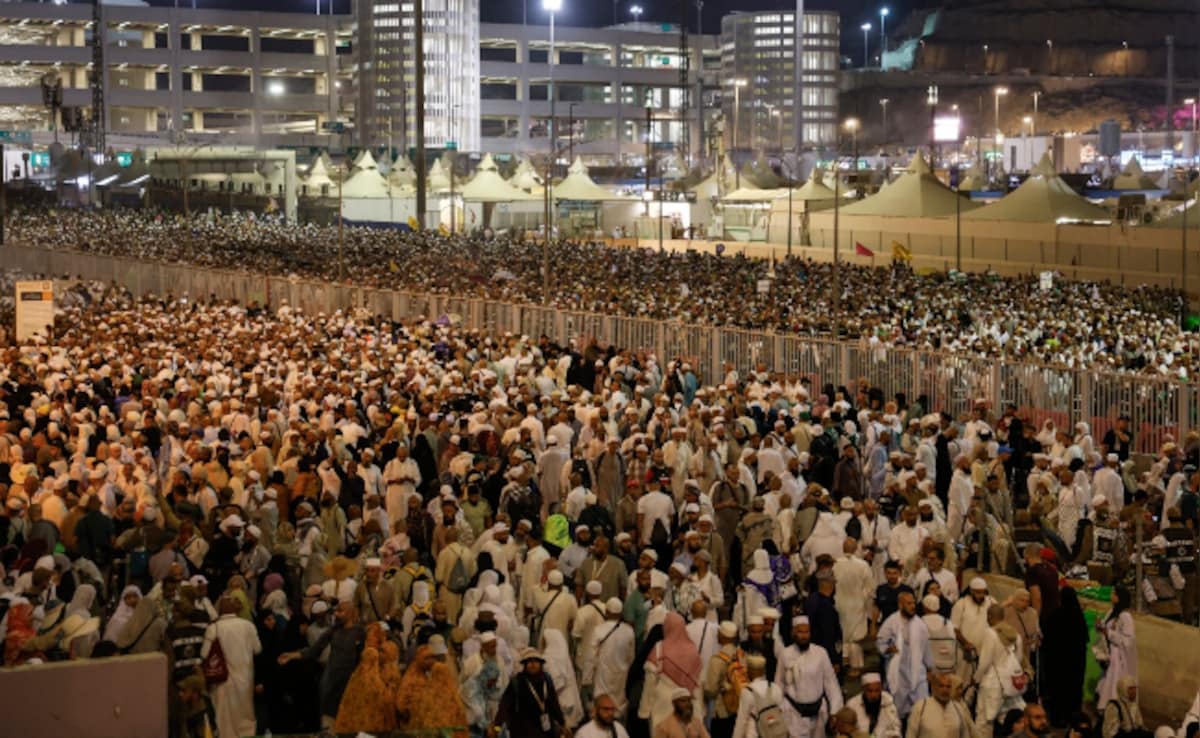
The itinerary of the Hajj is chronologically fixed by the Islamic lunar calendar and geographically bound to specific open-air sites outside Mecca, notably Mount Arafat and Mina. This creates a structural constraint: millions of individuals must move between specific coordinates within identical, narrow time windows.
When peak solar radiation coincides with these mandatory movement phases, crowds face extreme metabolic heat production (from physical exertion) overlaid on top of maximum environmental heat load. The high physical density of the crowd—frequently exceeding four people per square meter—creates a microclimate bubble. This tight packing traps radiant heat and moisture, effectively blocking ambient wind and rendering standard cooling measures ineffective.
The Cascade of Physiological System Failure
The transition from heat exhaustion to exertional heat stroke occurs along a highly predictable pathological timeline. Understanding this sequence is vital for designing effective medical interventions on-site.
[Ambient Heat + Metabolic Exertion]
               │
               ▼
   [Cutaneous Vasodilation]
               │
               ▼
[Splatnic Ischemia & Core Temp > 40°C]
               │
               ▼
[Endotoxemia & Systemic Inflammation]
               │
               ▼
  [Multiorgan Dysfunction Syndrome]
Environmental heat combined with physical exertion triggers profound cutaneous vasodilation. The body diverts blood flow to the skin to maximize heat dissipation. This circulatory shift causes a corresponding drop in central blood volume, forcing a compensatory increase in heart rate to maintain cardiac output.
As core body temperature breaches 40°C (104°F), this compensatory mechanism fails. Cellular membranes begin to denature. The hypoperfusion of internal organs leads to splanchnic ischemia—a lack of blood flow to the gut. The intestinal mucosal barrier breaks down, allowing endotoxins to enter the bloodstream. This triggers a systemic inflammatory response syndrome (SIRS), mimicking sepsis.
Once this threshold is crossed, the clinical presentation shifts rapidly from simple dehydration to Multiorgan Dysfunction Syndrome (MODS). This manifests as disseminated intravascular coagulation (blood clotting failure), acute renal failure due to rhabdomyolysis (muscle tissue breakdown blocking kidneys), and encephalopathy (altered brain function). At this stage, mortality rates climb exponentially for every ten minutes cooling is delayed.
Critical Infrastructure Limitations and Spatial Constraints
The primary failure mode in mass heat mitigation is not a lack of medical knowledge, but a series of interconnected logistical and structural bottlenecks.
The Myth of Infinite Shading
Deploying large-scale physical canopies and misting fans offers local relief but introduces secondary microclimate challenges. In high-density zones, large misting arrays can artificially drive up local relative humidity. In hyper-arid zones, this can backfire by lowering the air's capacity to absorb human sweat, raising the local WBGT and worsening the thermal strain on dense crowds.
The Mobility-Casualty Paradox
When pilgrims collapse from heat stroke, the immediate clinical requirement is rapid cooling, ideally via ice-water immersion or high-velocity evaporative cooling. However, the physical density of the crowd blocks emergency medical services (EMS) from reaching the casualty.
Vehicular access is structurally impossible in compressed pedestrian corridors. Foot-bound medical teams face intense friction moving against the crowd flow. Consequently, the time-to-treatment interval regularly exceeds the critical 30-minute window required to prevent permanent neurological damage or death.
Strategic Adaptation Protocols for Mass Gathering Management
Mitigating thermal risk during large-scale regional events requires a complete overhaul of traditional event management. The solution lies in treating thermal safety as a dynamic engineering problem rather than an unpredictable weather variable.
Chronobiological Route Optimization
The most direct tool for reducing heat stress is altering the schedule of human movement. Event organizers must use predictive WBGT modeling to implement mandatory pause windows.
When real-time sensor arrays indicate that the WBGT will exceed 32°C in a specific transit corridor, all pedestrian movement must be legally halted or routed into climate-controlled subterranean or elevated transit networks. High-exertion rituals must be shifted into nocturnal windows, utilizing the diurnal temperature drop characteristic of desert environments.
Thermodynamic Architecture and Micro-Venting
Urban planning within pilgrimage sites must prioritize aerodynamic design over static shelters. Deep urban canyons should be oriented parallel to prevailing wind directions to maximize natural ventilation and city flushing.
Using high-albedo materials (cool pavements) and retroreflective coatings on all horizontal surfaces can significantly reduce the solar heat absorbed by the ground, lowering evening radiant heat emissions.
Algorithmic Triage and Decentralized Cryo-Stations
Relying on centralized field hospitals creates a clear single point of failure during a thermal mass-casualty event. The medical architecture must be decentralized into highly modular, rapid-deployment cryo-stations situated every 100 meters along major transit routes.
These stations must prioritize targeted cooling mechanisms over generalized first aid:
- Strategic Deliverables: High-capacity immersion vats, non-invasive core cooling protocols, and automated external defatigation systems.
- Sensor Integration: Deploying wearable biometric patches to high-risk demographic cohorts can transmit real-time heart rate and skin temperature telemetry to a centralized command center, flags anomalies before clinical collapse occurs.
The future viability of mass religious and cultural gatherings in equatorial and arid zones depends on abandoning reactive emergency management in favor of predictive, algorithmically driven logistics. If the structural frameworks of thermodynamic monitoring, demographic screening, and spatial de-densification are not tightly integrated into urban planning, the rising baseline of global temperatures will turn these historic gatherings into recurring humanitarian crises.