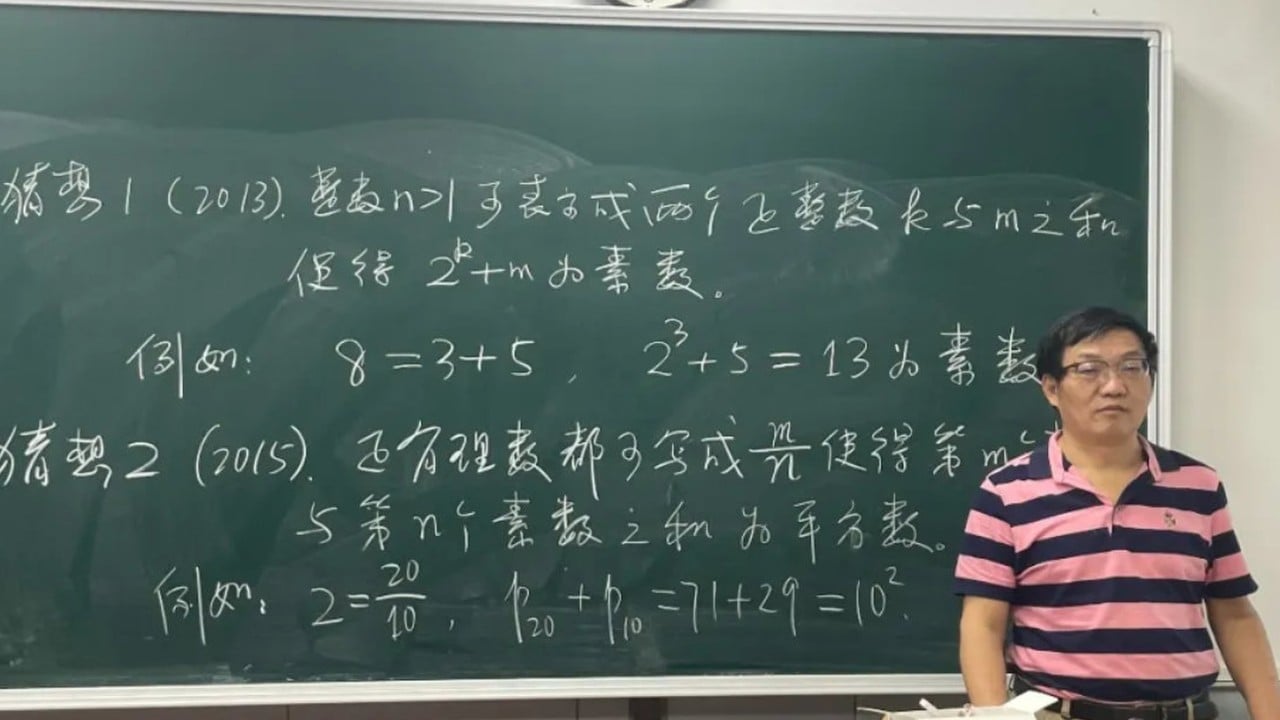
Putting 1,000 open number theory problems in front of artificial intelligence exposes a fundamental bottleneck in automated research: pattern interpolation is not mathematical proof. Nanjing University mathematician Sun Zhiwei has spent decades formulating conjectures about integers, primes, and additive combinatorics—many backed by personal cash prizes—and framing them as a stress test for machine intelligence. Coverage of this challenge frequently treats AI either as a triumphant problem-solver or as a glorified autocomplete engine waiting to hit a wall. Both framings miss the operational mechanics of how formal reasoning actually breaks down under adversarial conjecture testing.
To evaluate what a 1,000-problem conjecture suite really measures, we have to separate three distinct capabilities that standard commentary conflates: problem formulation, proof search, and verification. When an article says a model "struggles with multi-layer abstraction" or "lacks intuition," it describes symptoms rather than failure modes. A rigorous evaluation tracks where search explodes, where heuristic priors fail, and where formal checking is still required to prevent subtle logical slips.
What Sun Zhiwei's Challenge Actually Tests
Number theory is uniquely unforgiving for statistical models because small structural perturbations often change asymptotic behavior or introduce finite exceptions. Many conjectures in integer arithmetic are easy to state cleanly yet notoriously resistant to proof—a classic property of Diophantine and prime-distribution problems. In Sun's body of work, statements often connect elementary operations or prime sequences to structural claims that hold across vast numerical ranges while remaining unproven in general.
Commentaries on the 1,000-problem benchmark typically reduce the contest to a binary question: can AI solve hard math or not? That framing is too blunt. A benchmark of 1,000 distinct conjectures is better understood as a portfolio of search landscapes rather than a single monolithic exam. Some statements may yield to automated lemma discovery, algebraic manipulation, or computer-assisted case reduction, while others require inventing new structural invariants or bridging separate subfields.
Separating the workflow into operational stages clarifies where human mathematicians and AI systems currently divide labor:
- Conjecture generation and selection: Identifying which statements are both plausible and mathematically fruitful, rather than merely syntactically valid.
- Heuristic exploration: Testing numerical examples, spotting modular patterns, and proposing intermediate claims that might serve as stepping stones.
- Rigorous proof construction: Producing a chain of deductions where every step is justified without relying on unstated assumptions or statistical plausibility.
- Formal or peer verification: Checking that the completed argument contains no hidden edge cases, domain errors, or circular reasoning.
Sun's own observation—that AI resembles a capable graduate student needing guidance, while humans remain vital for asking original questions and building new theories—captures a real division of labor, though it can sound overly metaphorical if left unexamined. In practice, "guidance" means decomposing a high-level conjecture into tractable sub-goals, choosing the right representation, and pruning dead-end proof branches early.
Why Statistical Pattern Matching Hits Jagged Edges
Standard neural architectures excel at recognizing recurring motifs across large corpora of existing mathematics. When a problem resembles textbook exercises, competition tasks with known archetypes, or standard transformations, pattern-guided search can move rapidly. Research-level conjectures in number theory behave differently: they frequently hinge on jagged edges, modular arithmetic constraints, and isolated counterexamples or exceptions that smooth interpolation overlooks.
This is a known fact about statistical sequence prediction: high token or step likelihood does not guarantee logical validity. A model can generate fluent mathematical prose that mimics the cadence of a proof while skipping a non-trivial bound or assuming a property that only holds under extra hypotheses. What remains an educated hypothesis in current AI research is how far combining neural search with formal proof assistants (such as Lean) or symbolic engines can close that gap on open-ended research conjectures rather than curated benchmark problems.
A practical example illustrates the trap. Suppose a conjecture concerns integers satisfying a modular condition or a sum involving primes. A language model may correctly recall classical theorems—such as quadratic reciprocity, pigeonhole arguments, or basic sieve ideas—and string them together plausibly. Yet number theory proofs often fail on a boundary condition: $n = 1$, an even-versus-odd parity split, or a growth rate that holds "for sufficiently large $n$" without an explicit threshold. Without strict formal checking or exact inequality tracking, plausible prose easily masks an invalid step.
The Cost Function of Open-Ended Proof Search
Evaluating 1,000 problems is not just a test of intelligence; it is a compute and verification cost problem. Unlike multiple-choice or numeric-answer benchmarks where grading is cheap and immediate, open research conjectures have asymmetric feedback. A false or incomplete proof attempt can consume substantial inference and search budget without yielding a usable partial result.
Consider the economics of running a conjecture benchmark at scale:
- Search branching factor: As proof depth increases, the number of plausible algebraic rewrites, case splits, and auxiliary lemmas grows rapidly, driving up token and compute costs per attempt.
- Verification latency: Translating informal mathematical arguments into machine-checkable formal proofs—or having human specialists audit dense arguments—creates a review bottleneck that scales with proof length and subtlety.
- Reward sparsity: Most hard conjectures will not be solved on a single pass, meaning systems need mechanisms to cache partial insights, counterexamples, and failed strategies rather than starting from scratch.
Sun's personal prize model highlights another practical constraint in mathematical research: incentives and institutional funding structures are not always aligned with open bounty challenges, which is why researchers sometimes fund small prizes out of pocket. For AI labs and academic teams alike, the limiting factor on a 1,000-problem suite is rarely raw text generation speed. It is signal-to-noise ratio per unit of compute—how quickly a system can distinguish a promising proof direction from a hallucinated dead end.
Where Benchmarks Mislead Practitioners
Competitor articles often treat a headline number—like 1,000 problems—as proof that a definitive verdict on AI reasoning is right around the corner. Practitioners evaluating AI for technical or scientific workflows should avoid three common misreadings:
- Treating benchmark pass rate as theory-building ability: Solving or partially advancing specific conjectures does not automatically mean a system can invent a new mathematical framework or decide which questions matter most.
- Ignoring problem heterogeneity: Not all 1,000 problems carry equal structural difficulty or equal amenability to computational exploration. Treating every item as an equivalent data point distorts progress tracking.
- Conflating fluency with rigor: High-confidence explanatory text is an aid to brainstorming, not a substitute for proof verification.
There are also clear limitations to relying on any single conjecture collection as a general yardstick for AI capability. A set heavily weighted toward number theory or specific algebraic motifs tests specialized deductive and exploratory skills, not physical modeling, experimental design, or software engineering reliability. Moreover, even when an AI system contributes a breakthrough step, human domain experts remain essential to interpret significance, connect results to broader literature, and guard against subtle framing errors.
Operational Playbook for Testing AI on Hard Problems
Teams that want to use hard conjecture sets—whether Sun's problems or internal domain equivalents—to build real capability rather than chase headlines should instrument the process like an engineering pipeline:
- Log failure modes, not just wins: Categorize every failed attempt by where it broke—bad lemma choice, missing edge case, arithmetic/bound slip, or circular logic—so model and prompt iterations target real bottlenecks.
- Pair heuristic search with strict verifiers: Require formal proof checks, symbolic sanity tests, or explicit step-by-step justification wherever correctness is non-negotiable, keeping raw neural drafts strictly in the hypothesis-generation lane.
- Budget by problem tier: Allocate light exploratory passes across the full problem set first to surface quick wins or counterexamples, then concentrate deeper search and specialist review on high-value or high-leverage sub-problems.
The sharpest strategic move for research leaders and technical teams is to stop asking whether AI can replace mathematicians on 1,000 hard problems and instead build verification-first research loops where AI generates candidate lemmas, tests edge cases at scale, and hands structured proof sketches to human experts for final validation.