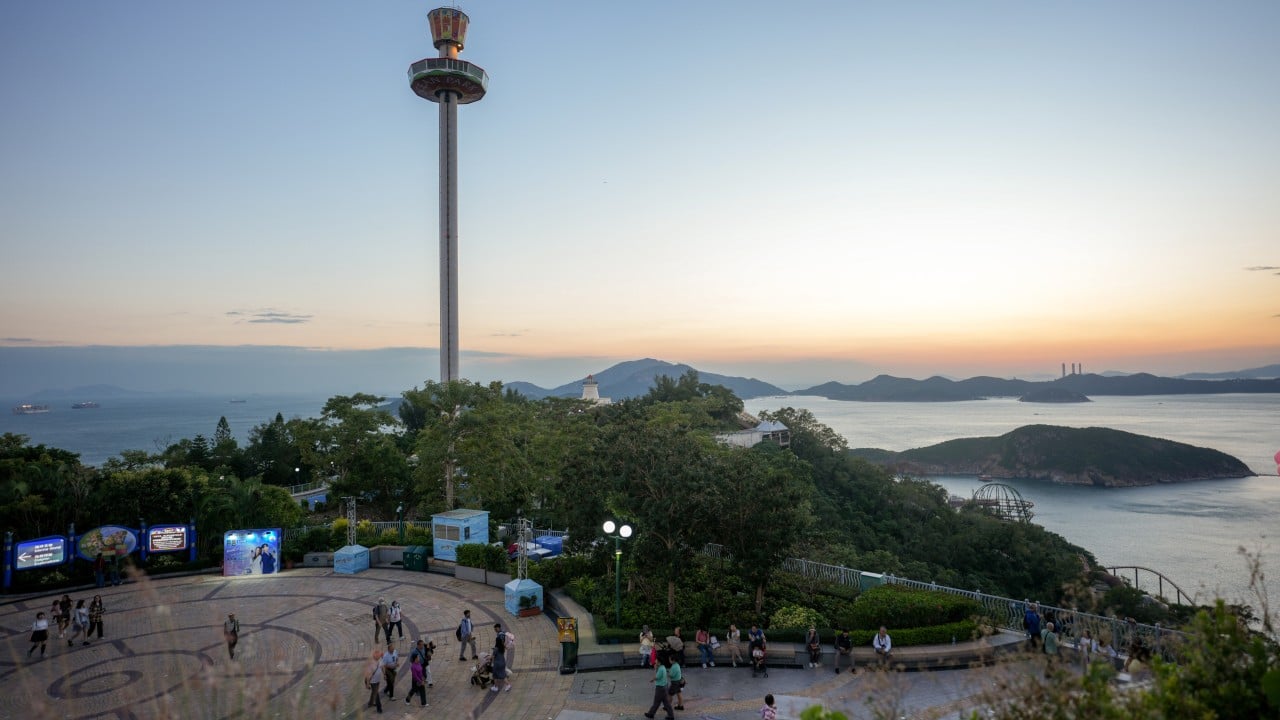
Two mechanical failures on the same vertical observation tower within a twenty-four-month window represent a systemic breakdown in reliability engineering, not an isolated operational anomaly. When Hong Kong’s Ocean Park experienced a second high-profile suspension of its Ocean Park Tower—stranding passengers mid-air and prompting renewed scrutiny from legislators and the Electrical and Mechanical Services Department (EMSD)—the public discourse immediately defaulted to surface-level demands for "boosted safety." That framing misses the structural reality. In high-capital, aging amusement infrastructure, recurring mechanical halts are the predictable output of deterministic degradation curves colliding with deferred capital expenditure, flawed preventative maintenance schedules, and reactive regulatory oversight.
To understand why a legacy theme park suffers repeated failures on a single flagship asset, operators and analysts must abandon generic safety platitudes and examine the underlying engineering, financial, and governance mechanics.
The Physics and Mechanics of Vertical Ride Stoppages
A vertical observation tower operates on a deceptively simple mechanical premise: a rotating, climate-controlled cabin ascends and descends a central steel column via a counterweight and hoisting cable system, governed by redundant programmable logic controllers (PLCs) and fail-safe braking assemblies. Unlike high-velocity roller coasters that experience violent dynamic loads and rapid thermal cycling, observation towers endure sustained static loads, constant torsional stress from rotation, and continuous exposure to coastal humidity and salt spray.
In amusement ride engineering, stoppages divide into two distinct operational categories: unplanned functional failures and fail-safe protective trips.
- Fail-Safe Protective Trips: Modern amusement rides are designed around the fail-safe principle, meaning any anomaly in sensor telemetry—a voltage fluctuation, an encoder mismatch, a hydraulic pressure drop, or a wind-speed threshold breach—automatically triggers mechanical disc brakes to clamp onto the guide rails. From an engineering standpoint, a cabin halting mid-air because a sensor detected a 2-millimeter alignment variance is a success of the safety architecture. From a guest experience and public relations standpoint, a two-hour mid-air evacuation via rescue cage or manual lowering procedures is indistinguishable from a catastrophic breakdown.
- Unplanned Functional Failures: These occur when primary components—such as variable frequency drives, main hoist gearboxes, or load-bearing sheaves—degrade past operational tolerances during active duty cycles. While secondary systems prevent injury, the primary asset becomes immobilized until heavy mechanical intervention occurs.
The critical distinction lies in Mean Time Between Failures (MTBF) versus Mean Time To Repair (MTTR). When an asset installed in the late 1970s or 1980s exhibits a shrinking MTBF across a two-year period, the root cause rarely stems from a single broken part. Instead, it indicates that the asset has entered the wear-out phase of the classic Bathtub Curve in reliability engineering. During this phase, random failure rates give way to accelerating, age-induced component fatigue where replacing individual parts merely shifts stress onto adjacent, equally aged subsystems.
The Three Pillars of Operational Degradation
When legislators urge an operator to "boost safety," they treat safety as a binary switch that management can simply turn up. In reality, operational reliability rests on three interdependent pillars. Weakness in any single pillar compromises the entire structure.
1. Predictive Versus Preventative Maintenance Regimes
Traditional theme park operations rely heavily on time-based preventative maintenance—inspecting cables every 500 operating hours or replacing hydraulic seals annually. While compliant with baseline statutory codes, time-based schedules fail to account for non-linear wear caused by environmental factors. Ocean Park sits directly on the southern coast of Hong Kong Island, exposing exposed steel structures and electronic cabinets to high salinity, typhoons, and extreme humidity.
Without transitioning to Condition-Based Maintenance (CBM)—utilizing ultrasonic thickness testing, vibration spectrum analysis on gearboxes, and real-time thermal imaging of electrical switchgear—maintenance teams operate blind between scheduled teardowns. A hairline fracture or moisture ingress inside a limit switch housing will not wait for the next calendar-driven inspection to trigger a mid-air halt.
2. The Capital Expenditure Trap in Legacy Parks
Ocean Park operates under a unique financial constraint: it is a statutory body balancing public recreational mandates against commercial self-sufficiency, while competing directly against newer, capital-rich regional rivals like Hong Kong Disneyland and mainland mega-resorts.
In capital-intensive attractions, management faces a continuous resource allocation dilemma:
$$\text{Total Capital Budget} = \text{Maintenance CapEx} + \text{Growth CapEx}$$
Growth CapEx—new rides, immersive IP zones, and high-visibility attractions—drives ticket sales, attendance rebounds, and media coverage. Maintenance CapEx—rewiring a 40-year-old observation tower, replacing legacy PLC architectures, or overhauling mechanical drive trains—generates zero incremental attendance. When liquidity is tight or attendance is recovering from macroeconomic shocks, institutional bias inevitably favors Growth CapEx. Maintenance CapEx is pared back to the minimum required to pass statutory certification. Over a multi-year horizon, this creates a hidden technical debt that manifests as repeated operational outages on legacy rides.
3. The Sensor Sensitivity Paradox
Following an initial incident, operators and regulators typically respond by tightening operational tolerances and adding redundant monitoring sensors. While intended to increase safety margins, this introduces the Sensor Sensitivity Paradox.
Every additional sensor added to a safety circuit increases the probability of a false-positive trip. If a tower’s control system requires simultaneous confirmation from twelve proximity sensors rather than six, and coastal corrosion degrades the signal-to-noise ratio on just one line, the system defaults to an emergency stop. The ride becomes statistically safer against catastrophic mechanical failure, yet operationally less reliable, resulting in more frequent passenger strandings and deeper erosion of public trust.
Regulatory Architecture and the Limits of Compliance
In Hong Kong, amusement rides fall under the statutory purview of the Amusement Rides (Safety) Ordinance (Cap. 449), enforced by the Electrical and Mechanical Services Department (EMSD). Under this framework, operators must employ qualified Competent Persons to conduct regular examinations, while the EMSD performs independent audits and investigates reportable incidents.
This regulatory model excels at preventing structural collapses and fatal accidents. However, statutory compliance establishes a floor, not a ceiling, for operational reliability.
- Reactive Investigation Loops: Regulatory intervention triggers after an incident occurs. The EMSD issues a suspension order, the operator submits a root-cause investigation report, repairs are verified, and operations resume. This loop addresses the proximate mechanical trigger—such as a faulty relay or a worn brake pad—without auditing the broader asset lifecycle strategy or spare-parts supply chain depth.
- The Obsolete Component Bottleneck: Legacy attractions frequently rely on proprietary mechanical or electronic components whose original equipment manufacturers (OEMs) have either exited the market or discontinued support. When a legacy drive controller fails, sourcing an exact replacement can take months, forcing engineering teams to fabricate custom interfaces or rely on refurbished inventory. Regulatory frameworks verify that the installed part works on the day of inspection; they do not score the supply-chain fragility of the underlying hardware.
The Cost Function of Public Stranding Events
A mechanical stoppage that results in zero physical injuries still inflicts severe financial and brand damage. In the high-density information environment of Hong Kong, a two-hour mid-air rescue operation is broadcast live via passenger smartphones before park public relations teams can draft a holding statement.
The true cost function of a repeat tower failure comprises four distinct variables:
- Direct Recovery and Inspection Costs: Overtime labor for specialized rescue teams, crane or auxiliary hoist deployment, third-party engineering audits, and expedited air-freight for replacement components.
- Capacity Utilization Loss: A flagship observation tower serves as a high-capacity "people-eater" that absorbs hundreds of guests per hour, relieving queue pressure on high-thrill attractions. Taking it offline for weeks during regulatory investigation degrades park-wide guest satisfaction and lowers per-capita spending.
- Brand Equity Erosion: Theme parks sell psychological escapism, which requires absolute subconscious trust in mechanical safety. When a second failure occurs on the same ride within two years, consumers stop viewing the event as bad luck and begin pricing systemic negligence into their visitation decisions.
- Political and Subsidy Friction: For a park reliant on government restructuring packages and public goodwill, recurring operational embarrassments hand political ammunition to critics questioning management competence and the viability of public bailouts.
Limitations of Standard Remediation Strategies
When management responds to legislative pressure by announcing "enhanced safety protocols," three standard interventions usually follow. Each carries strict operational limitations that must be accounted for:
- Increasing Inspection Frequency: Doubling manual visual inspections yields diminishing returns. Human inspectors suffer from vigilance decrement—the psychological decline in attention during repetitive tasks. Furthermore, visual checks cannot detect internal metallurgical fatigue or micro-cracking inside sealed bearings.
- Blanket Component Replacement: Swapping out every cable, sensor, and switch on a subsystem resets the wear clock on those parts, but introduces infant mortality risk—the left side of the Bathtub Curve. Newly installed electronic components and mechanical assemblies suffer elevated failure rates during their initial break-in period due to manufacturing defects or installation calibration errors.
- Lowering Operating Envelopes: Restricting ride operation during moderate wind speeds or high humidity reduces stress on the hardware, but increases unscheduled downtime, frustrating ticket holders and failing to solve the underlying mechanical vulnerability.
Strategic Restructuring for Legacy Amusement Assets
To break the cycle of recurring failures and legislative reprimands, Ocean Park—and any operator managing aging, high-profile vertical attractions—must execute a structural shift in asset governance rather than issuing incremental maintenance directives.
First, institute a strict ring-fence around Lifecycle Maintenance CapEx. Accounting practices must separate routine operational maintenance from Mid-Life Refurbishment CapEx. Any ride exceeding twenty-five years of service requires a mandatory, fully funded capital overhaul every decade that replaces entire control architectures, wiring harnesses, and primary drive assemblies as integrated systems rather than piecemeal swaps. If the projected return on investment of the asset cannot justify a full subsystem rebuild, the rational strategic play is permanent decommissioning rather than running the asset to failure.
Second, deploy continuous telemetry and predictive analytics. Move critical vertical assets off calendar-based inspection schedules and onto real-time condition monitoring. Installing continuous vibration sensors on main hoist gearboxes, current-signature analyzers on drive motors, and automated humidity monitors inside control cabinets allows engineering teams to detect component degradation weeks before a fail-safe trip occurs.
Third, redesign evacuation architecture to compress MTTR. Because fail-safe stops cannot be eliminated entirely in complex electromechanical systems, operational resilience depends on reducing the duration of passenger containment. Upgrading auxiliary rescue drive systems and pre-staging rapid-descent protocols to cut evacuation times from hours to under twenty minutes transforms a front-page crisis into a minor operational delay.
Finally, formalize transparent reliability reporting. Instead of waiting for legislators to demand answers after an incident, publish an annual asset reliability scorecard detailing ride availability rates, preventative maintenance ratios, and completed capital upgrades. In high-scrutiny public environments, institutional credibility is rebuilt not by promising perfection, but by proving rigorous, quantified control over mechanical risk.