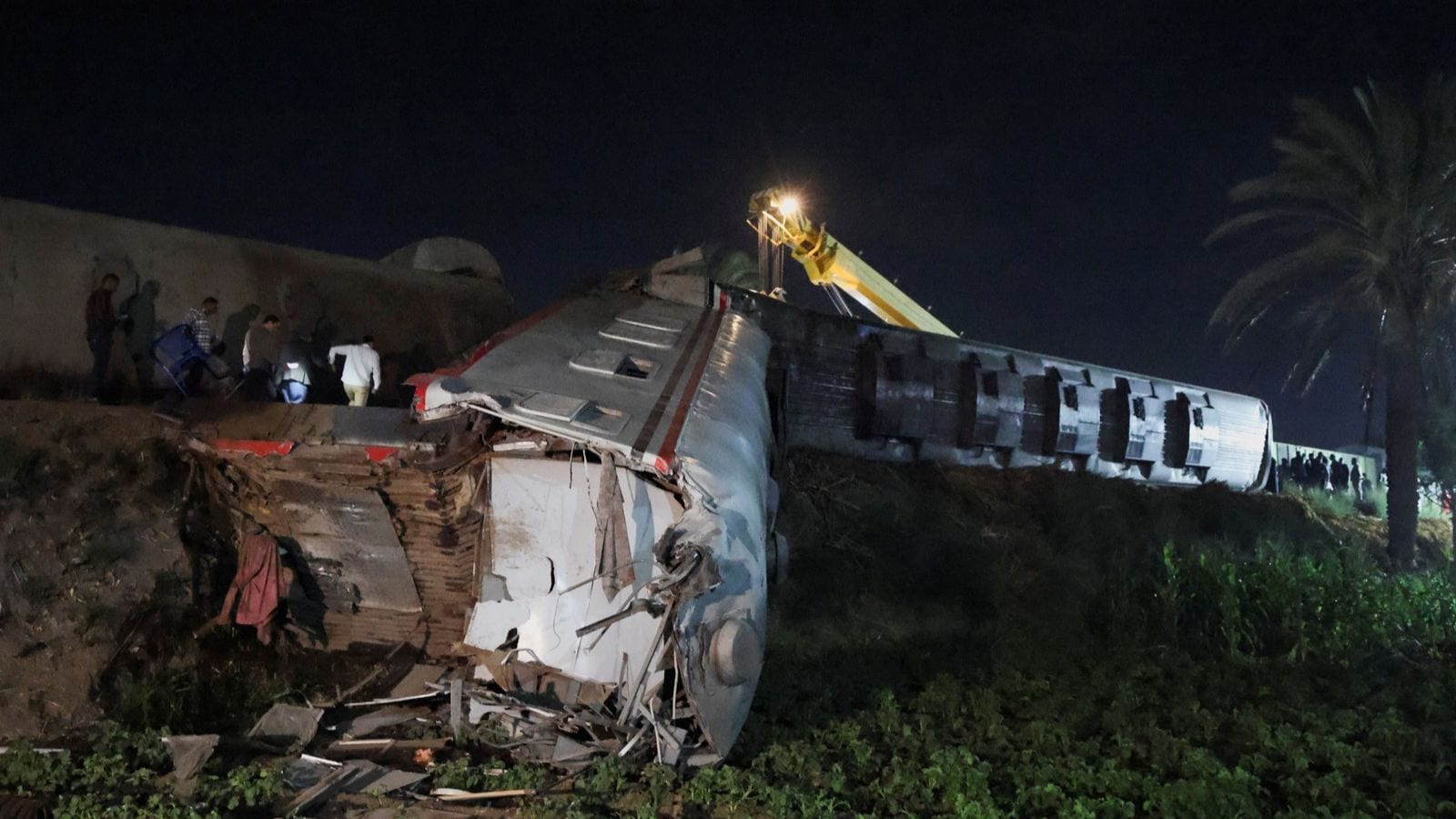
Fatal rail collisions in Egypt are rarely isolated operator errors; they are the predictable outputs of a high-density transit network running on legacy signaling architecture under severe capital constraints. When a collision kills at least seven people and injures dozens—as confirmed by Egypt’s Ministry of Health—the surface narrative focuses on immediate emergency response and casualty counts. That framing obscures the operational mechanics of the disaster. To understand why these events recur along the Nile Delta and Upper Egypt corridors, analysts must isolate the structural bottlenecks in track allocation, the physics of kinetic energy dissipation in aging rolling stock, and the institutional friction slowing down infrastructure modernization.
The Structural Anatomy of a Head-On or Rear-End Rail Collision
A collision between two passenger trains, or a passenger train and a locomotive, represents a catastrophic breakdown in block signaling, the foundational safety protocol of railway engineering. In a functional rail network, tracks are divided into discrete geographical segments known as blocks. Only one train is permitted to occupy a block at any given time.
When an incident results in dozens of injuries and multiple fatalities, one of three systemic failures has occurred:
- Manual Dispatch Latency: On stretches of the Egyptian National Railways (ENR) network where automated electronic interlocking has not yet replaced mechanical semaphore signals, block clearance relies on human communication via telephone or radio between signal boxes. High cognitive load, shift fatigue, or misheard track identifiers allow two trains to enter the same block simultaneously.
- Signal Overrun Without Automatic Train Protection (ATP): Even where visual signals function correctly, human error can cause a driver to pass a red aspect (Signal Passed at Danger, or SPAD). Without an active ATP system—such as the European Train Control System (ETCS)—to automatically trigger emergency braking when a driver ignores a stop signal, the system lacks a fail-safe mechanism.
- Switch Alignment Failure: Mechanical switches that divert trains onto passing loops or parallel tracks require physical locking mechanisms. If a switch fails to lock completely or is thrown prematurely under high traffic volume, a train traveling at mainline speeds is routed directly into an occupied siding.
The distinction between known facts and operational hypotheses is critical here. The confirmed facts in such an incident are the baseline metrics reported by health and transport authorities: a minimum of seven fatalities, dozens of non-fatal trauma cases, and physical impact between rail units. The specific root cause—whether mechanical switch failure, dispatch error, or brake degradation—remains an operational hypothesis until data loggers (event recorders) are extracted from the lead locomotives and analyzed by judicial and technical investigators.
Kinetic Energy and Casualty Distribution Mechanics
Casualty figures in rail accidents are governed by basic Newtonian physics rather than random chance. The kinetic energy ($E_k$) of a moving train is defined by the equation $E_k = \frac{1}{2}mv^2$, where $m$ is mass and $v$ is velocity. Because velocity is squared, even moderate mainline speeds generate massive amounts of energy that must be absorbed during an impact.
In modern rolling stock, this energy is managed through Crash Energy Management (CEM) systems. CEM designs incorporate sacrificial crumple zones at the ends of passenger cars, anti-climbing mechanisms that prevent one carriage from overriding another, and tightly secured interior fixtures.
Older carriages still operating across parts of the Egyptian network lack full CEM integration. When two trains collide without effective anti-climbing technology, the chassis of one carriage frequently overrides the frame of the adjacent carriage, shearing through the passenger compartment. This mechanism explains the specific casualty profile seen in Ministry of Health briefings: a concentrated number of fatalities in the leading or trailing impact cars, accompanied by a much wider distribution of blunt-force trauma, fractures, and lacerations among dozens of passengers across the remaining carriages due to sudden deceleration and unrestrained interior debris.
The Four Pillars of Egyptian Rail Vulnerability
To evaluate the risk profile of the Egyptian rail network objectively, we must separate the system into four interacting operational variables.
1. Throughput Demand Versus Infrastructure Capacity
Egypt’s geography forces nearly its entire population of over 100 million people into a narrow ribbon along the Nile River and the Delta. Consequently, the ENR carries hundreds of millions of passengers annually on a relatively compact track footprint. This creates extreme capacity utilization. High-frequency commuter trains, long-distance express services, and slow-moving freight locomotives share the same corridors. When utilization approaches 100% of theoretical track capacity, minor delays cascade rapidly across the network, compressing the temporal buffers between trains and increasing the probability of dispatch errors.
2. The Modernization Gap and Brownfield Integration
The Egyptian government has allocated billions of dollars toward upgrading signaling systems, procuring new locomotives, and rehabilitating tracks. However, upgrading an active railway is a brownfield engineering problem. Engineers cannot shut down the primary economic artery of the country for five years to rebuild it from scratch. Instead, new electronic signaling systems must be installed alongside legacy mechanical infrastructure while trains continue to run. During these transitional phases, interface zones—where automated digital blocks meet manual mechanical blocks—become acute points of vulnerability. Drivers and signalmen must constantly switch cognitive modes between modern automated protocols and legacy manual rules.
3. Maintenance Debt and Rolling Stock Fatigue
Decades of underinvestment prior to recent capital injections created substantial maintenance debt. Rolling stock operated beyond its optimal lifecycle suffers from cumulative metal fatigue, degraded pneumatic braking efficiency, and electrical faults. While the introduction of new locomotives and coaches reduces the average fleet age, legacy units remain in service to meet peak passenger demand. A single brake cylinder failure or wheel-set defect on a legacy coach can turn a routine station approach into a high-speed rear-end collision.
4. Right-of-Way Encroachment and Unregulated Crossings
Unlike fully grade-separated high-speed rail lines, much of the conventional Egyptian network runs at grade through densely populated agricultural and urban areas. Unofficial pedestrian and vehicle crossings—built by local residents to avoid long detours—introduce unpredictable external variables. Drivers frequently execute emergency brake applications to avoid collisions at illegal crossings, which flattens steel wheels, strains coupling mechanisms, and disrupts timetable spacing for every train following behind on the corridor.
Emergency Response and Medical Triage Logistics
When a collision occurs, the mortality rate is heavily influenced by the Golden Hour principle of trauma care—the critical 60-minute window following traumatic injury during which prompt medical intervention prevents death from hemorrhage or airway obstruction.
Deploying dozens of ambulances to a rail crash site presents distinct logistical challenges compared to highway accidents:
- Access Constraints: Rail lines frequently run parallel to irrigation canals or through dense farmland with narrow, unpaved access roads. Heavy rescue equipment, such as hydraulic cutting tools and cranes needed to separate mangled steel carriages, often faces severe transit delays reaching the exact kilometer marker of the impact.
- Hospital Surge Capacity: A sudden influx of 30 to 60 trauma patients overwhelms local district hospitals along the Nile corridor. Effective triage requires immediate regional coordination by the Ministry of Health to distribute critical surgical cases—such as internal bleeding and crush injuries—across multiple provincial trauma centers rather than clustering all casualties at the nearest facility.
- Extrication Physics: Victims trapped inside deformed carriage frames risk crush syndrome, where prolonged compression of muscle tissue releases toxic levels of myoglobin and potassium into the bloodstream the moment the weight is lifted. Rescue teams must administer intravenous fluids before lifting heavy debris, a procedure that slows down extrication timelines and keeps casualty counts fluid for hours after the initial impact.
Limitations of Current Safety Interventions
Recognizing these failure modes is straightforward; eliminating them is constrained by hard economic and operational trade-offs. No single policy or technology serves as a complete fix.
Automation does not eliminate human error; it shifts it. Implementing electronic interlocking and Automatic Train Protection drastically reduces dispatch errors and signal overruns. However, it introduces new failure modes: software bugs, sensor degradation from extreme desert heat and dust, and the risk of theft or vandalism of copper signaling cables along isolated track stretches. If an automated signal fails due to a severed cable, the system reverts to a degraded manual fallback mode—precisely when operators, accustomed to automation, are least practiced in manual protocols.
Fare structures restrict self-funded maintenance. Rail transit in Egypt functions as an essential social safety net for low-income commuters. Ticket prices are heavily subsidized and politically sensitive. Because operating revenues do not cover full lifecycle maintenance and capital depreciation, the ENR remains entirely dependent on sovereign debt and state budget allocations for safety upgrades. Any macroeconomic shock or currency devaluation immediately increases the cost of imported spare parts, signaling components, and technical consulting, slowing down maintenance schedules.
Strict punitive accountability can suppress safety reporting. Following fatal collisions, judicial authorities routinely arrest train drivers, signalmen, and local station managers. While legal accountability is necessary for gross negligence, an exclusively punitive culture incentivizes frontline workers to hide minor equipment defects, near-misses, and procedural shortcuts rather than reporting them. High-reliability organizations—such as commercial aviation—achieve low accident rates through non-punitive near-miss reporting systems that identify systemic flaws before they align to cause a fatal crash.
Strategic Imperatives for Risk Reduction
Reducing the frequency and lethality of rail collisions in Egypt requires shifting capital and operational focus from reactive crisis management to structural decoupling.
First, transport planners must accelerate the physical segregation of freight and passenger traffic on high-density corridors. Constructing dedicated freight bypass lines around major Delta junctions removes slow-moving, heavy-axle trains from passenger tracks, immediately expanding headway buffers and reducing speed differentials between consecutive trains.
Second, safety oversight must be institutionalized through an independent rail accident investigation board structurally separated from the Ministry of Transport and the ENR. Just as aviation regulators separate accident investigation from airline operations and criminal prosecution, rail investigators must have the authority to publish transparent, technical root-cause analyses focused entirely on engineering and procedural fixes.
Third, maintenance budgets must be ring-fenced from general operating deficits, prioritizing predictive maintenance sensors—such as wayside hot-box detectors that identify overheating axle bearings and acoustic monitors that detect wheel cracks—over purely cosmetic station upgrades. Until mechanical reliability and automated block enforcement achieve uniform coverage across every kilometer of active track, human operators will remain the sole barrier between routine transit and systemic failure.


