The sequins were blinding, the orchestra was deafening, and the woman standing in the center of the ballroom looked entirely out of place. She wore a canary-yellow dress that seemed to defy the very laws of aerodynamics. Her posture resembled someone bracing against a sudden, violent gust of wind on a seaside pier rather than a dancer waiting for a rumba beat.
When the music started, she did not move so much as she was moved. A professional dancer dragged her across the polished floor like a sack of valuable but highly uncooperative groceries.
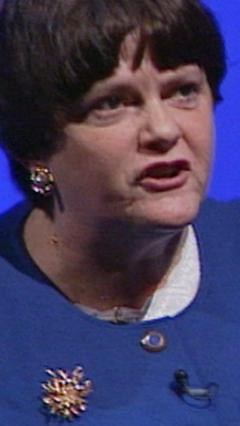
This was Ann Widdecombe in 2010. For weeks on end, millions of British citizens tuned in to Strictly Come Dancing to watch a former Shadow Home Secretary—a woman who had spent decades arguing about prison reform and economic policy—be spun around like a human top. She could not dance. She did not pretend she could dance. The judges were frequently horrified, throwing around single-digit scores and words like "disaster" and "culinary catastrophe."
Yet, the public kept voting for her. Week after week, the people saved her.
To understand why this happened is to understand a fundamental shift in how we consume personality, politics, and power. It was not a joke that went too far. It was a masterclass in the terrifying, brilliant weaponization of human vulnerability.
The Iron Lady of the Backbenches
Before the glitter, there was the grit. To those who grew up in the nineties and early two-thousands, Ann Widdecombe was a formidable, occasionally terrifying fixture of British public life. She was uncompromisingly socially conservative, fiercely articulate, and entirely unbothered by whether the media liked her or not. Her voice, a distinctive, high-pitched rasp, cut through the smooth, polished public relations veneer of modern parliament.
Imagine a world—no, imagine a specific boardroom in Westminster, cold and smelling of stale tea. In that room, politicians are terrified of saying the wrong word. They employ legions of advisors to sand down their rough edges. They want to appear perfect.
Widdecombe went the opposite way. Her rough edges were her armor.
She was famously dubbed "Doris Karloff" by her detractors. She opposed the legalization of various social reforms with a zeal that made opponents wince. She was traditional, dogmatic, and immovable. When she retired from parliament in 2010, everyone assumed she would fade into the quiet dignity of writing books or sitting on corporate boards.
Instead, she put on fake tan.
The Strategy of the Spectacle
There is a distinct form of courage in being willing to look ridiculous. Most public figures spend their entire lives building a fortress of dignity. They want us to see them as intelligent, capable, and superior.
When Widdecombe agreed to join Strictly Come Dancing, she knew she was entering an arena designed to strip that dignity away.
Consider what happens when a career politician falls over on live television. Normally, it is a career-ending humiliation. It becomes a meme. It symbolizes incompetence. But Widdecombe bypassed the risk by turning the incompetence into the main event.
Her partner, the smooth-stepping Anton Du Beke, realized early on that teaching her the technical mechanics of the foxtrot was a lost cause. Instead, he treated her like a prop in a comedic play. He spun her on her back. He dragged her across the floor by her wrists. In one memorable routine, she entered the stage from the ceiling, floating down like an pastel-colored angel of doom.
The judges, particularly the exacting Craig Revel Horwood, were unsparing. They looked at the performance through the lens of art, technique, and discipline. They saw an insult to the craft.
But the audience saw something else entirely. They saw someone who was willing to be bad at something in front of nine million people.
The Chemistry of Public Affection
Why do we love a beautiful failure more than a mediocre success?
There is a psychological comfort in watching someone fail spectacularly with a smile on their face. In a culture obsessed with optimization, wellness, and flawless execution, Widdecombe’s weekly routines were a chaotic relief. She was the antithesis of the modern influencer. She possessed no grace, no rhythm, and no desire to reform her ways.
Every time Craig Revel Horwood gave her a scathing review, the audience’s protective instinct kicked in. It became a battle between the elites and the ordinary viewer. The judges represented the gatekeepers—the people who tell you that you aren’t good enough, that your form is wrong, that you don't belong in the room. Widdecombe represented everyone who had ever felt clumsy at a wedding or terrified of a corporate presentation.
By voting for her, the public wasn't saying she was a good dancer. They were saying they preferred her authentic, joyful terrible-ness over the manufactured perfection of her younger, more agile competitors.
This was not a new phenomenon, but it was perhaps the moment the phenomenon became self-aware. It proved that in the modern entertainment economy, being memorable is infinitely more valuable than being good.
The Line Between Entertainer and Leader
But the real problem lies elsewhere. While it is easy to view this as a lighthearted chapter in television history, the implications for our broader culture were profound.
When a politician successfully transitions into an entertainer, something changes in the collective subconscious. The sharp edges of their policy positions begin to blur. It is difficult to remain deeply angry at someone's voting record when you have just watched them do the paso doble dressed as a matador while the audience roars with laughter.
Humor is a solvent. It dissolves scrutiny.
By making herself a figure of fun, Widdecombe did something her political arguments never could: she became universally liked, or at least universally tolerated. She became "Good Old Ann." The fierce social conservative who had defended some of the most rigid policies of her era was replaced by a lovable auntie who couldn't quite find the downbeat.
This transformation laid down a blueprint that others would follow. It demonstrated that the path to public redemption—or at least public relevance—did not require changing your views or apologizing for your past. It merely required a sense of humor and a willingness to perform.
The Final Bow
Eventually, the ride had to end. In week nine of the competition, the technical gap became too vast to ignore, and Widdecombe was voted off. She left not with a tearful apology, but with a wave and a sharp remark, entirely unchanged by the experience.
She had not learned to dance. She had not found a hidden passion for the tango. She had simply completed a job, executed a perfect piece of cultural theater, and walked away with her profile higher than it had been in decades.
Years later, she would use that revived profile to re-enter the political arena during the tumultuous Brexit years. The audiences who remembered her from the ballroom were suddenly listening to her again on the campaign trail. The yellow dress was gone, replaced by the familiar dark suits, but the connection had been forged.
We often think of television as an escape from reality, a place where the stakes are low and the glitter is harmless. But the stage is never just a stage. It is a laboratory where public affection is measured, tested, and weaponized. Ann Widdecombe did not need to win the trophy to win the game. She simply needed to make us look. And long after the final notes of the orchestra faded, the image of that canary-yellow dress remained, a stubborn reminder that in the theater of public life, a perfectly executed failure can be the greatest victory of all.