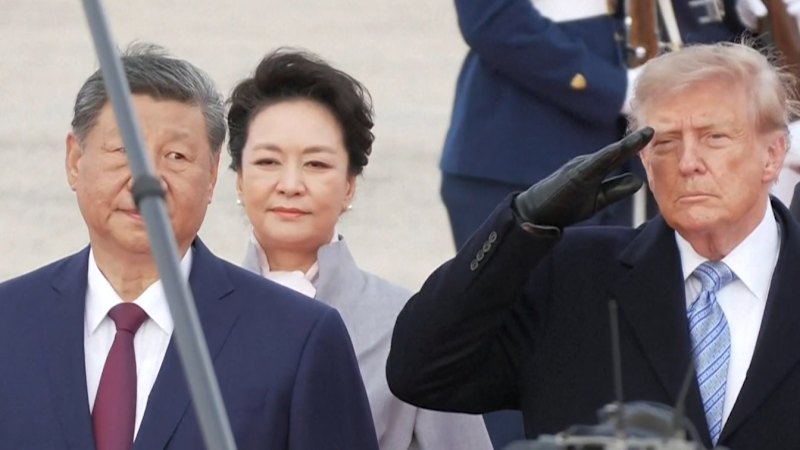
Diplomatic summits between the United States and China are frequently interpreted through the lens of immediate transactional outcomes: tariff adjustments, export quotas, or staged joint appearances. This analytical surface layer obscures the underlying structural reality. High-level bilateral meetings between Washington and Beijing function not as problem-solving mechanisms, but as structural management loops designed to regulate systemic friction between two interdependent yet structurally adversarial economic systems.
To understand the mechanics of these engagements, one must deconstruct the bilateral relationship into three distinct operational pillars: asymmetric interdependence, technological bifurcation, and strategic risk containment.
The Pillar of Asymmetric Interdependence and Trade Truces
The baseline economic architecture of the United States and China is defined by structural asymmetry. The American economy remains consumption-driven with deep capital markets, whereas the Chinese economy relies heavily on state-directed industrial policy, manufacturing capacity, and export surpluses. When bilateral friction escalates, both nations face unique economic cost functions.
For Washington, the cost function manifests as inflationary pressures, consumer price inflation, and supply chain vulnerability for critical components. For Beijing, the cost function centers on aggregate demand contraction, industrial overcapacity, and employment preservation in export-heavy coastal provinces.
Tariff truces and managed trade proposals, such as agricultural import targets or commercial aircraft procurement agreements, do not resolve structural imbalances. Instead, they serve as temporary economic stabilizers. These agreements lower the velocity of trade degradation, allowing domestic industries in both nations to adjust input costs without inducing macroeconomic shocks. The mechanism is purely palliative, designed to buy time while industrial strategies diverge.
The Cost Function of Technological Bifurcation
The primary driver of modern geopolitical friction is not traditional mercantile trade, but the competition for technological hegemony, specifically in artificial intelligence, semiconductor fabrication, and advanced computing infrastructure.
The economic cost function here is zero-sum. In legacy trade, mutual exchange generates comparative advantage. In frontier technology, market dominance yields systemic monopoly rents and military-industrial superiority. Consequently, standard diplomatic bargaining models fail. Compromise on core technological inputs implies structural surrender for whichever power falls behind in computing capacity or algorithmic scale.
Washington's policy relies on export controls and investment restrictions to preserve a technological lead, while Beijing accelerates indigenous substitution and alternative supply chains. Bilateral summits do not reconcile these objectives. Rather, they establish red lines and operational thresholds to prevent technological competition from cascading into kinetic conflict or catastrophic financial decoupling.
Strategic Risk Containment and Nuclear-Strategic Signaling
Beyond commerce and technology, bilateral engagements serve as a high-stakes signaling mechanism for regional and global security stability, encompassing maritime transit routes, sovereignty disputes, and multilateral flashpoints.
Strategic stability requires predictable communication channels to prevent miscalculation. In the absence of institutionalized trust, direct leader-level summits act as a makeshift deterrence backstop. When military assets operate in close proximity in contested zones, tactical misunderstandings carry systemic risk. The dialogue establishes a floor beneath the relationship, ensuring that tactical friction does not trigger unintended strategic escalation.
The Institutional Limitation
The fundamental limitation of superpower summits lies in their reliance on personal diplomacy rather than institutionalized enforcement. Agreements forged between individual leaders are vulnerable to domestic political cycles, electoral shifts, and legislative pushback within both capitals.
Without binding multilateral frameworks or verifiable enforcement mechanisms, bilateral understandings remain perpetually contingent on the immediate political utility they provide to each executive. As long as structural divergence remains the primary goal of both states, high-level diplomacy will function strictly as a volatility-suppression tool rather than a vehicle for enduring resolution.
Strategic Outlook
Future bilateral interactions will increasingly resemble managed competition rather than cooperative integration. Policymakers in both capitals will continue to decouple sensitive sectors while maintaining transactional engagement in non-strategic domains. The primary metric of success for any future summit is not the volume of signed commercial deals, but the absence of systemic escalation. Strategic stability will be maintained not through convergence of values or economic systems, but through a shared, calculated recognition of the prohibitive costs of open conflict.


