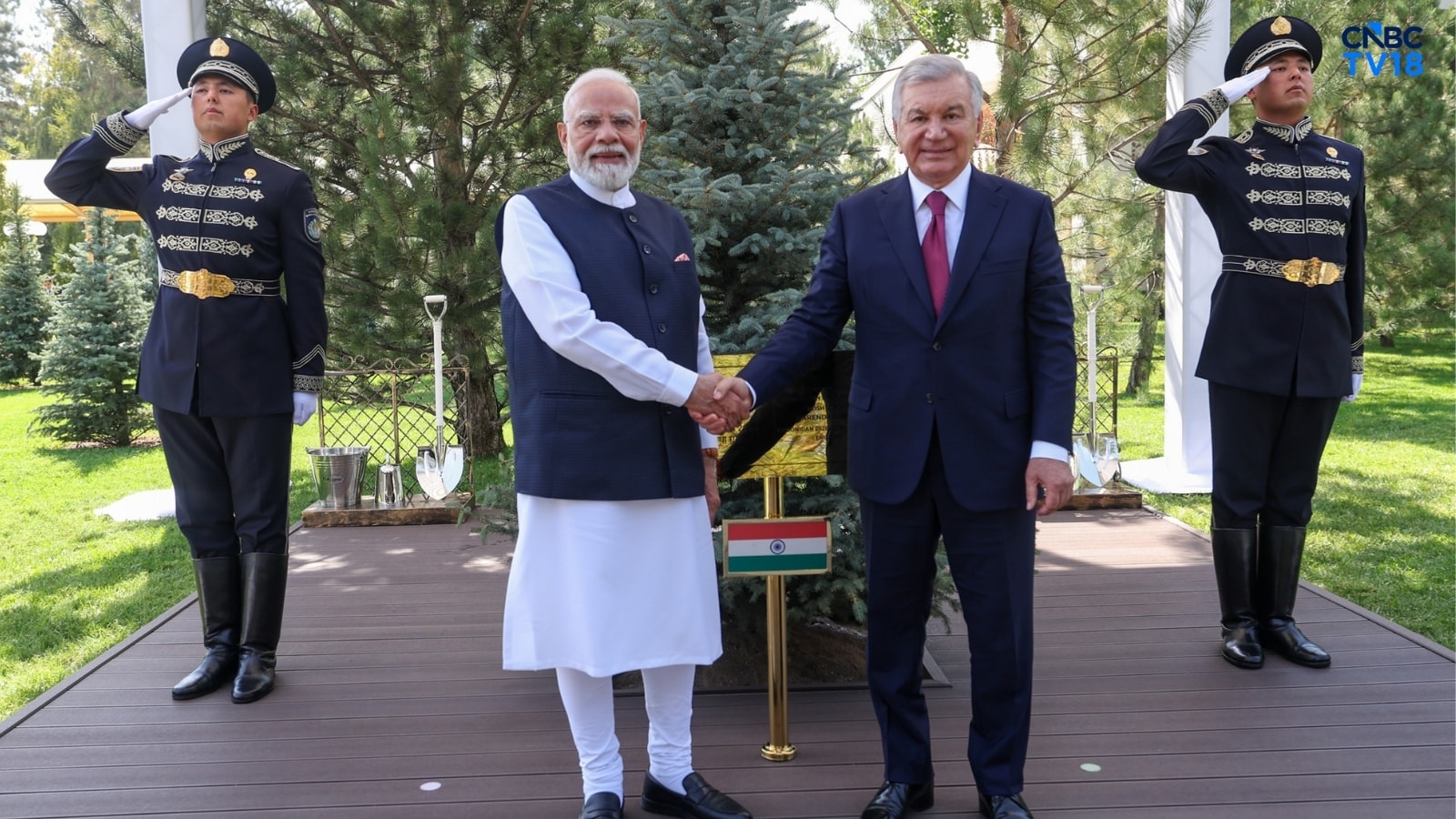
Prime Minister Narendra Modi’s recent state visit to Tashkent and the elevation of bilateral ties to a Comprehensive Strategic Partnership formalized a renewed framework for civil nuclear cooperation, specifically targeting long-term uranium procurement. While mainstream reporting treats such diplomatic communiqués as immediate commercial contracts, economic and operational realities dictate a much more complex transmission mechanism. Securing long-term fuel supplies from state-backed entities like Navoiyuran requires navigating intricate geopolitical constraints, long-term resource extraction cost curves, and stringent international non-proliferation oversight.
The Macroeconomic Architecture of Central Asian Fuel Procurement
India’s domestic nuclear power program operates under severe structural constraints regarding indigenous fuel availability. While the domestic Pressurised Heavy Water Reactor (PHWR) fleet relies on limited local reserves, scaling clean energy generation necessitates diversified foreign sourcing under International Atomic Energy Agency safeguards. Uzbekistan represents a critical node in the global uranium supply chain, holding top-tier recoverable resources largely extracted via cost-efficient In-Situ Recovery (ISR) methods.
The economic logic governing this bilateral arrangement rests on three distinct operational variables:
- Extraction Cost Advantage: Uzbek deposits, managed primarily through state structures like Navoiyuran, benefit from favorable geological formations in the Kyzylkum Desert that permit low-cost ISR extraction relative to conventional underground mining.
- Transit Logistics and Chokepoints: Landlocked geography forces any supply chain between Tashkent and nuclear fuel fabrication complexes in India to traverse multiple sovereign borders, introducing geopolitical and transit risk premiums.
- Regulatory Compliance and Safeguards: Civil nuclear trade requires rigid adherence to bilateral safeguards, tracking yellowcake from minehead to reactor core to satisfy international export control regimes.
Previous supply agreements, such as the multi-year contract executed for the 2022 to 2026 window, established baseline operational trust. The current framework intends to institutionalize this beyond short-term spot or medium-term purchase orders, shifting toward a predictable, multi-decade structural supply curve designed to feed India's expanding reactor fleet.
The Cost Function of Long-Term Nuclear Fuel Contracting
Evaluating the efficacy of this diplomatic outcome demands an analysis of the underlying cost function governing nuclear fuel supply agreements. Unlike spot markets for liquid hydrocarbons or dry bulk commodities, uranium transactions are dominated by long-term master contracts containing base-price mechanisms, market-price escalators, and volume-flexibility clauses.
When state entities sign Memoranda of Understanding or establish ministerial-level coordination councils to oversee critical mineral flows, they are essentially attempting to lower transaction costs and hedge against future market volatility. The cost function $C$ of procuring foreign uranium can be modeled as a function of extraction outlays ($E$), transit and insurance premiums ($T$), geopolitical risk adjustments ($G$), and regulatory compliance overhead ($R$):
$$C = f(E, T, G, R)$$
By establishing direct inter-governmental mechanisms and upgrading joint commissions to ministerial levels, both capitals seek to compress $G$ and $R$. Direct state backing mitigates the risk of export quota restrictions or sudden regulatory shifts, providing fuel buyers in New Delhi with predictable inventory scheduling. Simultaneously, Uzbek state enterprises secure a captive, high-volume consumer with sovereign creditworthiness, insulating their export revenues from spot price troughs.
Geopolitical Pressures and Regional Supply Integration
The strategic calculus extends far beyond bilateral trade ledgers. Central Asia is an arena of intense competition among major industrial powers seeking to lock down critical energy inputs and transition minerals. Other international stakeholders, including French and Japanese industrial consortia, maintain active joint ventures within Uzbekistan’s uranium sector.
Consequently, India's push for a formalized long-term arrangement is a defensive as well as an offensive maneuver. Without structural supply agreements, domestic utilities face exposure to global spot market spikes triggered by secondary supply contractions or geopolitical shocks. By anchoring procurement directly to Tashkent’s production expansion targets—which aim for significant output increases by 2030—New Delhi secures dedicated allocation ahead of rival industrial demand.
At the same time, physical connectivity remains a binding constraint. Surface transit routes from Central Asia to South Asia are encumbered by regional geopolitical frictions and mountainous topography. Resolving these bottlenecks requires parallel investments in digital payment rails, banking channel integration, and broader transport corridors to ensure that physical commodities and financial settlements move without friction.
To operationalize this comprehensive strategic partnership effectively, procurement agencies must transition away from rigid, single-source assumptions and implement a diversified portfolio model. Nuclear utilities should couple these long-term Uzbek state-to-state agreements with flexible spot-hedging strategies, while simultaneously investing in domestic fuel-cycle infrastructure optimization to maximize conversion and fabrication efficiency.