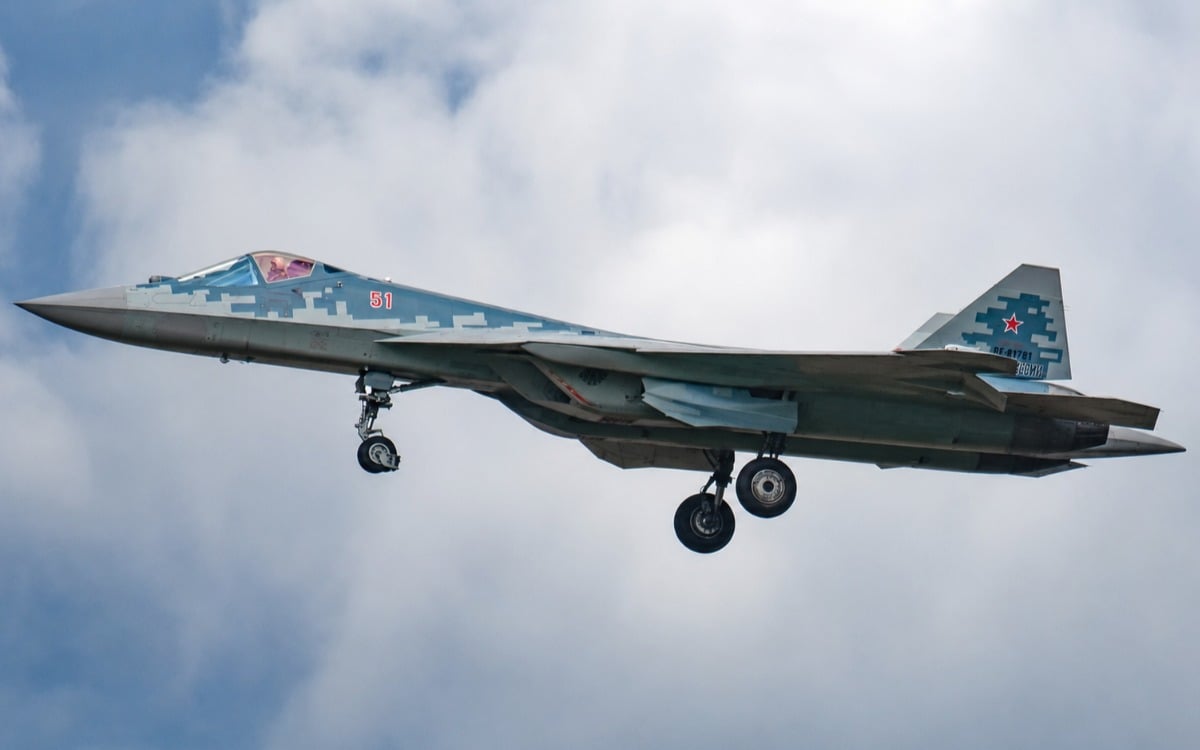
The operational reality of the Sukhoi Su-57 platform diverges fundamentally from its official characterization as a world-leading fifth-generation multirole fighter. While political rhetoric positions the aircraft as a peer competitor to Western platforms, domestic military analysts and defense bloggers inside the Russian Federation have increasingly highlighted severe engineering, supply chain, and doctrinal bottlenecks. Rather than assessing the platform through qualitative superlatives, an evaluation of its three core industrial pillars—low-observable engineering, propulsion maturity, and systemic microelectronic bottlenecks—reveals that the platform functions as an optimized fourth-generation derivative rather than a true fifth-generation asset.
This analytical deconstruction maps the specific variables preventing the Su-57 from achieving full operational capability, detailing the economic and technical trade-offs that have forced a reduction in procurement targets and undermined its viability as an export product.
The Low-Observability Formula and Aerodynamic Compromises
The primary metric separating fifth-generation aircraft from predecessor platforms is the reduction of the frontal Radar Cross Section (RCS). True low-observability relies on structural geometric alignment, internal weapons storage, and advanced Radar-Absorbing Materials (RAM). The Su-57 fails to optimize these variables due to a design philosophy that prioritizes hyper-maneuverability over absolute stealth.
The structural RCS equation can be modeled by analyzing the major radar scattering centers of the airframe:
$$RCS_{total} = RCS_{intakes} + RCS_{canopy} + RCS_{surface,discontinuities} + RCS_{nozzles}$$
In Western fifth-generation architectures, $RCS_{intakes}$ is minimized using an S-duct configuration that completely masks the highly reflective face of the engine compressor blades from forward-aspect radar illumination. The Su-57 utilizes a direct, straight-through intake duct design. While this maximizes airflow efficiency to sustain high thrust at extreme angles of attack, it exposes the engine face to incoming radar waves. Sukhoi attempts to mitigate this with a coaxial radar blockers mesh, but this is a secondary fix that yields an inferior attenuation profile relative to geometric masking.
The second major structural deficit lies in surface manufacturing tolerances. During close-up examinations of early-production models and prototypes at international exhibitions, significant variances in panel flushness, visible fasteners, and unshielded rivets were documented across the fuselage. In low-observable engineering, any gap or protruding fastener that exceeds a fraction of the operating radar's wavelength triggers surface wave scattering, effectively acting as a traveling-wave antenna that spikes the platform's overall RCS.
According to patents filed by Sukhoi designers, the expected frontal RCS of the aircraft sits between 0.1 and 1.0 square meters. For context, the F-35 maintains a frontal RCS estimated at roughly 0.001 square meters. This discrepancy means the Su-57 is detectable by modern Active Electronically Scanned Array (AESA) radars at ranges that nullify the tactical advantages of its beyond-visual-range missile systems.
Propulsion Evolution and the Izdeliye 30 Bottleneck
A defining requirement for fifth-generation classification is supercruise: the capacity to maintain sustained supersonic flight without the use of fuel-inefficient afterburners. This capability depends on the specific fuel consumption and dry thrust limits of the propulsion architecture.
[AL-41F1 Engine (Stage 1)] ---> Interim Solution: High IR Signature, Low Dry Thrust
                                      |
                                      v
[Izdeliye 30 (Stage 2)]   ---> Target Standard: Flat Nozzles, Supercruise Capable (Delayed)
The operational fleet relies primarily on the NPO Saturn AL-41F1 (Izdeliye 117) turbofan. This powerplant is an iterative evolution of the Su-35S engine, not a clean-sheet design. The technical limitations of the AL-41F1 split into two distinct categories:
- Thermodynamic Limitations: The engine lacks the turbine entry temperature thresholds required to achieve a dry thrust output capable of sustaining supercruise under combat payloads.
- Infrared (IR) Signature Management: The engine features conventional, circular, articulating thrust-vectoring nozzles with completely exposed metallic components. Unlike the F-22's two-dimensional flat nozzles, which mix hot exhaust gases with cooler ambient air rapidly via uncooled convergent-divergent flaps, the Su-57's round nozzles create a massive, unshielded thermal plume. This makes the aircraft highly vulnerable to long-range Infrared Search and Track (IRST) sensors and modern dual-band imaging infrared air-to-air missiles.
The intended definitive solution is the Izdeliye 30 engine, designed to feature serrated, low-observable nozzles, higher compression ratios, and a 19% improvement in thrust-to-weight ratio. However, serial integration has faced severe development delays. Russian military commentators have noted that testing cycles for the new engine have run concurrently with airframe assembly, creating an asynchronous production line where aircraft are delivered with obsolete propulsion baselines. The delay in the Izdeliye 30 deployment fundamentally breaks the platform's performance model, turning the current inventory into an expensive, sub-optimal bridge architecture.
The Microelectronic Supply Chain and Sensor Integration
The combat capability of a modern fighter is determined by its network-centric warfare integration and electronic warfare self-defense suites. The Su-57 integrates the Sh121 multifunctional radio-electronic system, which includes the N036 Byelka AESA radar system alongside the L402 Himalayas electronic countermeasures suite.
The system is designed to use five distinct AESA arrays: three X-band arrays (one nose-mounted, two cheek-mounted for wide-angle scanning) and two L-band arrays integrated into the wing leading edges. The L-band arrays serve a dual purpose: identification friend-or-foe (IFF) tracking and target acquisition of enemy stealth assets, exploiting the physical reality that radar-absorbent coatings optimized for X-band tracking lose efficiency against longer L-band wavelengths.
The structural bottleneck for this architecture is the supply chain for high-frequency Gallium Arsenide (GaAs) or Gallium Nitride (GaN) transmit-receive modules. International trade restrictions and strict technology-transfer sanctions have directly choked Russia’s domestic semiconductor fabrication capabilities.
The manufacturing yield rate for high-purity monolithic microwave integrated circuits (MMICs) within Russia remains critically low. Consequently, production facilities face a binary choice: rely on illicit parallel import networks for civilian-grade components that lack industrial thermal hardening, or manually assemble modules at a pace that prevents mass factory output.
This microelectronic deficit ripples across the platform's avionics. Domestic defense critics have pointed out that the sensor-fusion capabilities of the Su-57 do not achieve real-time, algorithmic processing parity with peer platforms. Data streams from the distributed radar arrays, the nose-mounted OLS-50M optical-electronic tracking system, and the electronic warfare suite must be integrated into a unified tactical picture for the pilot. Without high-throughput, domestic military-grade processors, the system experiences latency, increasing the cognitive load on the operator and slowing down the engagement cycle in high-intensity combat zones.
Fleet Scalability and Market Rejection
The macro-economic viability of any military aerospace program depends on scale. High fixed costs associated with research, development, testing, and evaluation (RDT&E) must be amortized over a large volume of production units to lower the per-unit flyaway cost.
$$Unit,Cost = \frac{Fixed,RDT&E,Costs}{Total,Volume} + Marginal,Production,Cost$$
The Russian Aerospace Forces (VKS) originally intended to procure hundreds of fifth-generation aircraft. This target was scaled back to a contract for 76 units to be delivered through 2028. Real production rates have consistently tracked behind schedule due to factory optimization delays at the Komsomolsk-on-Amur Aircraft Plant (KnAAPO). The destruction of an early-production model during its initial factory flight trials in 2019, followed by combat infrastructure vulnerabilities—including a documented long-range drone strike that damaged an airframe on the ground at Akhtubinsk—has further constricted the operational fleet size. Currently, the frontline inventory is estimated to be fewer than 25 fully mission-capable aircraft.
Because domestic procurement volume is insufficient to drive down unit costs, foreign military sales are necessary to sustain the program's financial viability. Here, the Su-57 has faced market failure.
The primary co-development partner, India, officially withdrew from the Fifth Generation Fighter Aircraft (FGFA) program in 2018. The Indian Air Force cited explicit structural failures in the design: specifically, unsatisfactory stealth performance, structural deficiencies in the radar housing, and the failure of the Russian defense industrial base to deliver a functioning next-generation engine within the agreed timeline.
Without a Tier-1 export partner to inject capital, Sukhoi cannot fund the re-tooling needed for high-rate serial production. The program is caught in an industrial loop: low production volume keeps unit costs prohibitively high, while high costs and unfulfilled technological milestones prevent the acquisition of export contracts that could subsidize manufacturing improvements.
Doctrinal Realignment and Strategic Outlook
The technical deficits of the Su-57 have forced a significant shift in how the platform is used. Rather than deploying the fighter for deep-penetration strikes or offensive counter-air missions inside dense enemy integrated air defense networks—roles for which it lacks the necessary low-observability—the VKS has adapted it into a standoff launch platform.
Operational tracking indicates that Su-57 missions are conducted almost exclusively within domestic airspace or heavily protected radar corridors. The aircraft is utilized as a high-speed, high-altitude delivery system for long-range precision-guided munitions, such as the Kh-59MK2 radar-guided standoff missile and the Kh-47M2 Kinzhal hypersonic missile variant. By launching weapons from positions deep behind the frontline, the VKS leverages the airframe's kinematic performance—its speed and altitude ceiling—while deliberately isolating its deficient radar and thermal signatures from direct engagement with adversary air defenses.
This deployment pattern confirms the criticisms raised by domestic military analysts: the platform is not being operated as a true fifth-generation asset. It functions instead as a highly specialized, low-volume extension of Russia's existing fourth-generation strike inventory. The long-term trajectory of the program will not be defined by political declarations of technological superiority, but by the raw industrial capacity to secure sanctioned microelectronics and successfully transition to the Izdeliye 30 engine. Until these two manufacturing bottlenecks are resolved, the Su-57 will remain an isolated, boutique capability rather than a scalable tool for regional air superiority.