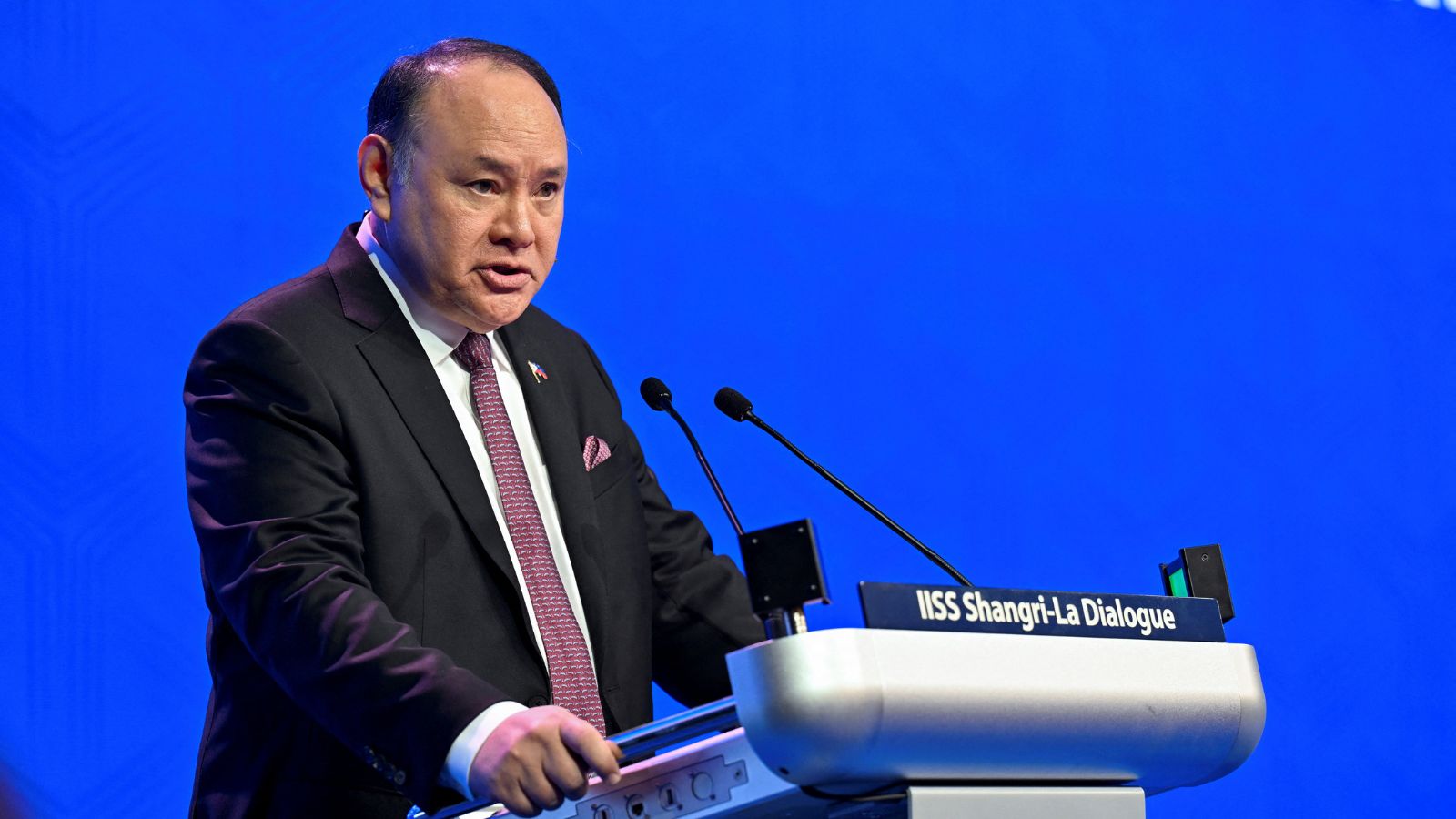
Public diplomacy in contested maritime spaces typically relies on calculated ambiguity, diplomatic channels, and carefully managed communiqués. When a defense official publicly abandons standard diplomatic euphemisms and demands public accountability from a regional hegemon on an international stage, it signals a distinct shift in signaling theory. This rupture in traditional protocol is not merely a rhetorical outburst; it is a calculated recalibration of deterrence. By moving dispute resolution from closed rooms to open forums, smaller states alter the political cost function of aggressive maritime expansion.
Understanding this shift requires analyzing the structural asymmetry of the South China Sea disputes. On one side stands a claimant with vastly superior economic, industrial, and naval mass. On the other side are littoral states whose military capabilities cannot match the absolute tonnage or missile density of the adversary. Traditional realist frameworks predict compliance or quiet bilateral accommodation in the face of such imbalances. Yet, recent Philippine defense posture demonstrates an alternative mechanism: asymmetric reputation management.
The strategic doctrine underpinning this public confrontation rests on three distinct operational pillars. First, the internationalization of domestic maritime grievances. By airing operational harassment—such as water cannon usage, laser painting, and blockade tactics—in multilateral venues like the Shangri-La Dialogue, Manila converts bilateral naval friction into a global credibility test for the aggressor. Second, the raising of diplomatic exit costs. When accusations are leveled on a global stage with named specificity, the accused power faces a binary choice between escalation that validates the critique or de-escalation that signals weakness to domestic nationalist audiences. Third, the reinforcement of alliance commitments through public visibility. Mutual defense treaties require operational clarity; public confrontations test the boundaries of those commitments under the harsh light of international scrutiny.
The calculus of maritime coercion depends heavily on the visibility of gray-zone tactics. Gray-zone operations—actions designed to achieve strategic objectives incrementally without crossing the threshold of conventional armed conflict—thrive in the shadows. Coast guard harassment, maritime militia blockades, and unilateral fishing bans rely on the assumption that individual incidents are too minor to trigger collective defense guarantees or sustained international outrage.
When a defense secretary publicly demands shame from a major power, he systematically disrupts this operational environment. The objective is illumination. By documenting and broadcasting the friction points of gray-zone warfare, the smaller state forces third-party guarantors and regional observers to acknowledge a continuous stream of violations rather than isolated incidents. This alters the adversary's cost-benefit calculation. The utility of low-intensity maritime pressure diminishes if the reputational damage at international forums outweighs the localized territorial gains.
Economic interdependence further complicates this strategic environment. The aggressor nation relies on regional stability to maintain supply chain security and favorable diplomatic optics within Southeast Asia. Open confrontations that expose aggressive behavior undermine regional economic pacts and harden the resolve of neighboring states within the Association of Southeast Asian Nations. While economic leverage gives the larger power significant bilateral sway, public shaming creates a collective action problem. It encourages smaller nations to align their diplomatic narratives, transforming fragmented bilateral disputes into a unified regional challenge regarding freedom of navigation.
To evaluate the long-term viability of this public deterrence strategy, analysts must examine the domestic political feedback loops within both nations. In the target state, aggressive foreign policy is often fueled by state-controlled media and intense nationalistic sentiment. Public rebukes from foreign officials complicate the domestic narrative, forcing state media to either ignore the challenge—risking perceived weakness—or overreact, which validates the target's framing of an aggressive regional hegemon.
Conversely, domestic politics in the challenging state dictate a parallel set of constraints. A defense leadership must demonstrate unyielding resolve to satisfy domestic audiences concerned with sovereign integrity and maritime resource rights. Public confrontation serves an internal signaling function just as much as an external one. It aligns public expectations with hardline policy, creating political capital that can be leveraged to sustain long-term modernization programs and alliance-building efforts.
The operational friction in contested waters is ultimately governed by rules of engagement and the threshold of kinetic action. Maritime law enforcement agencies, rather than formal navies, frequently execute the frontline maneuvers. This creates a structural ambiguity regarding escalation dominance. Coast guard vessels possess different legal authorities and weapon configurations than warships, allowing larger states to exert pressure while formally operating below the threshold of war.
When officials challenge this dynamic on international stages, they attempt to collapse the distinction between coast guard harassment and state-sponsored aggression. By attributing tactical actions directly to central government policy, the rhetoric strips away the plausible deniability inherent in gray-zone operations. The adversary is forced to own the operational consequences of its maritime militia and coast guard deployments, turning ambiguous tactical maneuvers into explicit strategic liabilities.
Sustaining this approach requires more than sharp rhetoric; it demands institutional backing, intelligence sharing, and persistent capability development. Public accusations lose their efficacy if they are not supported by unassailable sensor data, radar logs, and high-resolution visual evidence. The shift toward transparency in maritime reporting acts as an evidentiary anchor, ensuring that rhetorical demands for accountability are anchored in verifiable reality.
As regional competition intensifies, the reliance on public diplomatic friction will likely become a permanent fixture of asymmetric statecraft. The traditional playbook of quiet diplomacy, designed in an era of asymmetric bilateral negotiations, proves insufficient when faced with persistent, incremental expansionist tactics. By redefining the dispute as a global test of adherence to international norms, smaller claimant states construct a protective diplomatic architecture that compensates for conventional military deficits.
The strategic imperative moving forward requires institutionalizing this visibility. Defense planners must integrate strategic communications directly into naval and coast guard operations, ensuring that every tactical encounter is instantly processed, verified, and integrated into a broader diplomatic campaign. The primary objective remains preventing conflict through the relentless elevation of its political and reputational costs.