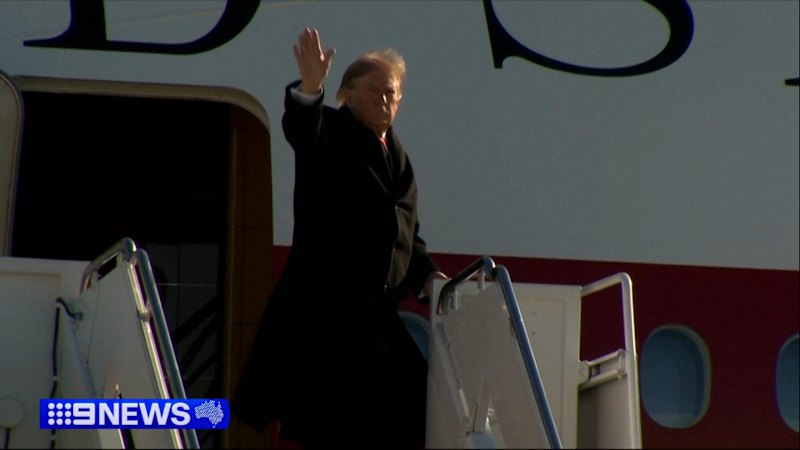
A presidential arrival in Manila functions as an immediate stress test of Indo-Pacific deterrence, alliance credibility, and domestic political survivability. When Donald Trump lands at Villamor Air Base or Ninoy Aquino International Airport, the physical touchdown is merely the visible surface of a high-stakes geopolitical transaction between Washington and the Republic of the Philippines. Standard diplomatic coverage treats these arrivals as ceremonial milestones or personality-driven spectacles. In operational reality, a U.S. executive visit to the Philippine capital operates as a precise signaling mechanism aimed at Beijing, a liquidity injection for bilateral defense frameworks, and a domestic political lever for Malacañang.
To understand the mechanics of this event, one must strip away diplomatic pageantry and examine the underlying strategic architecture. The bilateral relationship rests on the 1951 Mutual Defense Treaty (MDT), yet treaties are inert documents without continuous political validation. A physical visit by an American president converts abstract security guarantees into tangible geopolitical posture.
The Three Pillars of Presidential Signaling in the Philippine Archipelago
Every executive touchdown in Manila executes three distinct strategic functions simultaneously. Failure to execute any single pillar degrades the value of the entire deployment.
1. Geographic Deterrence and the First Island Chain
The Philippines occupies the central geographic hinge of the First Island Chain, separating the South China Sea from the wider Philippine Sea and the Pacific Ocean. From a purely military standpoint, control over the Luzon Strait—the maritime chokepoint between northern Luzon and Taiwan—dictates naval and aerial access for any regional conflict. When a U.S. president physically enters this theater, the administration signals to the People’s Liberation Army (PLA) that Washington views the archipelago not as a peripheral partner, but as an active forward operating perimeter. This physical presence raises the perceived cost of gray-zone coercion around Second Thomas Shoal, Scarborough Shoal, and Sabina Shoal.
2. Alliance Reassurance Under Transactional Doctrine
Donald Trump’s foreign policy framework relies heavily on transactional reciprocity and burden-sharing metrics. Allies frequently experience anxiety regarding whether traditional collective security guarantees remain unconditional under an "America First" doctrine. Landing in Manila serves as an explicit reassurance mechanism. By investing presidential time—the scarcest resource in U.S. statecraft—in the Philippines, the White House demonstrates that Manila meets Washington’s threshold for strategic return on investment. The visit confirms that the Enhanced Defense Cooperation Agreement (EDCA) sites, which grant U.S. forces rotational access to key Philippine military bases, remain protected executive priorities.
3. Domestic Political Calibration for Malacañang
For the Philippine administration, hosting a U.S. president carries immediate domestic consequences. Philippine politics operates through complex patronage networks and competing elite factions, often split between pro-Washington security establishments and economic pragmatists who favor accommodation with Beijing. A high-profile arrival strengthens the hand of the Philippine executive branch against domestic critics by projecting international backing. Simultaneously, it forces Malacañang to manage public expectations regarding economic deliverables, ensuring that security alignment does not appear to come at the expense of bilateral trade or overseas Filipino worker protections.
The Operational Cost Function of Executive Diplomacy
Deploying a U.S. president to Southeast Asia requires absorbing substantial logistical, financial, and political costs. Strategists evaluate the success of the touchdown against an implicit cost function where expected strategic yield must exceed operational expenditure.
- Security Footprint and Airspace Disruption: An executive arrival requires the temporary sanitization of Manila’s commercial airspace, the deployment of U.S. Secret Service advance teams, and the integration of Armed Forces of the Philippines (AFP) perimeter units. This creates immediate economic friction in Metro Manila through traffic lockdowns and commercial flight delays, generating localized public frustration that local media inevitably amplifies.
- Diplomatic Opportunity Cost: Every hour spent in bilateral meetings in Manila represents time diverted from domestic legislative priorities or competing global theaters such as Eastern Europe or the Middle East. If the visit produces only rhetorical communiqués rather than binding defense procurement or trade frameworks, the net diplomatic yield turns negative.
- Escalation Risk in the West Philippine Sea: High-visibility U.S. executive presence frequently triggers reactive posturing from Beijing. Historical precedent indicates that the China Coast Guard and maritime militia often intensify water-cannon deployments, laser illuminations, or blockade maneuvers immediately preceding or following major U.S.-Philippine summits to demonstrate local escalation dominance.
Cause-and-Effect Chains in Bilateral Security Frameworks
Standard reporting often isolates the presidential arrival from the bureaucratic machinery that precedes and follows it. In practice, the touchdown acts as a forcing function for stalled interagency processes across both governments.
The EDCA Acceleration Mechanism
Months before Air Force One touches down, defense ministries in both capitals accelerate infrastructure approvals to ensure deliverables are ready for presidential announcement. Under the Enhanced Defense Cooperation Agreement, Washington funds runway extensions, fuel storage facilities, and command centers at designated Philippine bases—including locations in Cagayan and Palawan that face Taiwan and the South China Sea, respectively. The impending arrival forces Philippine local government units and national agencies to resolve land-use bottlenecks and environmental clearances that would otherwise stall for years.
Foreign Military Financing and Force Modernization
The Philippines is currently executing Horizon 3 of its Revised AFP Modernization Program, shifting its military doctrine from internal counterinsurgency to external territorial defense. A U.S. presidential visit catalyzes the release of Foreign Military Financing (FMF) and Excess Defense Articles. The cause-and-effect sequence is direct: the presidential summit creates the political cover necessary for the U.S. Congress to approve multi-year funding packages, which in turn enables Manila to acquire multi-role fighter aircraft, coastal radar systems, and shore-based anti-ship missile batteries.
Economic Linkage and Supply Chain Resilience
Security guarantees alone cannot sustain a modern alliance. Under a Trump administration focused on tariffs, trade deficits, and reshoring, Manila faces acute pressure to prove its economic utility beyond geography. The arrival forces Philippine economic managers to present concrete proposals regarding critical mineral processing—specifically nickel and cobalt—and semiconductor assembly. By framing the Philippines as a secure node in non-Chinese supply chains, Manila attempts to insulate itself from broad-spectrum U.S. tariff regimes.
Separating Known Facts from Geopolitical Hypotheses
Rigorous analysis requires maintaining a strict boundary between documented operational realities and speculative diplomatic outcomes.
Established Facts:
- The 1951 Mutual Defense Treaty remains the legal foundation of the alliance, explicitly covering armed attacks on metropolitan territory, island territories under jurisdiction, or armed forces, public vessels, and aircraft in the Pacific.
- The U.S. maintains rotational access to nine EDCA sites across the Philippine archipelago, expanding from the original five agreed upon in 2014.
- Bilateral maritime cooperative activities—joint naval patrols involving the U.S. Navy, the Philippine Navy, and often third-party allies like Japan or Australia—have transitioned from sporadic exercises to regularized operational deployments.
- Trump’s prior engagements with Philippine leadership demonstrated a willingness to bypass traditional diplomatic protocols in favor of direct, leader-to-leader negotiations, often downplaying human rights critiques in exchange for strategic alignment.
Educated Hypotheses:
- Hypothesis on Tariff Exemptions: Manila will likely seek sector-specific exemptions from U.S. universal baseline tariffs by offering preferential access to Philippine critical mineral reserves. Whether Washington grants these exemptions depends entirely on whether the White House prioritizes trade deficit reduction over Indo-Pacific alliance cohesion.
- Hypothesis on MDT Activation Thresholds: While U.S. officials routinely state that the MDT commitment is "ironclad," the exact operational threshold for U.S. kinetic intervention in a gray-zone incident—such as a collision involving a Philippine resupply vessel at Ayungin Shoal—remains deliberately ambiguous. A Trump visit is unlikely to eliminate this strategic ambiguity, as preserving executive discretion aligns with his negotiating style.
- Hypothesis on Trilateral Integration: The visit will likely reinforce the U.S.-Japan-Philippines trilateral framework, utilizing Tokyo’s financial and infrastructure capacity to offset U.S. fiscal constraints in the region.
Limitations of High-Level Executive Diplomacy
Relying on presidential summits to manage complex geopolitical rivalries introduces structural vulnerabilities. No single diplomatic visit resolves the underlying asymmetries in the South China Sea.
First, executive attention is episodic, while Chinese pressure is continuous. A U.S. president spends 24 to 48 hours in Manila before departing for other global priorities. Beijing’s maritime militia and Coast Guard operate in the West Philippine Sea 365 days a year. Once the media cycle moves on, the tactical burden of contesting maritime features reverts entirely to the Philippine Coast Guard and Navy, which remain vastly outmatched in tonnage and hull counts.
Second, transactional alliances suffer from reversal risk. Agreements anchored heavily in personal rapport between two executives lack institutional durability if domestic political winds shift. In the Philippines, constitutional term limits restrict the president to a single six-year term, creating predictable cycles of foreign policy realignment every six years. Similarly, shifts in Washington’s executive branch can alter funding priorities overnight.
Third, economic asymmetry favors Beijing in non-security sectors. Despite strengthening defense ties with Washington, China remains one of the Philippines' largest trading partners and sources of imported goods. U.S. private sector investment in Philippine infrastructure has historically lagged behind state-backed Asian competitors due to regulatory hurdles, high electricity costs, and constitutional restrictions on foreign ownership in the Philippines. A presidential visit cannot instantly rewrite domestic commercial law or compel private American capital to enter high-friction markets.
Strategic Execution for Bilateral Stakeholders
To convert the momentum of a presidential touchdown in Manila into durable strategic advantage, decision-makers on both sides must bypass symbolic communiqués and execute three concrete operational adjustments.
- Institutionalize Logistics Over Exercises: Move beyond high-visibility joint naval sails and focus capital expenditure on pre-positioned munitions, fuel depots, and distributed repair facilities across northern Luzon and Palawan. Deterrence relies on sustainment capacity during a protracted blockade, not photo opportunities during peacetime.
- Bind Trade Access to Defense Infrastructure: Washington should establish a dedicated Indo-Pacific tariff-relief mechanism specifically for treaty allies that host forward-deployed infrastructure and secure critical mineral supply chains. This aligns Trump’s economic nationalism directly with Pentagon force-posture requirements.
- Establish Automated Gray-Zone Response Protocols: Rather than waiting for executive intervention during maritime crises, both defense departments must pre-authorize standardized, proportional responses to specific coercive actions—such as automated intelligence sharing, immediate deployment of unmanned surface vessels, and synchronized diplomatic sanctions—ensuring deterrence functions autonomously long after Air Force One leaves Manila airspace.



