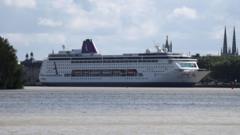
The headlines are predictable. They are almost mechanical. "Over 1,000 Passengers Trapped in Floating Petri Dish." "Luxury Cruise Becomes Biohazard." The media loves a shipboard outbreak because it offers a contained, cinematic version of a disaster. It’s easy to write. It’s even easier to click on.
But if you actually understand epidemiology and the logistics of mass tourism, you know the hysteria is a lie.
The recent reports of massive gastrointestinal outbreaks on high-capacity vessels aren't evidence of a failing industry or "dirty" ships. They are evidence of a hyper-vigilant reporting system that doesn’t exist anywhere else in the travel sector. You aren't "safer" at a five-star resort in Cancun or a music festival in Indio; you are just less likely to see those illnesses recorded in a federal database.
It’s time to stop blaming the buffet and start looking at the math.
The Reporting Bias That Scares You
The Centers for Disease Control and Prevention (CDC) operates the Vessel Sanitation Program (VSP). Under this program, cruise ships are legally required to report every single case of diarrhea or vomiting that hits their infirmary if the total reaches even 3% of the population.
Think about your office. Think about your kid’s school. Think about the last hotel you stayed at. If 3% of the people in a Marriott got a stomach bug, do you think the local news would lead with it? Would the hotel be forced to log every incident in a public, searchable government database?
Absolutely not.
Cruise ships are the only vacation venues on the planet where health transparency is mandatory. This creates a "glass house" effect. We see the cracks because the walls are transparent, while every other sector of the hospitality industry is hidden behind a brick wall of privacy laws and lack of oversight. When you read about 1,000 sick passengers, you aren't seeing a uniquely dangerous environment. You are seeing the only environment where the truth is actually counted.
The Myth of the Dirty Ship
The "lazy consensus" says that outbreaks happen because cruise ships are unsanitary.
The reality? Cruise ships are likely the cleanest environments you will ever inhabit. I have spent years observing the operational side of maritime hospitality. A modern cruise ship is scrubbed with hospital-grade disinfectants—Virex, Oxivir, and high-concentration bleach solutions—multiple times a day. Every handrail, elevator button, and slot machine handle is sanitized on a schedule that would make a surgical suite look neglected.
The problem isn't the ship. It’s the guests.
Norovirus—the most common culprit—is incredibly hardy. It can survive on a surface for weeks. It is resistant to many standard alcohol-based hand sanitizers. It takes as few as 18 viral particles to infect a human. For context, a single gram of infected feces can contain five billion particles.
When an outbreak occurs, it is almost always "patient zero" bringing it from the airport, the pre-cruise hotel, or the shuttle bus. The ship is just the unlucky host. By the time the crew realizes someone is sick, that person has already touched three tongs in the buffet and a dozen buttons in the elevator. The ship isn't a breeding ground; it's a high-frequency touch-point environment.
Stop Washing Your Hands (With Just Gel)
The cruise industry has spent millions "leveraging"—to use a word I despise—hand sanitizer stations at every doorway. It’s theater.
If you want to survive a cruise without spending three days in your cabin hugging a porcelain bowl, you need to understand the chemistry. Norovirus is a non-enveloped virus. This means it lacks a lipid membrane that alcohol can easily dissolve. While high-percentage alcohol rubs can kill some bacteria and "enveloped" viruses like the flu, they are notoriously ineffective against the "stomach flu."
The only way to actually protect yourself is mechanical removal. Soap and water. Friction.
The industry pushes sanitizer because it’s fast and keeps the lines moving. If you rely on it, you are essentially gambling with your gut. The "unconventional" advice here is actually the most basic: ignore the gel dispenser and walk to the bathroom. Scrub for twenty seconds. The goal isn't to kill the virus; it's to rinse it off your skin and down the drain.
The Economics of Quarantine
Why does the media focus on the "1,000 passengers held" narrative? Because "quarantine" sounds like a prison sentence.
In reality, the cruise line is the one losing money. When a ship goes into "Red Level" sanitization, the costs skyrocket.
- Labor costs: Crew members are pulled from their regular duties to perform deep-cleans every 30 minutes.
- Revenue loss: Buffets are switched to full-service, slowing down the "churn" of the ship and increasing waste.
- Brand damage: One viral tweet of a passenger complaining about being "trapped" costs millions in future bookings.
Cruise lines don't "allow" outbreaks. They are terrified of them. The idea that ships are cutting corners on hygiene to save money is a fundamental misunderstanding of their business model. A sick ship is an unprofitable ship. Period.
The "Petri Dish" Fallacy
People love to call cruise ships petri dishes. It’s a convenient metaphor that ignores how diseases actually spread in the 21st century.
If you want to find a real petri dish, go to a major international airport. Thousands of people from hundreds of different geographic locations, all touching the same kiosks, sitting in the same cramped seats, and breathing recycled air. But we don't call airports petri dishes because we spend four hours there, not seven days.
The length of stay on a cruise ship is what allows the incubation period of a virus to play out. If you catch Norovirus at an airport, you get sick at home. You blame the "taco place down the street." If you catch it at the airport and then board a ship, you get sick on Day 3. You blame the ship.
This is a classic case of post hoc ergo propter hoc—"after this, therefore because of this." We confuse the location of the symptoms with the source of the infection.
Why We Should Demand More Outbreaks (On Land)
Here is the contrarian take that people hate: We need the rest of the world to be as "dangerous" as cruise ships.
If hotels, theme parks, and malls were forced to report their illness rates with the same transparency as the Royal Caribbean or Carnival fleets, the data would be staggering. We would realize that gastrointestinal illness is an omnipresent tax on human movement.
By singling out the maritime industry, we allow land-based operators to remain lazy. We allow restaurants to slide on hand-washing protocols because there is no CDC-level "Vessel Sanitation Program" for the local bistro.
The cruise industry is the gold standard for public health tracking. They catch outbreaks early, they mitigate them aggressively, and they report them honestly. Shaming them for "allowing" an outbreak is like shaming a hospital for having sick people in it.
The Brutal Reality of Mass Travel
If you are terrified of Norovirus, don't go on a cruise. But also: don't go to the movies, don't go to a wedding, and definitely don't send your children to daycare.
The "status quo" of travel reporting wants you to believe that a cruise is a unique risk. It isn't. It’s a unique transparency.
When you see a headline about 1,000 sick passengers, don't think "What a disgusting ship." Think "I wish the hotel I stayed at last month was this honest about why half the guests were missing from the pool on Tuesday."
The risk of illness is the price of admission for living in a globalized society. You can either hide in your house or you can wash your hands with soap, skip the communal tongs, and accept that sometimes, the "petri dish" is just the place where we finally bothered to count the germs.
Stop reading the headlines and look at the denominator. Out of millions of passengers who sail every year, the percentage who get sick is statistically tiny. You are more likely to get injured in the car ride to the port than you are to be one of those 1,000 "trapped" passengers.
But "Man Drives Safely to Pier" doesn't sell ads. "Biohazard at Sea" does.
Pick your risks based on data, not drama.
_