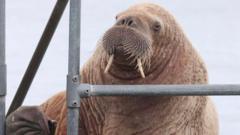
You see a crowd gathering on a slipway. Phones are held high, fingers twitching on camera buttons, and people are pushing their way to the front. They are desperate for a photo. There is a massive, blubbery creature hauled out on the concrete, looking utterly exhausted. That is the scene that plays out whenever a wayward walrus decides the Scottish coast is the place to stop and rest.
It sounds like a magical wildlife encounter. It isn't. It is a desperate struggle for survival.
When you see a walrus on a British beach, you are not witnessing a fun, quirky tourist attraction. You are watching an animal that is likely sleep-deprived, malnourished, and completely out of its element. This animal has traveled hundreds, maybe thousands, of miles away from its Arctic home. It needs sleep more than it needs your social media engagement.
The Reality Of A Displaced Arctic Visitor
Walruses are marine mammals that rely on sea ice. They use it as a platform for resting, calving, and foraging in the shallower waters that provide their food. When that ice disappears, they have a massive problem. Climate change is shrinking their natural environment at an alarming rate. This forces these animals to swim vast distances just to find food, and then they have to haul themselves out onto land or rocks to catch up on rest.
They aren't "visiting" Scotland for a holiday. They are lost.
When a walrus shows up on a Scottish island or a remote beach, it is usually because it pushed itself to the brink of physical collapse. They need to spend days, sometimes weeks, resting to regain the energy required for the long swim back to their Arctic range. During this time, they are incredibly vulnerable. They are not built to move well on land, and they are easily stressed by loud noises, sudden movements, and, most importantly, people.
Why The Selfie Craze Is Actually Lethal
I see people sharing photos of themselves standing dangerously close to these animals. They think they are being respectful because they aren't touching them. That is a dangerous misconception.
A walrus that is constantly disturbed by humans will never get the deep sleep it needs. It will stay in a state of high alert. Every time a dog barks, a child runs, or a crowd cheers, the walrus burns precious calories in stress responses. For a creature that has already depleted its fat reserves during a long migration, this extra stress can be the difference between survival and death.
If you crowd an animal, it cannot rest. If it cannot rest, it cannot recover. If it cannot recover, it eventually dies on the beach or goes back to sea too weak to survive the journey. It is that simple. There is no middle ground.
Wildlife experts, such as the teams at British Divers Marine Life Rescue, work tirelessly to set up cordons around these animals. They do this because they know the behavior of the general public. People tend to think that because the animal looks calm, it is happy to be watched. That calmness is often just a mask for extreme exhaustion.
Understanding The Vulnerability Of These Giants
Walruses are surprisingly sensitive. They have a complex social structure and rely heavily on their sense of hearing. In the water, they are agile and powerful. On land, they are cumbersome. They cannot escape a perceived threat quickly.
When they feel threatened, they might try to head back into the water, even if they aren't ready. This can lead to injury. They can scrape their skin on rocks, stress their muscles, and waste energy that they absolutely cannot afford to lose.
I have spoken to marine biologists who deal with these situations regularly. They are always frustrated by the "Disney-fication" of wild animals. We treat them like characters in a cartoon. We name them, we follow their progress on news feeds, and we treat their presence as a local event to be celebrated. This narrative distracts from the grim biological reality of an animal struggling to survive in a habitat that is not its own.
The Legal Side Of Interaction
In the United Kingdom, wildlife is protected under various laws. The Wildlife and Countryside Act makes it an offense to intentionally or recklessly disturb certain animals. While a walrus isn't a native resident, the ethical principle—and often the practical application of local bylaws—remains the same.
Public authorities and wildlife charities have the power to close off beaches or set up exclusion zones. Ignoring these zones isn't just rude. It is selfish. You are prioritizing a photo over the life of a protected species.
Think about the consequences. If an animal is forced to leave a safe resting spot because people won't give it space, where does it go? It might end up in an area with boat traffic, fishing nets, or pollution. It might get entangled. It might drown from sheer exhaustion. Every person who steps across a barrier to get a better angle is potentially pushing that animal one step closer to a fatal mistake.
How To Be A Responsible Observer
If you are lucky enough to be near a place where a walrus has hauled out, you have a responsibility. You are not a tourist. You are a temporary guardian.
Here is how you handle it:
- Respect The Cordon: If there is tape, fencing, or a line of people from a rescue group, stay behind it. That line was calculated based on the animal's behavior. It is not a suggestion.
- Keep Your Distance: Use binoculars. Use a high-zoom lens on your camera. If you are close enough to hear the walrus breathing, you are too close. Back away immediately.
- Control Your Pets: Keep your dog on a leash and far away from the area. The scent of a dog can terrify a wild animal, even if the dog is well-behaved. They don't know the difference between a golden retriever and a predator.
- Keep Quiet: Do not shout, do not cheer, and do not encourage others to make noise. The walrus needs silence to sleep.
- Spread The Word: If you see others behaving badly or crowding the animal, speak up. Politely tell them to give the animal space. Peer pressure works. If everyone knows it is unacceptable to disturb the walrus, fewer people will do it.
The Problem With The Social Media Narrative
We live in a world where everything must be documented. If you didn't post the photo, did you really see the walrus? This mindset is actively harming conservation efforts.
When you post a photo of yourself standing near the walrus, you are signaling to everyone in your network that this behavior is acceptable. You are validating the crowd. You are telling your followers that it is okay to invade the space of a wild animal for a bit of engagement.
Change your approach. Post a photo of the animal from a distance, with a caption explaining why you stayed back. Use your platform to educate people, not to show off. Tell them, "I saw this amazing creature, but I stayed far away so it could get some rest." That is the kind of content that actually helps. That is the kind of content that shows you understand the weight of the moment.
Looking Past The Cute Factor
It is easy to get caught up in the excitement. They are strange, fascinating, and rare. They look like old men with whiskers, and they have a certain charm that is undeniable. But that charm is exactly what gets them in trouble.
We need to stop viewing these events as opportunities for human amusement. A wandering walrus is a sign of a larger, global issue—a warning from the Arctic that things are changing rapidly. If we want to see these animals persist in the wild, we have to start treating them with the respect that wild animals deserve.
We have to be better. Next time you hear about a walrus on the coast, do everyone, and the animal, a favor. Stay home. Or, if you must go, stand at the very back, put your camera away, and just watch. Witness the reality of the situation without needing to put yourself in the frame.
The animal doesn't care about your post. It doesn't care about your follower count. It just wants to survive until it can get back to the ice. Let it do that. Give it the one thing it needs most: the space to be left alone.