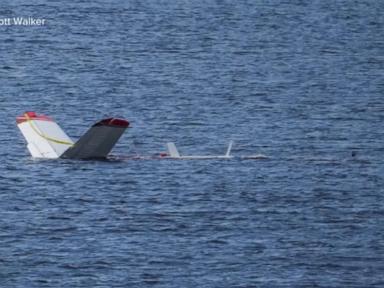
Every time a politician's single-engine aircraft experiences a forced power loss and touches down on a body of water, the media playbook unfurls with predictable panic. Headlines scream about dramatic plunges, miraculous survivals, and harrowing night-time rescues. Emotional press conferences follow, featuring tearful acknowledgments of divine intervention and first-responder heroics.
It makes for compelling television. It is also a fundamental misrepresentation of how aviation actually works.
When a Beechcraft K35 loses power over central Wisconsin at night, the public is conditioned to view it through the lens of a Hollywood disaster movie. Commentators act as though staying alive is a lottery win, a random stroke of celestial luck. This narrative strips agency away from training, engineering, and physics, replacing them with sensationalized theater.
Let us dismantle the lazy consensus surrounding emergency water landings. An engine failure is an emergency, yes. But it is not an improvised catastrophe when handled by a trained pilot executing standard procedures. The difference between survival and disaster is rarely divine favor. It is mechanical discipline, flight planning, and adherence to established emergency protocols.
The Myth of the Accidental Miracle
The mainstream media loves the word "miracle" because it absolves them from understanding technical reality. When Rep. Tom Tiffany and pilot Leonard Boltz came down in Lake Wausau after an engine failure, reporters treated the outcome as an extraordinary defiance of statistical odds.
Here is the unvarnished truth from someone who has spent decades watching aviation systems: single-engine aircraft lose power. Fuel starvation, mechanical wear, fuel management errors, magneto issues, and sudden component failures happen. They are calculated risks acknowledged by anyone who holds a private pilot certificate.
When a fan stops spinning up front, a glider is born. A fixed-wing aircraft does not instantly transform into a brick; it becomes a heavier, less efficient glider with a fixed glide ratio determined by its aerodynamic design and gross weight. The pilot’s job at that exact millisecond is not to panic or pray, but to establish best glide speed, trim the aircraft, scan for a survivable landing zone, and run the emergency checklist from memory.
Calling a successful engine-out landing a miracle implies that the pilot won a game of chance. In reality, Leonard Boltz executed a controlled descent, managed energy state, and picked a large, flat body of water rather than a populated subdivision or dense timber. That is not a miracle. That is competence.
The Mechanics of the Beechcraft K35 and Power Loss Realities
To understand why this specific incident played out the way it did, we must look at the machinery involved. The Beechcraft Bonanza series, including the K35 variant, is a high-performance, single-engine retract. It is a complex airplane with a complex fuel system, constant-speed propeller, and retractable landing gear.
When an engine quits at altitude, the pilot faces an immediate cascade of high-consequence decisions. Do you attempt a restart? Do you configure for best glide? Do you switch fuel tanks? Every second spent troubleshooting an unrecoverable engine is altitude lost.
In night operations, the problem compounds exponentially. Without external horizon cues, spatial disorientation is a lethal predator that claims pilots who rely on instinct rather than instruments. When Boltz lost power, the immediate priority was maintaining aircraft control, trimming for glide speed, and identifying an unlit expanse of water that offered a softer deceleration profile than terra firma. Trees rip wings off; concrete causes catastrophic structural failure; water, while hazardous, distributes deceleration forces across a fluid medium if entered properly.
Yet, mainstream reporting glosses over these aerodynamic realities. Instead of discussing glide ratios, density altitude, and energy management, news outlets focus on wet clothes and stitches. It is an insult to the rigorous training regimens that certified pilots must endure to earn their ratings.
The Landing Gear Fallback and Technical Literacy
One detail highlighted in nearly every broadcast report was the pilot's decision to retract the landing gear prior to hitting the water. Mainstream anchors gasped at this maneuver as if the pilot had invented a new flight control system on the fly.
Let us look at basic aeronautical engineering. Putting wheels down on water is the aviation equivalent of slamming your car brakes on a patch of black ice while steering hard left. Water has high surface tension. When rigid landing gear legs or wheels hit water at seventy knots, they act as anchors. The forward momentum stops instantly while the fuselage's center of gravity keeps moving forward. The result is a violent, destructive inversion known as a cartwheel.
Retracting retractable landing gear—or keeping fixed gear braced for impact—is step number one in every flight school's ditching checklist. It is taught in ground school. It is tested on checkrides. Praising a pilot for raising gear during a water landing is like praising a surgeon for washing their hands before an operation. It is basic procedural hygiene.
By framing standard operating procedures as acts of genius, the media infantilizes the audience and mystifies a technical profession. They substitute genuine operational competence with emotional hyperbole.
The Reality of Night Operations and Risk Management
Flying at night introduces a distinct layer of complexity. Human vision degrades, horizon references disappear over unlit bodies of water, and depth perception becomes notoriously unreliable. When an engine quits over pitch-black water, the pilot loses visual cues.
Yet, the narrative surrounding night flight often defaults to shock. Why were they flying at night? Why were they over a lake?
General aviation exists because transportation speed and point-to-point routing matter. Politicians, business leaders, and private citizens fly at night because commerce and schedules demand it. The risk is managed, not eliminated. Every pilot accepts that engine failures do not check the clock. Training programs specifically emphasize instrument proficiency and night emergency descent procedures precisely because darkness multiplies cognitive load.
When an emergency happens late at night, the response infrastructure swings into action. Wausau’s emergency services reached the downed aircraft via airboat within minutes. That speed is a testament to municipal preparedness and rapid 911 dispatch integration, not a stroke of cosmic luck. When emergency systems work exactly as designed, we should analyze response metrics rather than marvel that emergency responders responded.
The Emotional Press Conference Trap
Following the incident, the political machinery took over. Tearful press conferences, expressions of profound gratitude, and reflections on the fragility of human existence filled the airwaves.
Public figures are expected to process trauma publicly. The emotional reaction is entirely human; surviving an aircraft mishap leaves an adrenaline hangover that takes days to clear. But the transition from personal gratitude to political theater distorts public perception of risk.
Opposing campaigns issued statements praising the horrifying incident and emphasizing narrow escapes. This creates a feedback loop of fear. Every minor aviation incident is framed as a near-death catastrophe, driving public policy toward over-regulation, excessive caution, and an irrational fear of mechanical transport.
If we applied the same sensationalist panic to highway travel that we apply to general aviation, nobody would drive a car. Statistically, driving to a campaign event carries vastly higher per-mile fatality rates than flying a single-engine aircraft. Yet a controlled water landing makes national news because wings and airplanes carry a romanticized aura of peril.
Dismantling the Media Playbook
Why does the media insist on portraying standard emergency management as a heart-stopping thriller? Because ordinary competence does not drive advertising revenue.
A headline reading "Competent Pilot Performs Textbook Ditch After Engine Failure" generates zero clicks. A headline shouting about a politician plunging into dark lake waters and fighting for survival generates millions. The media industry trades in manufactured terror. They feed an audience that prefers drama over mechanics, emotional catharsis over technical analysis.
Let us look at the actual ecosystem of general aviation safety. The Federal Aviation Administration tracks every incident. Mechanical failures happen, but fatal outcomes are overwhelmingly tied to pilot error—specifically, stalling the aircraft while trying to turn back to tujuan runway after an engine failure (the classic "stall-spin" scenario).
Leonard Boltz did not try to turn back to the Wausau Downtown Airport against all odds. He recognized his glide limitations, maintained aircraft control, picked a clear body of water, and flew the plane all the way to impact. That discipline saved lives. Training saved lives.
What Actually Matters
If you take away anything from this episode, strip away the emotional soundbites and the political talking points.
First, respect the machine. Aviation is unforgiving of complacency, but it rewards discipline.
Second, ignore the media's obsession with miracles. When someone survives an emergency, look past the tears and examine the mechanics. Did they maintain control? Did they follow checklists? Did local emergency services execute their protocols? In this case, the answer to all three is yes.
Finally, stop treating every unexpected mechanical failure as an apocalyptic event. Machines break. Humans build them, humans maintain them, and occasionally, humans have to put them down in unconventional places.
When the next emergency landing hits the news cycle, look past the breathless anchors. Appreciate the cold, hard logic of glide ratios, checklist execution, and cold water survival. That is where the real story lives.
Watch the breakdown of the post-incident coverage here: Tom Tiffany post-landing press conference. This video captures the official press conference following the event, illustrating how media and political framing immediately takes over routine aviation safety narratives.