Archaeology journalism has a massive addiction to modern corporate buzzwords.
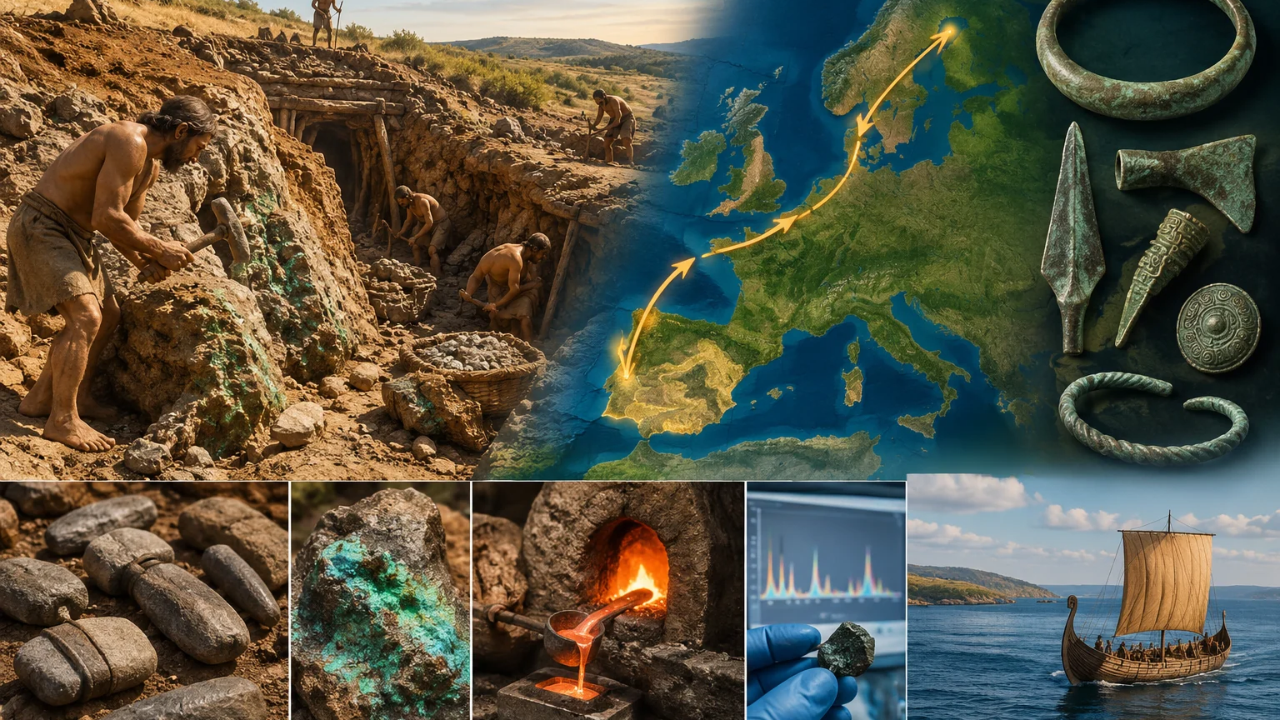
Every time an archaeometallurgist matches a trace element in a Scandinavian sword to a mine in southern Spain, the headlines explode with talk of "ancient trade networks," "Bronze Age globalization," and "intercontinental supply chains." The latest press cycle surrounding the 1300 BC El Aramo copper mine in Asturias—linked via lead isotope and trace element analysis to eleven bronze artifacts in Sweden and Denmark—is the exact same lazy narrative wrapped in a fresh press release.
It makes for a great clickable headline. It also fundamentally misrepresents how the ancient world actually moved metal.
If you picture a Phoenician-style merchant vessel loading ingots in northern Spain and charting a direct course to Jutland to fulfill a Scandinavian purchase order, you are projecting twenty-first-century logistics onto a fragmented, tribal world. Eleven objects do not prove a highway. They prove a game of multi-generational telephone played with axes, scrap metal, and human blood.
The Lie of the Direct Trade Route
When researchers like Johan Ling, Zofia Stos-Gale, and their colleagues run lead isotope analysis (LIA) on Nordic bronzes, they are doing brilliant hard science. The Nordic Bronze Age (roughly 1700–500 BC) produced thousands of spectacular bronze weapons, lures, and jewelry despite having almost zero domestic copper or tin deposits. Every single gram of metal in a Danish burial mound had to come from somewhere else.
Testing shows that around 1300 BC, copper from the El Aramo mine in northern Spain—alongside copper from the Italian Alps, Sardinia, and the British Isles—ended up in Scandinavia.
Here is where the mainstream coverage goes off the rails. Writers take a chemical match between Point A and Point B and immediately draw a straight line between them. They imply an organized, intentional trade network connecting Iberian miners to Scandinavian chieftains.
That is a fantasy.
In reality, metal in 1300 BC moved through what anthropologists call "down-the-line exchange." A miner in Asturias extracted copper ore, smelted it into rough bun ingots, and traded it to a coastal community a hundred miles away for salt, hides, or amber. That community melted it down, cast a few axes, and traded one of those axes to a neighboring tribe across a river valley. Over fifty years, through dozens of hands, border skirmishes, dowries, and seasonal fairs, a fraction of that Spanish copper drifted north through France, across the Rhine, and finally into the hands of a Jutland smith.
Calling this a "network" is like dropping a message in a bottle off the coast of Galicia, watching it wash up in Denmark three years later, and declaring that you have established a transatlantic postal service.
Why Lead Isotope Analysis Fuels Bad Headlines
To understand why these stories get twisted, you have to understand what lead isotope analysis actually measures—and what it misses.
Copper ores contain tiny, trace amounts of lead. The ratio of four specific lead isotopes ($^{204}\text{Pb}$, $^{206}\text{Pb}$, $^{207}\text{Pb}$, and $^{208}\text{Pb}$) acts like a geological fingerprint, locked in when the ore deposit formed millions of years ago. Unlike chemical compositions, which change when you smelt ore at high temperatures, lead isotope ratios survive the furnace intact.
When a lab tests a Swedish bronze dagger and sees a match for the El Aramo mine in Spain, the science is solid. That copper atom originated in the Cantabrian Mountains.
What the isotope ratio cannot tell you is how many times that metal was melted down, mixed with scrap, or recast along the way.
By 1300 BC, Europe was running on a massive recycling economy. Bronze was too valuable to throw away. When a sword broke or fell out of fashion, a smith tossed it into a crucible alongside three broken sickles from Sardinia, a spearhead from the Austrian Mitterberg mines, and a fresh ingot from Wales.
I have watched researchers and science communicators agonize over how to explain this nuance to the public, only to see editors strip it out because "messy scrap recycling" doesn't sound as sexy as "ancient maritime superhighways." When you test an object and find a dominant isotopic signature from Spain, you aren't looking at a pristine, factory-direct shipment. You are often looking at the heaviest surviving ghost in a metallurgical soup.
What People Actually Ask About Bronze Age Trade (And Why They Ask It Wrong)
Whenever these studies hit the news, the search engines light up with the same predictable questions. Nearly all of them are built on a flawed premise.
How did Bronze Age sailors navigate from Spain to Scandinavia?
They didn't. At least, not in a single continuous run. While Bronze Age seafarers were vastly more capable than we give them credit for—capable of crossing the English Channel and hugging the treacherous Atlantic façade in sewn-plank boats like the Ferriby or Dover vessels—there is zero archaeological evidence of an Iberian captain sailing straight into the Kattegat strait. Maritime movement happened in short, brutal coastal hops between localized chiefdoms. Each leg of the journey was controlled by local gatekeepers who demanded tolls, gifts, or blood oaths to pass.
Were there international metal corporations in 1300 BC?
No. Stop looking for proto-capitalism in the second millennium BC. Metal moved through prestige economies, gift-exchange rituals, and raiding. A chieftain in Thy, Denmark, didn't buy copper with currency; he acquired it by marrying his daughter to a warlord in northern Germany, or by sending a boatload of warriors south to raid a rival settlement, or by trading Baltic amber—the "gold of the north"—to middlemen who had connections further south. Profit margins didn't exist. Social status, alliance-building, and military dominance drove the entire system.
Does 11 objects prove major trade between Spain and Scandinavia?
Eleven objects out of the tens of thousands of Nordic bronzes cataloged in museums across Denmark and Sweden is a statistical whisper. It proves contact, yes. It proves that materials could traverse the length of Western Europe over time. It does not prove bulk dependency. If El Aramo had collapsed into the sea in 1305 BC, Scandinavian elites wouldn't have noticed a supply shock. They were already pulling massive amounts of copper from the Italian Alps (specifically the Trentino-Alto Adige region) and central Europe.
The Dark Side of the Bronze Economy Nobody Mentions
Mainstream articles love to paint Bronze Age exchange as a peaceful, romantic era of cultural connection. "Look how connected our ancestors were!" they cheer. "Trade brought people together!"
Read the skeletal record. It tells a much uglier story.
Bronze was not an agricultural convenience; it was a military monopoly. Farmers in 1300 BC were still largely using stone, wood, and bone tools for daily labor. Bronze was reserved for elite status symbols and killing people. Swords, spearheads, and battle axes dominated the metallurgical output of Scandinavia.
Control over the flow of metal created extreme, violent inequality. Look at the Tollense Valley battlefield in northern Germany, dating to roughly 1250 BC—right in the middle of this supposed golden age of peaceful trade. Archaeologists have uncovered the remains of hundreds of warriors, many bearing healed and unhealed trauma from bronze arrowheads, spears, and wooden clubs. Isotope analysis of the dead shows that combatants came from hundreds of miles away.
Why were men from central and southern Europe fighting and dying in a river valley near the Baltic coast? Because controlling the river crossings meant controlling the flow of amber south and bronze north.
When you hear "ancient trade network," picture armed warbands extorting merchants at river fords, ambushing pack animals in mountain passes, and burning rival coastal villages to secure harbor rights. The supply chain wasn't built on trust and contracts. It was built on deterrence and violence.
Admit the Flaws in the Skeptical View
To be completely fair, dismissing all long-distance coordination in the Bronze Age goes too far in the other direction. Minimalist archaeologists in the mid-twentieth century argued that prehistoric societies were entirely isolated, self-sufficient, and incapable of long-range logistics. We now know they were wrong.
The Uluburun shipwreck, which sank off the coast of Turkey around 1320 BC, proves that massive, state-sponsored bulk shipments of metal did happen in the eastern Mediterranean. That single ship carried ten tons of Cypriot copper ingots and a ton of tin—enough to equip an entire army.
Furthermore, Scandinavian rock art—thousands of carvings etched into granite slabs across Bohuslän in Sweden—is obsessed with boats. Ships carry the sun across the sky; ships carry warriors with horned helmets and oversized axes; ships sit at the center of Nordic religion. You do not build a religion around maritime travel unless your elite class is spending serious time on the open water.
So yes, long-distance voyages happened. Ambition existed. Amber from the Baltic has been found in the tomb of Tutankhamun in Egypt and in Mycenaean shaft graves in Greece. The world was connected.
The mistake is confusing the reach of the material with the structure of the system. Just because a piece of Baltic amber ended up on an Egyptian pharaoh's chest does not mean an Egyptian merchant ever set foot on a Polish beach.
How to Actually Read Archaeological News Without Getting Played
If you want to understand ancient history without falling for sensationalized press releases, apply three strict filters the next time a "groundbreaking trade discovery" hits your feed:
- Check the sample size against the total corpus. When a headline screams about a link between two distant regions, look for the exact number of artifacts tested. Eleven objects is a fascinating data point for tracking material drift, not evidence of an industrial pipeline.
- Look for the recycling caveat. Ask yourself whether the study accounts for mixing and remelting. In the Late Bronze Age, almost every piece of metal was a composite. A match to a Spanish mine means Spanish copper is in the mix, not that the object was cast in Spain and shipped intact.
- Follow the tin, not just the copper. Copper is relatively common across Europe. Tin—the other 10% required to make true bronze—is geologically rare, found only in places like Cornwall, Brittany, Iberia, and the Erzgebirge mountains. Wherever you find bronze in Scandinavia, someone had to solve a brutal logistical puzzle just to get the tin there. That is where the real geopolitical friction lived.
Stop picturing ancient Europe as an early prototype of Amazon Prime. See it for what it actually was: a brutal, fragmented, high-risk gauntlet where a lump of Spanish copper could survive fifty years of smelting, theft, dowries, and river wars just to end up buried in a Danish bog. That story is infinitely more impressive than a trade route.