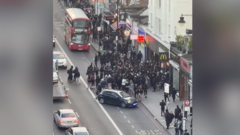
Every few months, the local news runs the exact same segment.
Footage of hundreds of teenagers swarming an inner-city shopping mall, a beach promenade, or a city square. Screaming. Running. Cell phones held high. Police sirens blaring in the background. News anchors lean into the microphone with grave expressions, wringing their hands over "youth delinquency," "TikTok-fueled chaos," and the terrifying rise of the teenage "link-up."
Then comes the predictable playbook: city councils issue curfews, mall security doubles down on banishing anyone under eighteen without a guardian, and pundits demand algorithmic regulation to stop kids from coordinating online.
It is a comfortable narrative. It gives adults a villain to blame—social media algorithms—and an easy fix: enforcement.
It is also completely wrong.
The panic surrounding teen link-ups misses the entire point of why these events occur, why they explode with such velocity, and why every attempt to crush them only makes the next one bigger. Teen link-ups are not a spontaneous breakdown of public order. They are the logical, predictable consequence of two decades of urban decisions that systematically declared young people financial non-entities and evicted them from physical reality.
The Death of the Third Place
For decades, sociologists spoke about the concept of the "third place"—environments outside of the home (the first place) and school or work (the second place) where people gather, socialize, and build community.
Historically, teenagers had an abundance of third places:
- Public parks with active, non-surveilled seating.
- Community arcades and youth clubs funded by municipal budgets.
- Suburban malls that welcomed foot traffic even if teenagers only bought a single soda.
- Diners and plazas where sitting for two hours was considered normal behavior.
Look at any major metropolitan area today. What happened to those spaces?
They were systematically dismantled or monetized out of reach.
Parks installed hostile architecture—benches engineered with middle dividers to prevent lounging, high-frequency sound emitters designed to irritate teenage ears, and floodlights meant to deter hanging out. Suburban malls, struggling against e-commerce, transformed into high-end experience hubs guarded by private security teams tasked with ejecting unescorted minors. Youth centers were cut during successive rounds of municipal austerity.
Even basic public seating has vanished from commercial districts, replaced by outdoor dining tables reserved exclusively for paying customers.
If a seventeen-year-old wants to sit with six friends in a city center today without spending thirty dollars per head, where do they go?
They are told, implicitly and explicitly, that they do not belong in public space unless they are actively consuming goods.
Network Effects in a Spatial Vacuum
When you strip a population of distributed, daily space, you do not destroy their human need for social connection. You merely compress it.
Enter modern broadcast networks.
When adults look at a viral video organizing a massive gathering at a downtown train station, they blame the app. They see viral algorithms as a hypnosis tool driving innocent kids to riot.
This misunderstands network mechanics entirely. TikTok, Snapchat, and Instagram do not create the desire to gather; they provide the infrastructure to coordinate when all local options have been stripped away.
Consider the math of modern adolescent socialization.
Traditional Gathering Model:
[10 Small Local Spots] x [20 Kids Each] = 200 Kids Distributed Peacefully

Modern Compressed Model:
[0 Free Local Spots] + [Instant Broadcast Network] = 1 Mass Event of 200+ Kids
In the past, teenagers hung out in small, decentralized clusters across hundreds of local neighborhoods. Today, because those neighborhood options have been criminalized or commercialized, teenagers use broadcast tools to aggregate at the few high-density transport nodes remaining.
The link-up is not an anomaly. It is the natural result of squeezing pressure into a sealed pipe until it bursts at the weakest joint.
The Escalation Trap: Why Security Escalation Backfires
City leaders invariably respond to mass gatherings with an iron fist. They deploy riot police, issue dispersal orders, and institute blanket bans on youth presence.
I have watched local governments burn millions of dollars on high-visibility policing strategies that accomplish less than zero. High-pressure enforcement in these situations produces a feedback loop known in criminology as spatial displacement coupled with anti-enforcement signaling.
Here is what actually happens when police move in to clear a thousand teenagers from a transit hub:
- Adrenaline spike: The presence of militarized security converts a mundane social gathering into an event with high stakes and high narrative value.
- Content generation: Clashes with authority generate the exact dramatic video content that drives exponential reach on social platforms.
- Scatter effect: Dispersing a group of five hundred teens from a central square doesn't make them go home. It breaks them into angry, restless sub-groups that flood surrounding residential and retail streets.
By treating a crowd of bored teenagers like an insurrection, authorities create the very chaos they claim to prevent.
Thought Experiment: Imagine a city where every coffee shop, library, and park suddenly banned adults over forty unless accompanied by a toddler. Within three weeks, adults would organize massive, informal gatherings in public parking lots just to talk. If police arrived with megaphones to disperse them, the gathering would turn hostile instantly. The issue was never the crowd; it was the total lack of permitted alternative space.
Dismantling the Mainstream Lies
Let us confront the most common myths repeated by news outlets and city managers regarding teen gatherings.
Myth 1: "It Is Organised Crime and Gang Activity"
While bad actors occasionally exploit crowds, the overwhelming majority of participants in link-ups are there for the simple, boring reason that teenagers have gathered for thousands of years: to be seen, to flirt, to assert independence, and to observe their peers. Labeling mass youth socialization as inherently criminal is a tactic used to justify disproportionate surveillance budgets.
Myth 2: "If We Ban Social Media Features, the Gatherings Will Stop"
Removing group chat features or trying to censor regional hashtags is like trying to stop rain by outlawing umbrellas. Kids will move from open platforms to encrypted channels, then to direct peer-to-peer apps, then to mesh networks. The technology is secondary to the physical impulse.
Myth 3: "Youth Centers Aren't Used, So They Don't Work"
Traditional youth centers failed because they were designed like pseudo-schools with adult supervision and mandatory activities. Teenagers do not want structured babysitting; they want autonomous, low-cost space where they can exist without being monitored like shoplifting hazards.
What Actual Solutions Look Like
If cities genuinely wanted to stop disruptive flash-gatherings, they would stop spending money on riot gear and start investing in urban design that accommodates human development.
| Traditional Failed Approach | Pragmatic Real-World Alternative |
|---|---|
| Mall Curfews | Dedicated, non-commercial public spaces with high-speed open Wi-Fi and seating. |
| Acoustic Noise Emitters | Decentralized neighborhood infrastructure (skate parks, outdoor courts, sheltered plazas). |
| Mass Dispersal Orders | Neutral liaison teams instead of heavy tactical police units. |
| Social Media Censorship | Direct communication with youth creators to coordinate location management. |
Adolescence requires peer interaction outside the gaze of parents and teachers. That is a biological and developmental fact, not a policy debate. If a society refuses to provide physical space for that reality to occur safely, it surrenders the right to be surprised when that energy spills into the streets.
Stop blaming the phone in the teenager's hand. Look at the concrete under their feet.