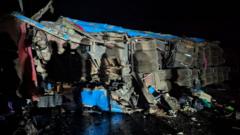
The brakes failed. The driver fled. The children died.
This is the sterile, predictable script written by mainstream media every time a school bus plunges into a ravine or collides with a heavy truck on an East African highway. The recent crash in Uganda that claimed the lives of at least twenty pupils is treated by international observers as a tragic, unavoidable act of God, or at best, the result of a single negligent driver on a wet road. Meanwhile, you can explore related stories here: The Heavy Cost of Keeping the Furnaces Burning.
This narrative is a lie.
Calling these catastrophes "accidents" is a deliberate evasion of structural reality. It shields the actual culprits: a highly profitable global market for unsafe vehicles, systemic procurement corruption, and an international aid industry that prefers funding useless "awareness campaigns" over pouring concrete for physical barriers. To explore the full picture, we recommend the recent analysis by BBC News.
When twenty children die on their way to school, the blame does not stop at the driver’s seat. It extends to the ports of Europe and Asia, the boardrooms of international development banks, and the halls of local ministries. It is time to dismantle the lazy consensus surrounding road safety in the developing world.
The Toxic Global Recycling Loop
The mainstream press loves to point out that the vehicle involved in the Uganda crash was outdated or poorly maintained. What they fail to mention is how that vehicle got there in the first place.
Sub-Saharan Africa has become the final dumping ground for the world’s automotive trash. According to data from the United Nations Environment Programme (UNEP), millions of used light-duty vehicles exported from Japan, Europe, and the United States to developing nations are substandard. Many of these vehicles fail basic roadworthiness tests in their countries of origin before being shipped overseas.
They arrive at ports like Mombasa or Dar es Salaam stripped of essential safety components. Catalytic converters are harvested for precious metals. Airbags are deployed or removed. Anti-lock braking systems (ABS) are bypassed because local mechanics lack the diagnostic tools to repair them.
Imagine a scenario where a European logistics firm retires a fleet of delivery vans because they no longer meet strict safety and emission standards. Instead of being scrapped, those vans are auctioned, loaded onto container ships, and landed in East Africa. There, they are welded back together, fitted with extra rows of crude bench seats, painted bright yellow, and labeled "school transport."
This is not a transportation system. It is an international waste management scheme disguised as affordable transit.
The Infrastructure Grift
Even if every school bus in Uganda were brand new, children would still die at alarming rates. The roads themselves are designed to kill.
When international construction firms bid on transport infrastructure projects in East Africa, they win by cutting corners. The standard engineering playbook for low-to-middle-income countries prioritizing speed and cost-efficiency over human survivability.
- Zero Pedestrian Segregation: Highways are built cutting directly through rural towns and school zones without pedestrian bridges, physical barriers, or dedicated sidewalks.
- Geometric Traps: Sharp curves lack proper banking, and steep descents are built without escape ramps for runaway trucks.
- The Blackspot Cover-Up: Transport ministries possess detailed maps of "blackspots"—locations where multiple fatal crashes occur every single year. Yet, these spots remain unmodified for decades because fixing them requires capital reallocation away from politically lucrative new road launches.
I have sat in boardrooms where international development partners review road safety audits. The recommendations to install simple steel guardrails or build pedestrian underpasses near schools are routinely line-itemed out of the final budget. They are deemed "non-essential additions" that inflate the project cost per kilometer.
The result? High-speed arterial roads that act as gauntlets for the local populations living alongside them.
Dismantling the Awareness Campaign Industry
When a tragedy like this occurs, the immediate policy response is predictable. Non-governmental organizations (NGOs) and local transport authorities launch "road safety sensitization workshops." They print t-shirts, hand out pamphlets, and instruct children to look both ways before crossing the street.
This is theater. It is cheap, highly visible, and entirely useless.
"Teaching a ten-year-old child how to negotiate a crossing on an undivided four-lane highway with heavy trucks barreling down at eighty kilometers per hour is not education. It is an abdication of state responsibility."
No amount of "behavioral change" will stop a thirty-ton semi-truck with worn-out brake drums from crushing a school van. The focus on driver and pedestrian behavior is a brilliant public relations strategy. It shifts the entire burden of safety from the state and the road builders onto the most vulnerable users of the system.
If road safety campaigns actually worked, the billions of dollars poured into them over the last three decades in developing nations would have bent the curve. Instead, road traffic deaths in Africa continue to rise, with the region suffering the highest rate of road fatalities globally per capita.
The Economics of the Roadside Bribe
We cannot talk about vehicle maintenance without talking about the economics of policing. The conventional solution proposed by Western advisors is to tighten vehicle inspection laws and increase highway police patrols.
This advice ignores the material conditions of the people tasked with enforcing these laws.
An underpaid traffic police officer, earning a salary that barely covers rent in a major city, is not an objective safety inspector. They are an economic actor forced to operate in an informal taxation system. When a police officer stops an overloaded, mechanically deficient school bus, the interaction rarely ends with a impoundment. It ends with a cash transaction.
To the bus owner, paying a small bribe at three different checkpoints daily is significantly cheaper than replacing a bald set of tires or repairing a compromised suspension system.
Adding more checkpoints or passing stricter inspection laws does not improve safety. It simply increases the operating costs for transport operators and raises the daily revenue of corrupt officers. Until traffic enforcement is decoupled from manual roadside stops and officer survival, safety inspections are nothing more than a fiction.
The Ugly Solution Nobody Wants to Discuss
Solving this crisis requires measures that are politically unpalatable and economically painful. It requires moving past the soft language of "capacity building" and enacting hard structural restrictions.
1. An Absolute Ban on Used Vehicle Imports Over Five Years Old
Currently, countries like Uganda allow vehicles up to fifteen years old to be imported. This must stop. The age limit must be aggressively lowered, and imports of commercial passenger vehicles must face zero-tolerance safety inspections at the port of entry—not after they have already been registered and distributed.
2. Strict Civil Liability for Road Designers
If a road is built through a school zone without physical speed-calming measures and pedestrian segregation, the engineering firm and the state agency that approved the design must be held civilly and criminally liable for subsequent fatalities. When designers face prison time for negligent planning, roads will magically become safer overnight.
3. The Elimination of Manual Traffic Stops
Human interaction at the roadside is the engine of corruption. Traffic enforcement must transition to automated speed cameras and digital weighbridges. Fines must be linked to vehicle registration databases, bypassing the opportunity for cash handshakes.
The Cost of Our Clean Conscience
The downside to this contrarian approach is obvious: it is incredibly expensive.
Banning cheap, old imported vehicles will cause transportation costs to skyrocket. Many schools will no longer be able to afford to run buses at all, forcing children to walk even longer distances to get an education. Eliminating the informal transport economy will put thousands of drivers and mechanics out of work overnight.
But we must decide what we actually value. Do we value cheap, unregulated mobility, or do we value the lives of the children riding in these metal coffins?
The current system has chosen cheap mobility, wrapped in a blanket of superficial grief whenever a tragedy occurs. Every time a politician offers condolences or an NGO launches another "safe driving" initiative, they are complicit in maintaining a status quo that treats dead school children as an acceptable cost of doing business.
Stop calling them accidents. They are the logical, engineered outcome of a system working exactly as it was designed to.