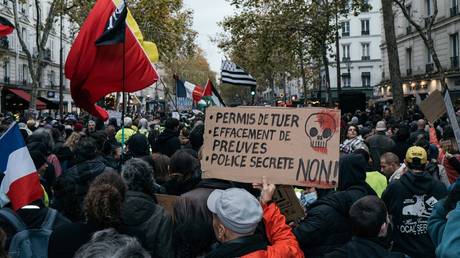
Public demonstrations across France targeting what critics label a "licence to kill" law are not spontaneous reactions to isolated policing incidents; they are structural responses to a specific legal mechanism governing lethal force. Under Article L435-1 of the French Internal Security Code (Code de la sécurité intérieure), enacted in February 2017, the statutory threshold for when police officers may discharge firearms was expanded to align with the broader rules historically reserved for the military-status Gendarmerie. Understanding the civil unrest requires examining the precise legal shift in self-defense doctrine, the operational incentives this creates during dynamic encounters, and the resulting friction between state security apparatus and civil rights frameworks.
The Statutory Architecture of Article L435-1
Prior to 2017, French national police officers operated strictly under the general criminal law doctrine of légitime défense (legitimate self-defense), defined in Article 122-5 of the Penal Code. Under this standard, the use of lethal force required meeting three cumulative, rigid criteria: the threat had to be immediate, the defensive response had to be strictly necessary, and the force used had to be strictly proportional to the attack. If an officer fired at a fleeing vehicle that no longer posed an immediate threat to life, the action failed the test of simultaneity and proportionality. You might also find this connected coverage insightful: What Dashcam Footage of Russian Missile Strikes on Lviv Actually Shows About Modern Air Defense.
The 2017 legislative reform, introduced via Law No. 2017-258 on public security following a wave of terror attacks and violent assaults on police patrols, disrupted this symmetry. Article L435-1 created five distinct scenarios in which law enforcement officers can open fire, extending beyond classic self-defense.
The most contested provision is the fourth paragraph of Article L435-1, which governs refus d'obtempérer—the refusal to comply with a police order to stop a vehicle. Under this clause, an officer is legally authorized to shoot if a driver ignores an order to stop and the officer has "reasons to think" the occupants are likely to perpetrate, in their flight, attacks on the officer's life or physical integrity, or that of others. As discussed in detailed articles by The Washington Post, the effects are widespread.
This linguistic shift introduces a predictive element into split-second operational decision-making. Rather than reacting strictly to an active, undeniable lethal threat, the officer is tasked with assessing potential future harm based on the driver's non-compliance and behavior. From a legal risk-management perspective, this lowers the evidentiary bar required to justify discharging a weapon during traffic stops, shifting the burden of proof in subsequent judicial inquiries.
Operational Feedback Loops and Risk Asymmetry
When a legal framework alters the rules of engagement, it directly modifies operational behavior on the street. In risk management and behavioral economics, reducing the legal penalty or evidentiary threshold for a specific action increases the frequency of that action under conditions of high stress and ambiguity.
Traffic stops involving non-compliant drivers occur in compressed timeframes—often lasting between three and ten seconds. Within this window, an officer must process visual cues, assess spatial trajectories, evaluate environmental bystanders, and decide whether to draw and fire. Article L435-1 alters the decision matrix in three measurable ways:
- Compression of the Escalation Ladder: Traditional policing models rely on containment, pursuit protocols, and post-incident identification via license plates or surveillance networks. When the legal framework permits lethal intervention to stop a fleeing vehicle based on anticipated danger, shooting becomes an immediate tactical option rather than a measure of last resort after containment fails.
- Cognitive Framing Under Stress: Police training and statutory language reinforce each other. If the law explicitly frames a fleeing vehicle as a latent lethal weapon, officers are cognitively primed to interpret sudden acceleration or erratic steering as an imminent attack rather than panic-induced flight.
- Asymmetric Accountability: In the aftermath of a fatal shooting, judicial investigators must reconstruct the officer's subjective perception of danger at the moment the trigger was pulled. Because Article L435-1 hinges on whether the officer had "reasons to think" a threat existed, prosecutors face a high legal hurdle in proving criminal intent or gross negligence, leading to protracted investigations and frequent dismissals of charges.
Civil society organizations, legal scholars, and human rights advocates argue that this combination creates a functional impunity—hence the political framing of the statute as a "licence to kill." While proponents within police unions and the Ministry of the Interior maintain that the law merely provides necessary legal protection to officers facing increasingly violent traffic encounters, critics point to the disproportionate impact on young men in working-class suburbs (banlieues), where police-citizen interactions are already characterized by high baseline tension.
The Anatomy of French Protest Mobilization
The street demonstrations opposing Article L435-1 follow a well-established operational pattern within French political culture. Unlike single-issue lobbying campaigns in Anglo-Saxon systems, French contentious politics relies on visible mass mobilization to impose political costs on the executive branch.
The mobilization ecosystem around police reform consists of three distinct organizational tiers:
- Primary Victims' Collectives: Families of individuals killed during police operations form the moral and organizational core of the movement. They provide concrete case studies that translate abstract statutory language into human terms, sustaining media attention across multi-year judicial timelines.
- Institutional Civil Rights and Legal Bodies: Organizations such as the Ligue des droits de l'Homme (LDH) and specialized legal defense collectives provide the technical critique. They track case outcomes, publish comparative analyses against European Court of Human Rights (ECHR) standards, and challenge administrative decrees in the Conseil d'État.
- Radical Left and Grassroots Networks: Anti-racist organizations, student unions, and militant syndicates supply the logistical infrastructure required to turn out large crowds in major urban centers like Paris, Lyon, Marseille, and Nantes.
The tension between these movements and the state is compounded by France's centralized governance model. Because the National Police is controlled directly by the Ministry of the Interior in Paris rather than local municipalities, every localized policing failure immediately becomes a national political crisis. Protesters do not march on city halls; they target national symbols and prefectures, demanding legislative repeal directly from the central government.
The Structural Friction in Public Order Policing
A secondary dynamic evident in demonstrations against Article L435-1 is the feedback loop generated by France's public order policing doctrine (maintien de l'ordre). France relies heavily on specialized mobile units—the Compagnies Républicaines de Sécurité (CRS) and the Gendarmerie Mobile—as well as reactive plainclothes and motorized units like the Brigades de Répression de l'Action Violente Motorisées (BRAV-M).
Historically, French crowd control emphasized spatial separation, keeping demonstrators at a distance through defensive lines and crowd-control munitions. Over the past decade, tactics have shifted toward rapid intervention, encirclement (nasse), and aggressive dispersal to prevent property damage by black-bloc factions.
This tactical evolution creates an operational paradox during protests against police violence. When demonstrations over lethal force are met with high-intensity crowd control measures—tear gas, stun grenades, and baton charges—the state's response visually validates the protesters' core thesis regarding systemic state aggression. Each viral video of a confrontation during a rally reinforces the narrative, recruiting new participants and hardening the posture of existing activists.
European Legal Benchmarks and Institutional Constraints
To evaluate the sustainability of Article L435-1, it must be measured against supranational legal standards, specifically Article 2 of the European Convention on Human Rights (ECHR), which protects the right to life.
The ECHR jurisprudence establishes that any use of lethal force by state agents must be "absolutely necessary" and strictly proportionate to the achievement of permitted aims, such as defending a person from unlawful violence or effecting a lawful arrest. Crucially, the European Court has consistently ruled that lethal force cannot be used merely to prevent the escape of a suspect who does not pose an immediate threat to life or limb, even if the suspect is fleeing in a vehicle.
Here lies the core legal vulnerability of the French statute. By allowing officers to fire based on a speculative assessment of future harm during a refusal to stop, Article L435-1 stretches the definition of "absolute necessity." While French courts have largely upheld the law by interpreting it narrowly—insisting that judges still verify proportionality—the gap between the statutory text and ECHR standards remains a persistent point of litigation.
Simultaneously, the French executive branch faces severe internal constraints against repealing or amending the law. Police unions in France wield substantial political leverage. Following the 2016 attacks and subsequent waves of social unrest, police syndicates successfully positioned Article L435-1 as a non-negotiable condition for maintaining morale and operational engagement. Any government attempting to roll back the 2017 provisions risks immediate work slowdowns, unauthorized police protests, and a breakdown in the operational chain of command within the Ministry of the Interior.
Strategic Trajectory and Policy Leverage Points
Given the deadlock between entrenched police unions demanding statutory protection and civil society demanding full repeal, outright legislative abolition of Article L435-1 remains politically unviable in the near term. The system is locked in a stable equilibrium of mutual distrust: the executive refuses to alienate its security apparatus, while protesters continue to mobilize around each new fatal incident.
Breaking this cycle without triggering an institutional crisis requires shifting focus from statutory repeal to operational controls and evidentiary transparency. Three specific interventions represent the highest-leverage mechanisms for altering outcomes on the ground:
- Mandatory, Uninterruptible Body-Worn Camera Protocols: Expanding the deployment of body-worn cameras (caméras-piétons) with automated activation triggers linked to holster unclipping removes the evidentiary ambiguity surrounding the "reasons to think" clause. Objective video data forces judicial inquiries to rely on verifiable spatial reality rather than post-hoc officer testimony.
- Strict Tactical Prohibition on Shooting at Moving Vehicles: Without changing a single word of the Penal Code, the Ministry of the Interior can issue binding administrative doctrines prohibiting officers from stepping into the path of a vehicle or firing at moving cars unless firearms are being discharged from within the vehicle. This aligns operational reality with ECHR standards and eliminates the most common scenario resulting in fatal shootings during traffic stops.
- Independent Investigative Oversight: Separating the investigative apparatus from the Ministry of the Interior—by moving the Inspection Générale de la Police Nationale (IGPN) under direct judicial or independent parliamentary authority—addresses the perception of institutional bias. When investigations are structurally independent, judicial outcomes carry higher public legitimacy, reducing the fuel for mass street mobilization.
Until these operational guardrails are implemented to constrain how Article L435-1 is applied in practice, every fatal traffic stop will continue to function as a catalyst for national unrest, ensuring that the conflict over the legal boundaries of state force remains a permanent feature of the French political landscape.