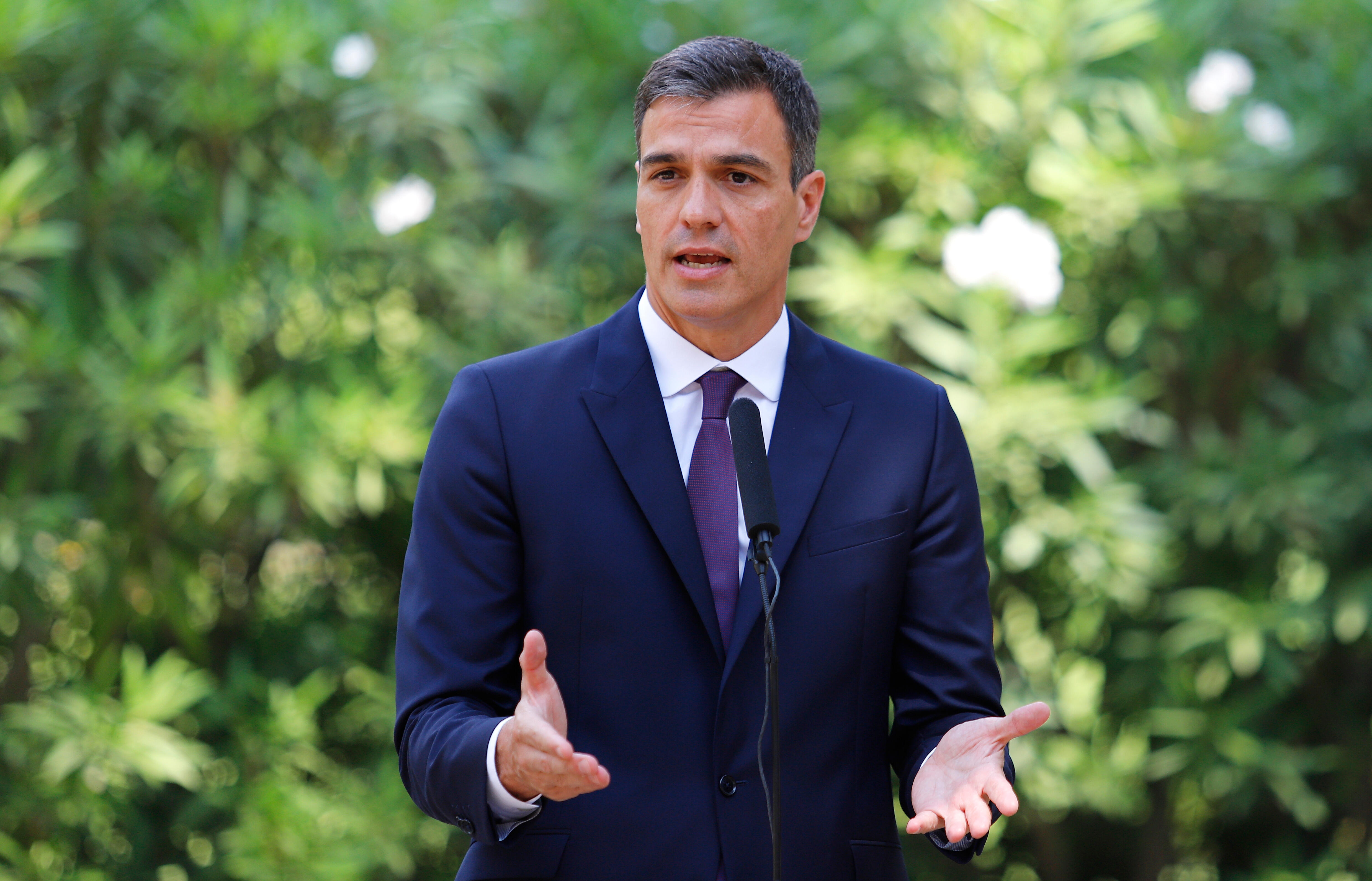
Pedro Sánchez likes the sound of his own voice when it echoes off the marble walls of the Moncloa Palace. Calling for an immediate halt to the Gaza conflict and demanding that the international community "rein in" Benjamin Netanyahu isn't just predictable—it is a masterclass in geopolitical irrelevance. While the Spanish leader postures for a domestic base that thrives on moral signaling, he ignores the cold, hard mechanics of Middle Eastern power dynamics.
Sánchez frames the conflict as a simple matter of a runaway leader who needs a firm hand on the collar. This is the "lazy consensus" of European mid-level powers: the belief that diplomatic scolding from Brussels or Madrid carries the weight of a carrier strike group. It doesn’t.
The Fallacy of "Reining In" a Sovereign State
The term "rein in" suggests that Israel is a proxy or a satellite state of a Western collective. It is a colonial-era holdover in the minds of European diplomats who forget that the era of the British Mandate ended in 1948. Israel’s security doctrine is not dictated by the preferences of the Spanish Socialist Workers' Party. It is dictated by the existential reality of the "Iron Wall"—a concept popularized by Ze'ev Jabotinsky and maintained by every Israeli administration since the state's inception.
The premise that external pressure can simply flip a switch on a nation's defense strategy is a fantasy. When a country perceives a threat as existential, the cost-benefit analysis of international "approval" drops to near zero. Sánchez’s rhetoric fails to account for the internal political gravity of Israel. Netanyahu isn't a rogue agent; he is the product of a shifted Israeli center that no longer believes in the viability of the two-state solution as presented by 1990s-era European diplomats.
Spain’s Double Standard on Sovereignty
Madrid speaks of international law and humanitarian restraint while simultaneously maintaining its own strategic red lines in North Africa. If we apply the "Sánchez Standard" to Spain's own border security or its historical conflicts, the hypocrisy becomes glaring.
The Spanish Prime Minister argues that the war must stop because it creates regional instability. This is a classic case of misidentifying the symptom as the disease. The instability is not a byproduct of the war; the war is a result of a decades-long collapse of regional deterrence. By demanding an immediate stop without a structural replacement for Hamas's governance, Sánchez isn't advocating for peace. He is advocating for a reset of the status quo that led to the October 7 massacre in the first place.
Why Sanctions and Symbolic Gestures Fail
Sánchez has hinted at the possibility of unilateral recognition of a Palestinian state and pushed for the suspension of the EU-Israel Association Agreement. These are blunt instruments that usually break the hand of the person wielding them.
- Economic Interdependence: Israel’s tech sector is deeply integrated into the European economy. From cybersecurity to medical tech, a "divestment" strategy would hamper European innovation as much as Israeli exports.
- Intelligence Sharing: The mossad-directed intelligence pipeline to Europe is a critical wall against domestic terrorism in cities like Madrid and Paris. Severing ties over a rhetorical disagreement puts Spanish citizens at risk.
- Diplomatic Vacuum: If Europe exits the room, it loses its seat at the table. Russia and China are more than happy to fill the void left by posturing European leaders.
The Real Cost of Virtue Signaling
The "Stop this war" slogan is a sedative for the European voter. It makes the public feel like their leaders are doing "something" while doing absolutely nothing of substance. It ignores the actual players in the room: Qatar, Egypt, the United States, and Iran. Spain is not a power broker in this region. Every time Sánchez makes these declarations, he further isolates Spain from the actual negotiations happening in Doha and Cairo.
The reality of 21st-century warfare is that it is no longer governed by the Westphalian norms that European leaders still cling to. We are in an era of multi-domain attrition. In this context, calling for a ceasefire without a plan for the demilitarization of non-state actors is equivalent to asking one boxer to drop his gloves while the other is still swinging a lead pipe.
The Nuance of the Israeli Domestic Crisis
Sánchez treats Netanyahu as the sole architect of the conflict. This is a gross simplification. Even if Netanyahu were to resign tomorrow, the Israeli defense establishment (the IDF and Shin Bet) would continue the operation. The strategic objective—the destruction of Hamas’s military infrastructure—has broad support across the Israeli political spectrum, including from many of Netanyahu's fiercest rivals like Benny Gantz.
By focusing on a single personality, Sánchez misses the tectonic shift in Israeli public opinion. The country is not in the mood for "reining in." It is in the mood for "never again."
A Strategy for Actual Influence
If Spain actually wanted to impact the outcome of the conflict, it would stop issuing press releases and start building a coalition that offers tangible security guarantees.
- Fund Radicalization Reform: Instead of broad-spectrum aid that gets siphoned off, demand oversight on educational materials in the region.
- Pressure Regional Proxies: Use diplomatic leverage on nations that host the political wing of Hamas.
- Stop the Recognition Theater: Unilateral recognition of a state that doesn't yet have a functioning, non-terrorist government is a paper tiger. It solves zero problems on the ground.
The international community does not "rein in" nuclear-armed democracies. It negotiates with them. It acknowledges their security needs. And it stops pretending that a speech in Madrid changes the reality of a tunnel in Gaza.
Sánchez isn't fighting for peace. He is fighting for a headline. In the brutal theater of Middle Eastern politics, headlines don't save lives—strength and leverage do. Spain has neither, and as long as its leader continues this performative crusade, it never will.
Stop asking Israel to stop. Start asking what comes after.