When deposed Venezuelan president Nicolás Maduro walked into a Manhattan federal courtroom in tan prison garb, he brought something far more dangerous to American legal precedent than his personal guilt or innocence. Seized from his Caracas compound by U.S. forces in a covert January operation, Maduro now faces federal drug trafficking and narco-terrorism charges before 92-year-old U.S. District Judge Alvin Hellerstein. Defense counsel Barry Pollack formally signaled that Maduro will challenge his indictment on head-of-state sovereign immunity grounds, arguing that a foreign leader cannot be grabbed by military force and put on trial in a domestic court.
The trial date is now anchored for June 1, 2027. Behind the procedural scheduling and courtroom formalities sits an uncomfortable clash between American criminal law and international order.
The Mirage of a Routine Criminal Proceeding
Federal prosecutors inside the Southern District of New York are treating United States v. Maduro as a heavy drug case. The indictment frames Maduro not as a head of state, but as the leader of the Cartel de los Soles, an alleged syndicate of high-ranking Venezuelan officials working alongside Colombian rebel splinter groups to transport cocaine into the United States.
The Department of Justice wants jurors to focus strictly on flight manifests, intercepted communications, and testimony from former insiders.
That approach deliberately overlooks the elephant in the room. Maduro did not arrive in New York through an extradition treaty. He was taken from his residence in a military raid authorized by the White House. By prosecuting a deposed leader captured on foreign soil without host-nation consent, federal prosecutors are asking American courts to ratify a doctrine of unilateral executive abduction.
The government relies heavily on the 1992 Supreme Court ruling in United States v. Alvarez-Machain, which held that forcible abduction from a foreign nation does not inherently deprive a U.S. court of jurisdiction. But Humberto Alvarez-Machain was a Mexican physician, not a recognized head of state. The legal mechanics shift dramatically when the defendant was the sitting executive of a sovereign nation, regardless of how autocratic or illegitimate Washington declared his leadership to be.
The High Stakes of the Sovereign Immunity Strategy
The legal defense isn't just throwing claims at the wall. Defense attorney Barry Pollack has constructed a two-pronged defense strategy aimed directly at the jurisdiction of American federal courts.
Head-of-State Immunity
Under established international law and customary norms, sitting heads of state enjoy absolute immunity from foreign criminal prosecution. The U.S. government counters that Washington stopped recognizing Maduro as Venezuela’s legitimate president in 2019, instead treating opposition figures and later transitional authorities as the official representatives of the state.
Yet Maduro retained effective, physical control over Venezuelan territory, its armed forces, and its institutions until the moment American troops breached his residence.
If Judge Hellerstein rules that U.S. recognition policy completely overrides functional head-of-state status, it creates a precedent with immediate global consequences. Any foreign state could declare an American president illegitimate, launch a military raid, and subject that official to criminal trial in their own domestic courts under their own interpretation of international law.
The Ker-Frisbie Doctrine and Military Abduction
The defense will simultaneously invoke the Ker-Frisbie rule and its exceptions. While U.S. courts generally do not inquire into how a defendant was brought before them, the Second Circuit Court of Appeals recognized a crucial exception in United States v. Toscanino (1974). Under Toscanino, courts must divest themselves of jurisdiction if federal agents secure a defendant through deliberate, shocking brutality or violations of constitutional due process.
Defense attorneys intend to argue that launching a foreign military strike to capture a political leader crosses that threshold. If the court accepts that the military seizure violated fundamental international treaties signed by the United States, prosecutors could find their primary evidence barred or the case dismissed entirely.
| Defense Claim | Legal Mechanism | Prosecution Counter-Argument |
|---|---|---|
| Head-of-State Immunity | Customary International Law | Executive branch non-recognition of Maduro presidency |
| Illegal Abduction | Toscanino Exception to Ker-Frisbie | Alvarez-Machain precedent on foreign capture |
| Sanctions Impediment | Fifth Amendment Due Process | U.S. Treasury carve-outs for defense legal fees |
What Happened Inside Courtroom 26B
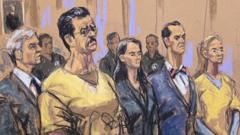
During the brief 15-minute scheduling conference in Manhattan, the physical reality of the situation was impossible to ignore. Maduro sat beside his wife, Cilia Flores, dressed in standard-issue beige prison garb from the Metropolitan Detention Center in Brooklyn. He appeared noticeably thinner than during his years in the Miraflores Palace, wearing wire-rimmed glasses and clutching a black pen over a legal notepad.
He did not speak during the procedural hearing, listening instead through a Spanish translation headset while adjusting his position in the leather chair. His posture was surprisingly calm. He smiled at his defense counsel and offered a slight wave toward the gallery before marshals led him away in handcuffs.
Flores sat separately at her own defense table, flanked by her attorneys. She faces identical conspiracy charges and potential life imprisonment.
The atmosphere inside the gallery was taut. Dozens of federal marshals lined the walls while diplomats, Venezuelan expatriates, and journalists crammed into the benches. Outside on Pearl Street, opposing groups of demonstrators banged drums and shouted slogans—some celebrating the fall of a leader responsible for economic collapse and repression, others condemning the operation as imperialist overreach.
The Geopolitical Fallout and the Delcy Rodríguez Factor
While Maduro sits in a Brooklyn cell, the geopolitical reality in Caracas has moved on. Acting President Delcy Rodríguez, former vice president under Maduro, quickly assumed power following the raid and initiated a rapid reorganization of the Venezuelan military high command.
Washington lifted long-standing personal sanctions against Rodríguez shortly after she signaled a willingness to cooperate on oil production quotas and migration management.
This pragmatic alignment creates a jarring contrast. The U.S. Department of Justice charges that the Venezuelan government operated as a criminal narco-state for two decades. Yet Washington is actively cutting deals with the second-in-command of that same administration while prosecuting the former chief executive down the block from Wall Street.
This dynamic undercuts the moral clarity federal prosecutors hope to project to a jury. Defense attorneys will almost certainly point out that key potential government witnesses are former high-ranking Chavista officials who received immunity or leniency in exchange for testifying against their former boss.
The Road to the Pretrial Clash
The trial schedule established by Judge Hellerstein sets up a sequence of high-stakes legal battles:
- September 2026: Defense files formal motions to dismiss based on sovereign immunity, act of state doctrine, and unlawful military abduction.
- November 17, 2026: Oral arguments before Judge Hellerstein on the motion to dismiss.
- Early 2027: Proceedings under the Classified Information Procedures Act (CIPA) to resolve disputes over secret military and intelligence evidence collected during the Caracas raid.
- June 1, 2027: Scheduled jury selection and start of the criminal trial.
The intelligence review alone could derail that timeline. The defense will demand full disclosure of CIA and military operational orders, communications regarding the planning of the raid, and internal legal memorandums from the Department of Justice. The government will fight to keep those documents classified under CIPA, setting up a clash between Maduro's constitutional right to exculpatory evidence and national security secrets.
The prosecution of Nicolás Maduro was conceived as a decisive blow against state-sanctioned crime. Instead, it has transformed into a high-stakes stress test for the limits of U.S. extra-territorial power. If the U.S. government secures a conviction, it establishes that no foreign leader is beyond the reach of American law enforcement. If the case falters on jurisdictional grounds or founders in a sea of classified evidence disputes, Washington will have executed a daring overseas military operation only to demonstrate the boundaries of its own judicial authority.