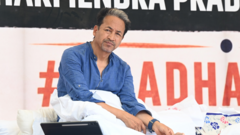
Climate activist Sonam Wangchuk went 26 days without food in the freezing altitude of Ladakh. By the time he broke his hunger strike, he had lost 11 kilograms, survived on nothing but water and salt, and drawn global attention to a fragile Himalayan region pushed to the brink.
He didn't do it for fame. He did it because promises were broken.
When the Indian government turned Ladakh into a Union Territory in 2019, removing it from Jammu and Kashmir state control, locals expected political empowerment. Instead, they got disenfranchisement. Ladakh was left without a state legislature, stripped of autonomous local governance power, and exposed to aggressive industrial and mining interests.
What Ladakh Is Fighting For
Wangchuk’s demand is simple: protect Ladakh under the Sixth Schedule of the Indian Constitution.
The Sixth Schedule exists specifically to protect tribal lands, cultures, and fragile ecosystems in India. It gives local tribal populations autonomous regional councils with the authority to make laws regarding land use, forest management, and local development. Over 90% of Ladakh’s population belongs to scheduled tribes. On paper, it fits every single criterion for Sixth Schedule protection.
Yet the central government keeps stalling.
Without Sixth Schedule status, land in Ladakh can be acquired by outside commercial entities. That means massive industrial ventures, mining projects, and commercial tourism entering an environment that cannot handle them.
The region sits in a high-altitude desert. Glaciers supply virtually all the fresh water for local villages. These glaciers are melting at alarming rates due to global warming, and heavy industrial pollution directly over the fragile soil speeds up that destruction. When you build heavy infrastructure on permafrost, you don't just build roads—you destroy water security for hundreds of thousands of people downstream.
The Human Cost of High Altitude Fasting
Fasting at 3,500 meters above sea level isn't like a standard hunger strike. Cold temperatures force the body to burn calories simply to stay warm. Hypoxia—low oxygen availability—places immense pressure on the cardiovascular system.
During his 26-day fast in Leh, temperatures regularly dropped well below freezing at night. Wangchuk slept in open tents alongside hundreds of supporters who rotated through symbolic shorter fasts.
Medical teams monitored his vital signs daily. Rapid weight loss of 11 kilograms—about 15% of total body weight—brings severe risks:
- Acute muscle wasting as the body metabolizes its own tissue for energy.
- Electrolyte imbalances leading to cardiac arrhythmia.
- Severe kidney strain from dehydration and ketone production.
- Extreme fatigue, dizziness, and compromised immune response.
When Wangchuk spoke toward the end of his strike, his voice was faint, but his message stayed sharp: "I am still alive, but my body is weak. My resolve is not."
Why This Goes Beyond One Region
This protest isn't just a regional border dispute or a localized political movement. It serves as a testing ground for how democratic governments treat ecological frontline communities.
Wangchuk is best known internationally as an innovator. He invented the "Ice Stupa"—an artificial glacier technology that stores winter runoff water in conical ice towers, melting slowly in spring to provide water for crops. He won the Rolex Award for Enterprise and the Ramon Magsaysay Award. He's not a professional agitator; he's an engineer who dedicated his life to practical climate solutions.
When someone like Wangchuk stops building solutions and starts refusing food, it signals a complete failure of formal political channels.
Local leadership in Leh and Kargil formed the Apex Body and the Kargil Democratic Alliance (KDA), uniting historically separate Buddhist and Muslim communities in a shared cause. Their core demands remain unchanged:
- Statehood for Ladakh.
- Sixth Schedule constitutional protections.
- Dedicated parliamentary seats for Leh and Kargil districts.
- Job reservation for local youth and an independent Public Service Commission.
What Happens Next
The government opened talks with Ladakhi representatives in early 2024, but those discussions stalled, prompting the hunger strike. While Wangchuk ended this specific phase of his fast, civil disobedience across the region hasn't stopped.
Women's groups, youth associations, and local leaders have taken up rolling fasts. Plans for a border march to highlight land lost to Chinese incursions and industrial allocations remain on the table.
If you're following this issue, watch how the Ministry of Home Affairs responds in upcoming policy rounds. The decision on Ladakh's constitutional status will set a clear precedent for how India balances industrial development against indigenous rights and ecological survival in its most sensitive borderlands.

/https://i.s3.glbimg.com/v1/AUTH_e84042ef78cb4708aeebdf1c68c6cbd6/internal_photos/bs/2026/g/B/3vpkvHQKizRKAfzDxjXA/vini-jr-antes-e-depois.jpg)