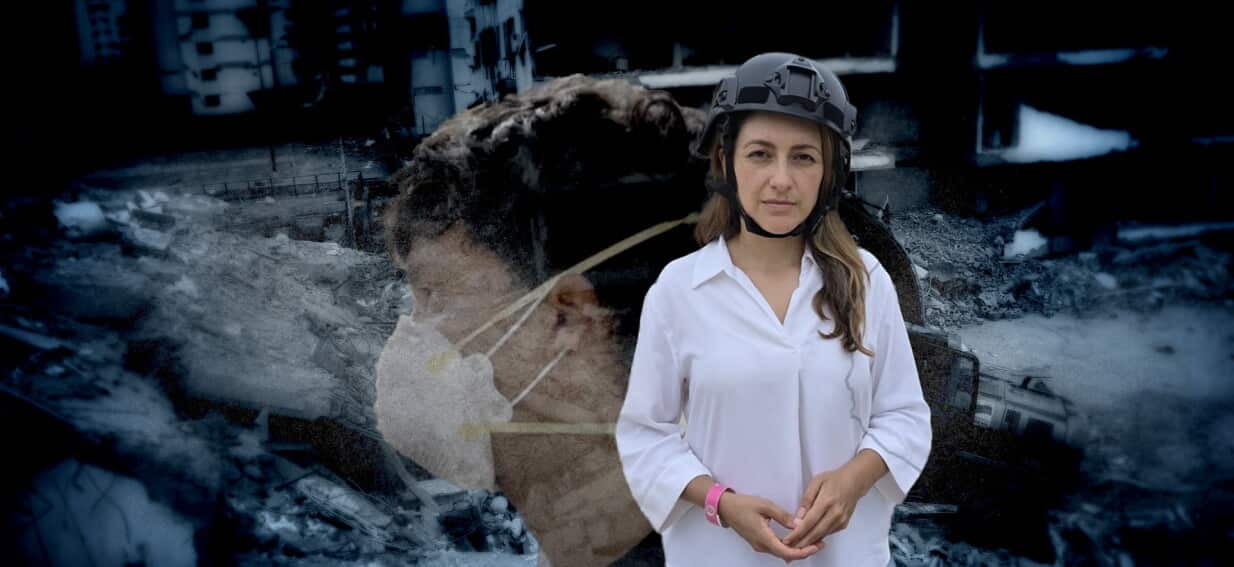
The sound that wakes you at 2:00 AM in Kyiv is not a sudden crash. It is a low, vibrational hum that begins in your teeth before it reaches your ears.
Imagine a young mother—let us call her Iryna, a composite of the millions sleeping with one eye open tonight—reaching through the dark of her Darnytskyi district apartment. Her hand finds her three-year-old daughter. There is no time for the basement. The bathroom will have to do. The bathtub is ceramic, cast iron, thick enough to deflect shattered glass, maybe a stray piece of masonry. They lie there together, the cold porcelain pressing against their backs, listening to the sky tear itself apart.
A cobblestone, dislodged by a supersonic shockwave from three blocks away, smashes through the nursery window. It lands precisely where the child’s head rested five minutes earlier.
"Thank God we are alive," Iryna whispers to the dark. "Today we are alive. Today we are lucky."
But forty miles away, and in the high-rises down the street, twenty-two people were not lucky. Their Tuesday morning did not end with a sigh of relief in a bathtub. It ended under tons of pulverized concrete, or in the white-hot flash of a burning sedan as car alarms wailed a useless symphony into the smoke.
The Math of the Exhausted Sky
The official press releases from the defense ministries read like inventory sheets. They tell us that Russia launched 351 drones and 68 missiles in a single, massive overnight barrage. They tell us that the Ukrainian Air Force performed exceptionally well, swatting down hundreds of Shahed loitering munitions and cruise missiles out of the pre-dawn mist.
But those numbers hide a terrifying, mathematical asymmetry.
To understand why twenty-two people died on a morning when air defenses shot down the vast majority of incoming targets, one must look at the mechanical reality of modern interception. Drones are slow. They buzz like lawnmowers, tracing predictable arcs across the radar screen. A mobile team with a heavily modified pickup truck and a thermal-scoped machine gun can bring one down if they are positioned correctly. Cruise missiles are faster, but they hug the terrain and can be intercepted by conventional anti-aircraft batteries.
Ballistic missiles are a different species of terror entirely.
When a Russian Iskander or a hypersonic Oreshnik leaves its launcher, it ascends into the upper atmosphere before arching back down toward Earth at several times the speed of sound. It does not cruise; it falls like a kinetic hammer. You cannot shoot it down with a machine gun. You cannot trick it with electronic jamming.
To stop a ballistic missile, you need a specialized interceptor. You need a U.S.-made Patriot missile system.
Consider what happens next on the radar consoles inside Kyiv’s defense command centers. The screens illuminate with dozens of red tracks. The operators know exactly what they are looking at. They have the training, the positioning, and the will. What they do not have is the ammunition.
Every Patriot battery requires interceptor missiles that cost millions of dollars and take months to manufacture. Because of the prolonged conflict in the Middle East and the shifting priorities of global arms shipments, the global supply of these interceptors has run dangerously low.
During this week's attack, Russia fired twenty-nine ballistic missiles. Every single one of them bypassed Ukraine's defenses and struck its target.
The sky simply ran out of shields.
The Retaliation Loop
The Kremlin claimed the bombardment was a precise strike targeting military-industrial facilities, drone factories, and energy infrastructure. They framed it as a justified retaliation for Ukraine’s recent long-range drone strikes on Russian soil, which have targeted three major oil refineries and a vital terminal in the Baltic Sea port of Vysotsk. Those Ukrainian strikes worked; they caused genuine fuel shortages across parts of Russia, creating a logistical headache for President Vladimir Putin and making the reality of the war visible to a domestic Russian audience that had previously been insulated from it.
But on the ground in Kyiv and Vyshneve, the abstract concept of "retaliation" looks like a collapsed nine-story apartment building. It looks like rescue workers digging through smoking rubble with their bare hands, trying to reach a family trapped in a basement stairwell while the smell of ruptured gas lines fills the humid July air.
The political stakes of this specific tragedy are not accidental. The timing forms a deliberate piece of theater. The missiles fell just as Western leaders were packing their bags for a major NATO summit in Ankara, Turkey.
For Ukraine's leadership, the tragedy provides a grim, undeniable talking point for the diplomatic tables. President Volodymyr Zelenskyy took to social media before the smoke had even cleared from the Podilskyi district, pointing out the brutal reality that while his troops can stop the drones, they are entirely helpless against ballistics without Western resupply.
The message to Washington and Brussels is stripped of all diplomatic nuance: as long as interceptor missiles sit in storage crates across Europe and America while bureaucrats debate budgets, apartment blocks in Kyiv will continue to split in half.
What Remains When the Smoke Clears
The human mind cannot easily process the reality of sixteen thousand civilian deaths over four years of escalation. The numbers become a grey fog, a background hum that the rest of the world tunes out between news cycles.
It is easier to look at the small things left behind.
A school backpack covered in white plaster dust. A dog barking frantically at the edge of a cordoned-off street because its owner is still somewhere beneath the weight of the top three floors. The way the morning sun hits a shattered kitchen wall, revealing a calendar still pinned to the drywall, its July dates crossed off one by one until today.
The war has entered a phase where the front lines on the map barely move, pinned down by drone technological parity and trench warfare. Instead, the true conflict is being fought vertically, in the space between the clouds and the roofs of ordinary homes. It is a war of logistics disguised as a war of attrition.
As the emergency vehicles finally turn off their sirens and the city begins the grueling process of clearing sixty-four thousand tons of debris, the survivors look up. The summer sky over Kyiv is clear, blue, and completely indifferent. Everyone knows the inventory on the other side of the border is being replenished for the next wave. Everyone knows the screens will light up red again.
The only question that matters to the people waiting in the dark is whether the next time they hear that low, teeth-rattling hum, there will be anything left in the inventory to meet it.