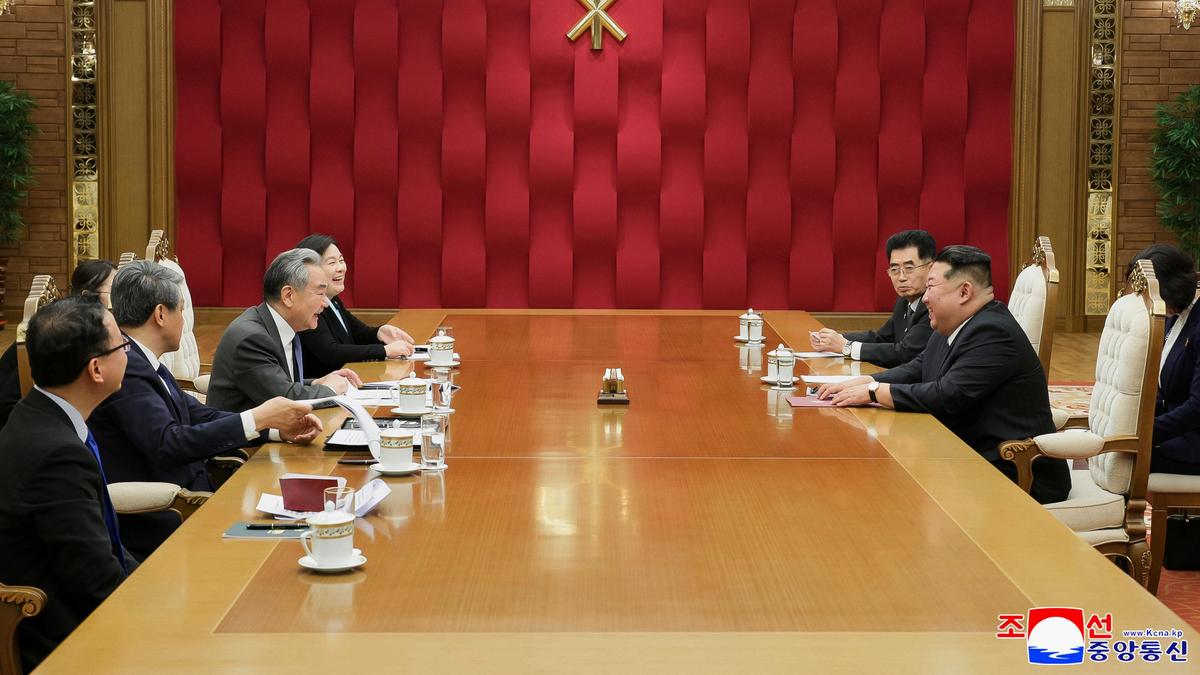
The recent high-level diplomatic engagement between Kim Jong Un and the Chinese Foreign Ministry transcends traditional bilateral cooperation, signaling a shift from reactionary defense to a proactive, structural reconfiguration of the East Asian security environment. This alignment is not a product of shared ideology alone; it is a calculated response to the tightening constraints of the US-led "integrated deterrence" strategy. By endorsing China’s vision of a multipolar world, Pyongyang is attempting to secure a permanent seat within a non-dollarized, non-Western-centric power bloc that provides both economic insulation and strategic depth.
The Strategic Triad of the Sino-DPRK Axis
The current synchronization between Beijing and Pyongyang operates across three distinct functional layers. Understanding these layers is essential to move past the superficial "friendship" rhetoric often found in regional reporting. In related news, take a look at: The Long Walk Back to Gravity.
- The Security Shield (Operational): North Korea serves as a critical buffer zone that prevents the direct placement of US land-based assets on the Chinese border. For Pyongyang, China provides a diplomatic veto at the UN Security Council, effectively neutralizing the legal mechanisms of international sanctions.
- The Economic Bypass (Logistical): Through the advancement of the "multipolar" narrative, North Korea seeks to integrate into China-led financial and trade networks that operate outside the SWIFT system. This is a survival mechanism designed to make Western economic pressure irrelevant.
- The Normative Shift (Ideological): Both nations are actively promoting a "sovereignty-first" international law framework. This framework rejects the universal application of liberal democratic values, replacing them with a model where regional powers dictate the internal norms of their respective spheres of influence.
Deconstructing the Multipolarity Function
Multipolarity, in the context of Kim Jong Un’s rhetoric, is a mathematical necessity rather than a vague aspiration. In a unipolar or bipolar system, a small state like North Korea is forced into a binary choice that usually leads to total isolation or total subservience. In a multipolar system, Pyongyang gains "strategic flexibility," allowing it to play various power centers against one another.
The cost of maintaining this alignment is high for Beijing. Supporting a nuclear-armed North Korea complicates China’s relationship with South Korea and Japan, potentially accelerating the formation of a "Pacific NATO." However, the benefit—a permanent distraction for US Indo-Pacific Command—outweighs the diplomatic friction. This creates a state of Equilibrium of Inconvenience, where all parties accept a sub-optimal status quo to avoid a catastrophic shift in the regional balance of power. Associated Press has provided coverage on this fascinating topic in great detail.
Technical Limitations of the Alignment
Despite the high-level optics, the integration between China and North Korea faces significant structural bottlenecks.
- Asymmetric Dependency: North Korea’s economy is almost entirely dependent on Chinese energy and food imports. This creates a master-servant dynamic that Pyongyang resents and occasionally attempts to sabotage through independent nuclear testing or engagement with Russia.
- Technological Interoperability: While North Korea has made strides in missile technology, its command-and-control systems are generations behind China’s People’s Liberation Army (PLA). The lack of shared data links prevents a true "coalition" military force, keeping the relationship limited to parallel operations rather than integrated ones.
- The Russian Variable: The strengthening of the Moscow-Pyongyang axis introduces a third variable. China views the North Korean-Russian defense pact with cautious skepticism. If North Korea leans too heavily into Russian military support, China loses its primary point of leverage over the Kim regime.
The Weaponization of Multipolar Rhetoric
The term "multipolarity" functions as a geopolitical code. When Kim Jong Un backs China’s push for this world order, he is signaling to the Global South that there is a viable alternative to the Washington Consensus. This is particularly relevant in the context of the BRICS+ expansion and the growing influence of the Shanghai Cooperation Organization (SCO).
The North Korean state media’s emphasis on "international justice" and "anti-hegemony" aligns perfectly with China’s Global Security Initiative (GSI). This is a calculated branding exercise. By framing their bilateral ties as a contribution to a "just" world order, they attempt to decouple their actions from the specific violations of international law—such as illegal arms transfers or nuclear proliferation—and reframe them as acts of resistance against an outdated global hierarchy.
The Cost Function of Sanctions Evasion
The efficacy of international sanctions against North Korea is inversely proportional to China's commitment to enforcing them. In a multipolar framework, China treats UN sanctions as "negotiable guidelines" rather than "binding mandates." This creates a fragmented trade environment where:
- Ship-to-ship transfers in the Yellow Sea become the primary artery for North Korean oil imports.
- Cyber-enabled revenue generation (cryptocurrency theft and IT worker outsourcing) is laundered through Chinese OTC brokers.
- Labor exports continue under the guise of "educational exchanges," providing Pyongyang with the hard currency necessary to fund its weapons programs.
This ecosystem represents a "Sanctions-Proof Enclave." The more the US uses the dollar as a weapon of statecraft, the faster this enclave matures. The logic is simple: if the penalty for participating in the Western system is the potential for total economic erasure, the incentive to build a parallel system becomes absolute.
Strategic Divergence in the Taiwan Strait
The most significant risk to this alignment is a conflict over Taiwan. While Pyongyang would benefit from the distraction of a US-China war, Beijing is wary of North Korean opportunism. If Kim Jong Un were to initiate a provocation on the Peninsula simultaneously with a Chinese move on Taiwan, it could force a nuclear escalation that China is not prepared to manage.
This creates a Strategic Decoupling Point. China wants a stable, quiet North Korea that consumes US attention; it does not want a volatile North Korea that triggers a regional nuclear exchange. Consequently, China’s support for the "multipolar" transition is also a method of tethering Pyongyang to a predictable, Beijing-centric trajectory.
The Nuclear-Conventional Paradox
The North Korean military is currently transitioning from a mass-army model to a high-tech, tactical nuclear-strike model. This transition is heavily reliant on dual-use technologies—semiconductors, advanced materials, and satellite guidance systems—that originate in or transition through China.
- Variable A: The speed of North Korean miniaturization of warheads.
- Variable B: The willingness of China to provide the precision manufacturing tools (CNC machines, sensors) required for advanced telemetry.
If Variable B increases, the threat to the US mainland scales exponentially. However, China maintains a strict "Threshold Control" policy. They provide enough support to keep the Kim regime viable and threatening, but not enough to make North Korea a peer competitor that could eventually threaten Chinese interests in the Longman or Liaoning provinces.
Forecasting the Friction Points
The relationship will likely encounter severe stress in the 2026-2027 window as the US deployment of Tomahawk missiles and SM-6 interceptors in Japan and Guam reaches full operational capacity. This will force Beijing to decide whether to provide North Korea with advanced Integrated Air Defense Systems (IADS).
Providing these systems would signify a move toward a formal military alliance, effectively ending China’s policy of "non-alignment." Refusing to provide them would leave North Korea vulnerable, potentially driving Kim Jong Un toward even more radical nuclear posturing to compensate for conventional weakness.
The strategic play for Western observers is to stop viewing the Sino-DPRK relationship as a monolith. It is a transactional, high-stakes negotiation where both parties are constantly recalibrating the price of their loyalty. The move toward multipolarity is not a sign of strength, but a sign of a hardening regional architecture where the room for diplomatic error has effectively vanished.
The immediate tactical priority for the Kim regime is the securement of a sovereign, satellite-based reconnaissance network. China’s assistance in this "peaceful space development" will be the litmus test for the depth of this multipolar commitment. If China facilitates a successful North Korean satellite constellation, it confirms that Beijing has moved from passive support to active enablement of Pyongyang’s strategic nuclear force. This would represent the final collapse of the post-Cold War non-proliferation regime in Northeast Asia.