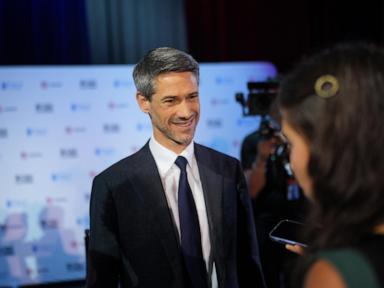
Silicon Valley isn't just donating to the California governor's race; it’s trying to engineer the outcome. For years, tech moguls were content to write checks to whoever seemed most likely to leave them alone. But as we head toward the 2026 primary, that passive approach has vanished. The industry’s heavy hitters have found their vessel in San Jose Mayor Matt Mahan, and they’re pouring in cash at a rate that should make every other candidate nervous.
It’s not hard to see why Mahan is the chosen one. He’s one of them. Before he was navigating the bureaucracy of San Jose City Hall, he was a tech executive who built and sold companies. He speaks the language of "performance-based government" and "accountability metrics." In a state where voters are increasingly frustrated by high taxes and visible homelessness, Mahan’s pitch—running California like a results-oriented startup—is exactly what the billionaire class wants to hear.
The seven million dollar head start
While other Democratic candidates like Xavier Becerra and Katie Porter are stuck in the traditional retail politics grind, Mahan is sitting on a war chest that’s growing faster than a Series A startup. By mid-April 2026, Mahan had already brought in $13 million. For a candidate who started the race with relatively low name recognition outside of the South Bay, that kind of liquidity is a massive advantage.
It’s not just the amount; it’s the names on the checks. We’re talking about the royalty of the tech world.
- Sergey Brin, Google co-founder.
- Garry Tan, CEO of Y Combinator.
- Joe Lonsdale, Palantir co-founder.
- David Baszucki, CEO of Roblox.
- Reid Hoffman, LinkedIn co-founder.
These aren't just random wealthy donors. They represent a specific faction of the tech world that has grown tired of Sacramento’s status quo. They’re looking for a leader who won't just "foster innovation" in a press release but will actually take a hatchet to the regulations they claim are stifling the state.
Why the moderate Democrat is tech's safest play
You might wonder why conservative-leaning tech titans like Peter Thiel or Joe Lonsdale aren't putting all their weight behind a Republican like Steve Hilton. Honestly, they’re being pragmatic. California is a deep-blue state. A Republican governor is a long shot, no matter how much money you throw at them.
Mahan offers a middle ground. He’s a Democrat, but he’s one who fights the powerful labor unions that usually dictate terms in the state capital. He’s promised not to raise taxes and wants to suspend the state gas tax. To the tech elite, he’s a "reasonable" Democrat—someone who can actually win a general election but won't try to implement a wealth tax the moment he gets into office.
The billionaire tax initiative is the shadow hanging over this entire election. It’s a proposed 5% tax on Californians with more than $1 billion in assets. Mahan has been vocal in his opposition to it. For donors like Sergey Brin, who has reportedly considered leaving the state over the tax, Mahan isn't just a candidate; he’s an insurance policy.
The Super Bowl ad that changed the game
Most gubernatorial candidates wait until the final weeks of a campaign to drop big money on television. Mahan didn't. Backed by an independent expenditure committee called "California Back to Basics," Mahan’s supporters dropped a statewide Super Bowl ad earlier this year.
That move was a total power flex. It signaled to the rest of the field—and to the voters—that Mahan has the resources to bypass traditional media coverage and go straight to the public. The PACs supporting him have already raised $25 million and spent $19 million of that on ads through April. This isn't a campaign; it’s a blitzkrieg.
The backlash from the left
Of course, not everyone is thrilled about a tech executive taking the reins. Progressive critics have been quick to label Mahan a "vessel for deregulation." They argue that his focus on "performance metrics" is just a polite way of saying he’ll cut social services and privatize government functions.
There’s also the question of whether a tech-first approach actually works for a state with 39 million people. Running a city like San Jose is one thing; managing the world’s fifth-largest economy is another. Skeptics point out that while Mahan claims trust in city government has increased since he took office, the underlying issues of housing and cost of living remain as stubborn as ever.
What this means for your vote
The 2026 primary is going to be a test of whether money can still buy a governorship in the age of viral social media and extreme polarization. Tom Steyer is out there spending over $132 million of his own money, mostly on ads attacking his opponents. Meanwhile, Mahan is leveraging a network of the most influential people in tech to build a campaign that feels more like a corporate takeover than a grassroots movement.
If you’re a voter, you need to look past the "accountability" slogans and the shiny ads. Mahan is promising efficiency, but you have to ask: efficiency for whom? If you think Sacramento needs a CEO who will disrupt the system, he’s your guy. If you think the tech industry already has too much influence over California life, his candidacy should probably give you pause.
The path forward
The primary is June 2, 2026. If Mahan manages to finish in the top two, he’ll likely face either a Republican like Steve Hilton or a more traditional Democrat like Xavier Becerra in November.
Don't expect the tech money to dry up anytime soon. If anything, it’ll accelerate as we get closer to the finish line. Keep an eye on the campaign finance disclosures in late May. If Mahan’s fundraising continues at this pace, he won't just be the tech candidate; he’ll be the frontrunner.
Your move is to look at the donor lists yourself. See who is funding the PACs and ask if their interests align with yours. California is at a crossroads, and Silicon Valley is doing everything it can to make sure it’s the one holding the map.