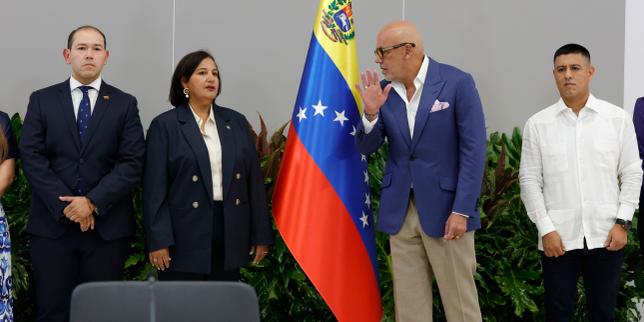
The air inside the room was heavy, smelling faintly of stale coffee and the quiet panic of men who knew their time was running short. Outside, Caracas hummed with a different kind of desperation—the sound of empty pockets, rusted infrastructure, and a quiet, grinding exhaustion that had settled into the bones of a generation.
For years, the standoff had been simple to map on a television screen. On one side stood the state, entrenched behind barricades of ideology and military loyalty. On the other stood an opposition fractured by internal rivalries and external pressures. But behind the closed doors where actual decisions crawled forward, a third invisible entity sat heavily at the head of the table.
Washington.
To understand what was happening beneath the surface, you had to stop looking at the press releases and start looking at the oil terminals.
I remember standing near the docks of Lake Maracaibo years ago, watching the rusted skeletal frames of tankers sit motionless against a bruised sunset. The water was dark, slicked with a sheen of neglect. That image stayed with me because it wasn't just about economic failure; it was about stagnation so complete it felt architectural. The political deadlock in Venezuela was never an abstract debate about democracy alone. It was a pressure valve connected directly to global energy markets, sanctions, and survival.
When foreign actors dictate the terms of engagement, negotiations stop being a conversation between citizens and start becoming a transaction between distant capitals.
Consider the choreography of these dialogues. Every movement was measured. Every concession was weighed against the looming threat of renewed economic blockages or the easing of targeted measures. The state needed cash. The foreign power needed stability and a reliable barrel of crude. The opposition needed a path back to legitimacy.
And trapped in the middle were millions of ordinary people trying to figure out how to buy bread tomorrow when the currency in their pocket dissolved by noon.
(Note: While the specific room and the precise whispered exchanges represent a composite narrative built from journalistic accounts of these diplomatic backchannels, the structural reality of American oversight in these negotiations is a matter of historical record.)
The irony was thick enough to cut with a machete. The architects of the socialist revolution, who built their entire platform on the rhetoric of anti-imperialist defiance, found themselves negotiating their political survival under the watchful eye of the very government they had spent decades demonizing.
Power does that to ideology. It strips it down to bare bone.
When you sit across the table from an adversary, you can at least pretend to hate them on your own terms. But when a superpower holds the keys to the financial system outside your borders, the dialogue shifts. It stops being a dialogue at all. It becomes a tutorial.
The opposition delegates arrived with briefcases full of democratic demands—free elections, release of political prisoners, independent oversight. These were noble ideals. They were also luxuries that could not survive the cold calculus of realpolitik. Every time the delegates moved an inch toward compromise, a phone call from a northern embassy reminded them of the boundaries.
Stay inside the lines. Do not break the fragile consensus. Keep the oil flowing, or at least keep the possibility alive.
We often talk about geopolitics as if it were a game of chess played by gods who never bleed. We look at maps, draw arrows, and tally sanctions like points on a scoreboard. But down on the asphalt, the stakes were measured in hospital beds without medicine and university graduates boarding rickety buses bound for the Darién Gap.
The tragedy of the dialogue under tutelage was its predictability. Both sides were dancing to a rhythm composed in a language neither truly owned. The government needed legitimacy without relinquishing control. The opposition needed victory without triggering a chaotic collapse. And the supervising power needed a quiet hemisphere that wouldn't disrupt its own domestic inflation rates or election cycles.
Nobody got what they wanted. Everyone got just enough to keep talking.
History is rarely made in grand, sweeping revolutions where the righteous overthrow the corrupt. More often, it drags forward in damp rooms with bad lighting, where exhausted negotiators argue over commas while the world burns outside.
The sun set over Caracas, casting long, fractured shadows across the concrete facades of the city. Down on the street, a vendor folded up his empty cart, counting a handful of nearly worthless bills by the dim light of a passing headlight. The talks inside would resume tomorrow. The invisible hand from the north would still be there, guiding the pens, trimming the demands, keeping the machinery grinding on. Nothing was fixed. Everything was managed. And the silence of the streets remained louder than any treaty ever signed.