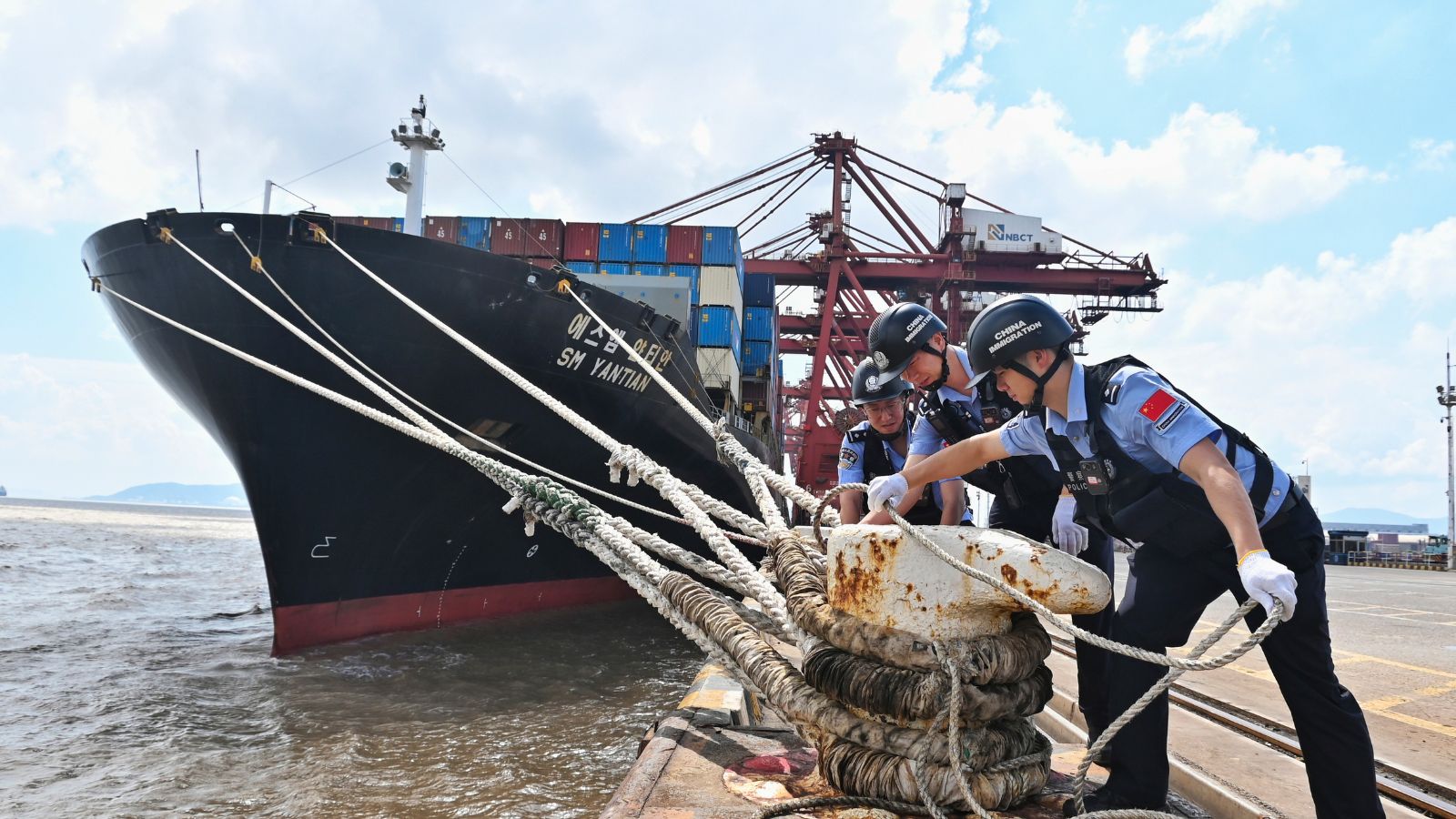
The map of Eurasia is a bruised thing. It is stitched together by pipelines, barbed wire, and mountain ranges that refuse to negotiate with engineers. For a century, we have looked at that massive block of the earth and accepted its divisions as permanent. If you wanted to move goods from the frosty docks of Moscow to the humid, crowded sprawl of Mumbai, you did not look at the land. You looked at the sea. You loaded a steel box onto a ship, watched it clear the Suez Canal, and prayed for calm weather through the Arabian Sea.
Moscow has just suggested we look at the dirt instead.
It sounds like a drunken blueprint sketched on a paper napkin in a drafty railway station. A train. From Russia. To India. Thousands of miles of frozen taiga, high-altitude passes, and geopolitical friction zones, bridged by a continuous ribbon of iron. Officials in Moscow are calling the idea something that should be explored. Analysts are calling it impossible.
I call it a window into how geography is slowly losing its grip on us.
To understand why this matters, you have to stand on a platform in the middle of a continent where the tracks change gauge. I remember the heavy clank of metal against metal at the border of two former Soviet states years ago, the distinct drop in temperature as the carriage sat idle while cranes hoisted our entire car to swap its undercarriage. Trains do not like borders. Nations love them. Every border is a tollbooth, a suspicion, a bureaucratic knot designed to slow things down.
Now, imagine trying to tie Moscow to New Delhi through a rail link.
The physical reality of the route is an exercise in stubborn geometry. To run a train from Russia down to the Indian subcontinent, you have to cross a continent that changes its mind about weather every few hundred miles. You are talking about bridging gaps through Central Asia, threading through the Hindu Kush or skirting the edges of nations where stability is a fragile commodity. You are talking about engineering marvels that dwarf the Channel Tunnel, built across terrain that eats heavy machinery for breakfast.
Let us be honest about the mechanics for a moment. This is a hypothetical scenario, but it is rooted in real geopolitical desperation. Sanctions choke traditional trade routes. Sea lanes grow more crowded and volatile by the week. Nations that find themselves on the outside of Western-dominated maritime corridors are looking for internal lines of supply, digital or physical. They want sovereign tracks. They want paths that cannot be shut down by a naval blockade in a narrow strait thousands of miles away.
Consider what happens next in a world where this rail line actually exists.
A shipping container leaves a factory in the industrial heartland of Russia. It does not see salt water. It does not wait for a slot in a congested port. It rolls south, past the Caspian, through the high, thin air of Central Asian republics, sliding quietly down into the vast railway network of South Asia.
The cargo arrives in days, not weeks. The cost structure of continental trade flips on its head.
Yet, bridges are never just made of steel. They are made of trust. And trust is the rarest commodity in Eurasia right now.
To make a Moscow-to-Mumbai rail line work, you need adversaries to act like roommates. You need nations with competing ambitions, differing security concerns, and distinct economic priorities to agree on standard rail gauges, customs protocols, and maintenance schedules. You need a diplomatic miracle every fifty miles.
History tells us that infrastructure projects of this scale are rarely about economics alone. The Trans-Siberian Railway was not built simply to move grain; it was built to claim an empire and project power across a frozen void. The original colonial rail networks in South Asia were designed to extract wealth and move troops with ruthless efficiency. When modern states talk about megaprojects today, they are drawing lines of influence with heavy ink.
If this route is ever built, it will not be because it is cheap. It will be because someone decided that distance is negotiable if the political will is thick enough.
We live in an era that pretends the world is flat and frictionless because we can send a digital packet across the globe in milliseconds. But physical reality keeps biting back. Ships run aground in canals. Cables snap on the ocean floor. Supply chains shatter because a single port sneezes.
So they float the idea of the train.
It is easy to dismiss it as a diplomatic talking point, a headline designed to signal strategic alignment rather than pour concrete. It is easy to look at the mountains and the maps and laugh. But human ambition has a strange habit of rendering the impossible merely expensive, and then eventually, routine.
Stand outside on a clear night and listen to the low, distant rumble of a freight train cutting through the dark. You cannot see the destination. You cannot see the tracks five miles ahead. You only see the beam cutting a hole in the blackness, moving forward because the machine doesn't know how to do anything else.
Moscow wants to lay down iron toward the Indian Ocean. Whether the rails ever meet the dirt is almost secondary. The mere fact that we are talking about it proves that the map is shifting beneath our feet.
The distance between Moscow and Mumbai is roughly seven thousand miles. That is a long way to build a bridge. But it is an even longer way to stay apart.