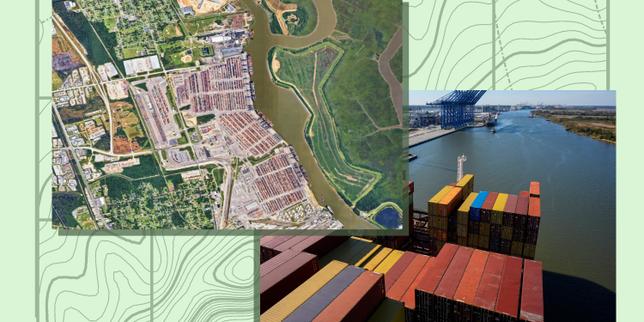
The rapid ascension of the Port of Savannah as a dominant node in global trade is frequently framed as a simple indicator of American consumer demand. This interpretation misses the structural, geographical, and mechanical realities of modern supply chains. The growth of the Garden City Terminal—the largest single-operator container facility in North America—is not merely a passive mirror of consumption, but the result of a deliberate, capital-intensive realignment of logistics infrastructure. This realignment is governed by clear cost functions, inland transit efficiencies, and systemic capacity thresholds.
Analyzing the expansion of the Georgia Ports Authority (GPA) requires moving past superficial descriptions of "busy docks" and "mammoth ships". Instead, we must examine the specific bottlenecks, capital allocations, and intermodal networks that dictate how goods flow from ocean carriers to the American interior.
The Eastward Realignment Cost Equation
The historical concentration of U.S. container imports on the West Coast created a structural vulnerability. For decades, the ports of Los Angeles and Long Beach processed approximately half of all U.S. containerized imports. By the mid-2020s, that market share contracted to roughly one-third, transferring a massive volume of cargo to East and Gulf Coast gateways.
This structural pivot is explained by a total logistics cost function, where shippers optimize for total transit cost ($C_{\text{total}}$) rather than ocean transit time alone:
$$C_{\text{total}} = C_{\text{ocean}} + C_{\text{port}} + C_{\text{drayage}} + C_{\text{rail}} + C_{\text{holding}}$$
Where:
- $C_{\text{ocean}}$ is the ocean freight rate.
- $C_{\text{port}}$ is the sum of port terminal handling charges and dwell-time penalties.
- $C_{\text{drayage}}$ is the short-haul trucking cost from dock to warehouse.
- $C_{\text{rail}}$ is the long-haul intermodal rail tariff.
- $C_{\text{holding}}$ represents the inventory carrying cost incurred during transit.
While routing goods from East Asia to the U.S. East Coast via the Panama Canal increases $C_{\text{ocean}}$ and $C_{\text{holding}}$ due to longer transit times, it drastically reduces $C_{\text{rail}}$ and $C_{\text{drayage}}$ for destinations in the Sunbelt and Midwest. Historically, West Coast ports relied on costly transcontinental rail to reach these regions.
By utilizing Savannah, shippers bypass thousands of miles of expensive domestic rail transit. The GPA capitalized on this cost arbitrage by establishing a single-terminal operational model. Unlike fragmented ports where multiple terminal operators compete for scarce rail and gate access, Savannah consolidates its operations under a single entity. This eliminates inter-terminal drayage, optimizes labor allocation, and drives down $C_{\text{port}}$.
The Depth to Volume Constraint
Ocean shipping operates on stark economies of scale. The introduction of Neo-Panamax vessels, capable of carrying over 16,000 twenty-foot equivalent units (TEUs), drastically reduced slot costs for ocean carriers. However, these vessels impose severe physical requirements on port infrastructure, specifically draft depth and air draft.
The Savannah River is a tidal estuary, meaning vessel transit is historically restricted by tidal cycles. The physics of draft utilization can be expressed as:
$$U = \min \left( 1, \frac{D_{\text{actual}} - D_{\text{safety}}}{D_{\text{design}}} \right)$$
Where:
- $U$ is the vessel cargo capacity utilization coefficient.
- $D_{\text{actual}}$ is the actual water depth available in the channel.
- $D_{\text{safety}}$ is the required under-keel clearance safety margin.
- $D_{\text{design}}$ is the fully laden draft design of the vessel.
When $D_{\text{actual}}$ is insufficient, vessels must "tide-ride"—waiting for high tide to enter or depart—or undergo "light-loading," which involves leaving cargo behind at the port of origin to reduce draft. Both options introduce significant financial friction.
To resolve this limitation, the Savannah Harbor Expansion Project (SHEP) deepened the shipping channel to 47 feet, completing the work in 2022. Yet, the rapid escalation of vessel sizes quickly outpaced this upgrade. In 2026, the GPA initiated a new feasibility study with the U.S. Army Corps of Engineers to evaluate further deepening and the construction of channel passing lanes. The strategic objective of these passing lanes is to transition the channel from one-way transit for mega-ships to continuous, two-way traffic, cutting idle vessel times and maximizing berth throughput.
Intermodal Evacuation Mechanics
A port’s ultimate capacity is not determined by how fast it can unload a vessel, but by how rapidly it can evacuate containers from the terminal footprint. Without efficient inland connections, high-volume container cranes simply accelerate the creation of yard congestion, paralyzing terminal operations.
The GPA addressed this physical bottleneck by shifting the logistics burden from local road networks to high-capacity rail and dedicated freight corridors.
[Ocean Vessel]
      │
      ▼ (Super Post-Panamax Cranes)
[Garden City Terminal Yard]
      │
      ├─────────────────────────────────────────┐
      ▼ (Mason Mega Rail)                       ▼ (Drayage Trucks)
[Class I Railroads: CSX & Norfolk Southern]   [Brampton Road Connector]
      │                                         │
      ▼ (Inland Ports: Gainesville/Appalachian) ▼ (Interstates: I-16 / I-95)
[Midwest / Regional Distribution Centers]     [Southeast Logistics Warehouses]
The Rail Network Expansion
The Mason Mega Rail terminal consolidated two separate on-port rail yards into a single, massive intermodal facility. This integration allows the port to build and receive 10,000-foot double-stack trains directly on-site, serving Class I carriers CSX and Norfolk Southern. By building unit trains on-terminal, the port bypasses local switching yards, reducing transit times to key inland hubs like Atlanta, Chicago, and Memphis by 24 to 48 hours.
To further offload terminal dwell times, the GPA is deploying an inland port strategy. The opening of the Gainesville Inland Port in mid-2026, constructed at a cost of $134 million, acts as a pressure relief valve. Containers destined for the upper Southeast are immediately loaded onto rail cars and moved to the inland terminal, shifting the drayage and storage footprint 300 miles away from the coast.
The Last-Mile Roadway Beltway
For cargo moving via truck, local municipal roads present a constant friction point. The opening of the $126 million Brampton Road Connector in July 2026 completed a multi-year, $600 million cargo beltway designed by the Georgia Department of Transportation.
By creating a direct, four-lane highway linking the Garden City Terminal to Interstate 16, the project systematically removes heavy truck traffic from local municipal streets. This yields two distinct operational efficiencies:
- Drayage Turn-Time Optimization: Eliminating at-grade rail crossings and signalized urban intersections reduces truck trip variability, allowing carriers to complete more turns per driver hour.
- Asset Utilization: Faster gate-to-highway transit improves chassis fleet utilization, reducing the total capital requirement for regional drayage operators.
The Volatility of Trade Front-Loading
The structural expansion of Savannah must also be analyzed through the lens of recent macroeconomic volatility. The period spanning 2024 through early 2026 saw extreme fluctuations in import volumes, driven not by organic consumer demand, but by regulatory anxiety.
Throughout 2024 and early 2025, U.S. importers engaged in aggressive inventory "front-loading". Fearing impending tariff escalations and a highly publicized East and Gulf Coast labor dispute, retailers pulled forward holiday and spring inventories months ahead of schedule. This artificial demand spike strained warehouse capacity throughout the Savannah logistics corridor, sending industrial real estate vacancies to historic lows and driving up local warehousing rates.
Following the implementation of reciprocal tariffs in mid-2025, import volumes experienced a sharp correction. Ocean carriers responded with aggressive capacity management, utilizing blank (canceled) sailings to artificially stabilize spot rates. By early 2026, volumes stabilized at a lower, more sustainable baseline.
This boom-and-bust cycle highlights a critical vulnerability in the port’s growth model: while physical infrastructure can be expanded to handle peak volumes, the local warehousing ecosystem cannot instantly scale up or down to absorb extreme inventory fluctuations. Shippers must plan for permanent structural volatility rather than relying on historical seasonal averages.
Strategic Playbook for Supply Chain Executives
Relying on a single entry point—whether it is the West Coast or the East Coast—presents unacceptable systemic risk. Shippers must transition from reactive logistics to a highly structured, multi-gateway strategy that treats port selection as a dynamic portfolio optimization problem.
First, establish a formal Split-Gateway Allocation Model. For inventory destined for the U.S. interior, distribute volumes across a 60/40 or 50/50 split between West Coast ports (Los Angeles/Long Beach) and East Coast gateways (primarily Savannah). This model must be dynamically adjusted based on real-time metrics:
- Dwell Time Delta: If terminal container dwell times in Savannah exceed 5 days, automatically divert non-urgent cargo to West Coast intermodal corridors.
- Ocean-to-Rail Spread: Monitor the cost delta between ocean freight to Savannah versus transpacific ocean freight combined with inland rail. When domestic rail rates drop, shift discretionary volumes to the West Coast to optimize working capital.
Second, integrate Inland Port Decoupling into Southeast distribution networks. Instead of draying containers directly from the Garden City Terminal to coastal warehouses—where real estate costs are inflated—route cargo through inland terminals like Gainesville. By utilizing short-haul rail to move containers inland before transferring them to trucks, shippers reduce drayage costs, bypass coastal congestion, and access lower-cost industrial real estate for regional distribution centers.
Third, enforce strict Chassis and Carrier Diversification. Do not rely on a single drayage provider or a single chassis pool. The physical infrastructure upgrades in Savannah, such as the Brampton Road Connector, only yield cost savings if your carriers possess the operational agility to bypass bottlenecks during peak volume spikes. Secure dedicated chassis contracts to ensure asset availability when the next inevitable import surge occurs.