Everybody loves a clean narrative. Strip away the complexity, toss in a splash of corporate redemption, and watch the public swallow a comforting fable whole.
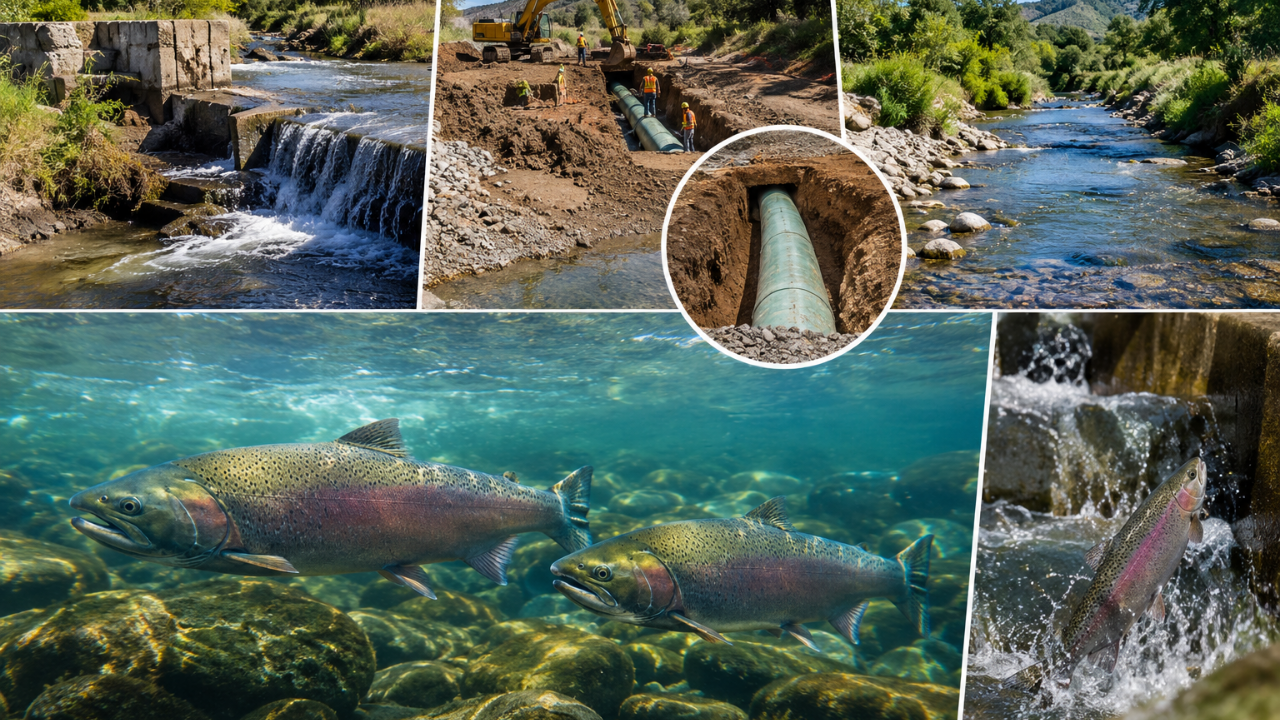
The media went into a frenzy over a patch of California river where a buried gas pipeline and a minor obstruction vanished, allowing a handful of chinook salmon to wiggle back into waters they abandoned decades ago. Headlines declared a glorious triumph for nature. Photographers captured soaring fish mid-leap. Bureaucrats patted themselves on the back so hard their shoulders dislocated.
It is a fairy tale. And it is actively destroying the rivers it claims to save.
I have spent decades watching environmental agencies trade fifty million dollars in public relations theater for actual, systemic ecological survival. I have seen corporations orchestrate high-profile, low-impact ribbon-cuttings to mask the systematic, ongoing slaughter of entire watersheds upstream and downstream.
This pipeline burial and minor barrier removal is not a victory. It is a calculated distraction. It is a shiny object dangled in front of an exhausted public so nobody looks at the catastrophic plumbing disaster draining the lifeblood out of the West.
The Anatomy Of A Token Gesture
Let us look at the mechanics of what actually happened. A utility company buried a pipeline deeper or moved it out of the streambed, and a localized physical block was cleared. For seventy years, that specific pinch point blocked passage. Removing it allowed a modest number of fish to access a fraction of historic spawning grounds.
On paper, that sounds great. In reality, it is the equivalent of taking a single aspirin while your liver fails from cirrhosis.
A salmon does not care about a cleared creek bed if the water temperature fifty miles downstream is boiling at seventy-two degrees Fahrenheit in July. A salmon does not care about a newly opened tributary if the entire lower river system is a shallow, stagnant irrigation canal choked with agricultural runoff, heavy metals, and herbicide residue.
We are celebrating a fish finding a door unlocked while the house is burning to the ground.
When you fix a single local bottleneck while leaving the macroeconomic drivers of habitat destruction untouched, you engage in performative conservation. You spend a fraction of a percent of your capital budget on a PR stunt that generates a week of glowing news coverage, neutralizing activists and satisfying regulatory checkboxes. Meanwhile, the industrial water extraction pumps running full blast twenty-four hours a day continue to suck the delta dry.
The Plumbing Problem Nobody Wants To Touch
California water management is a monument to human hubris and political cowardice. The Central Valley Project and the State Water Project form a colossal, engineered suction machine. They reroute entire rivers before they ever reach the ocean, shipping water south to concrete suburbs and corporate almond orchards planted in the middle of a desert.
These water projects do not care about pipelines or small barriers. They care about volume. They operate massive pumps that can literally reverse the flow of rivers, pulling migrating smolts backward into massive concrete holding facilities where predators shred them to pieces.
To pretend that burying a gas pipeline fixes this systemic nightmare is intellectual dishonesty of the highest order. It is worse than useless; it is pacifying. It creates a false sense of security. The average citizen reads the headline, thinks mother nature is healing herself, turns off their brain, and goes back to sleep.
Meanwhile, commercial fisheries are collapsing. Hatcheries are dumping millions of genetically weakened fish into an ocean that is acidifying and warming due to global emissions, creating a fragile loop of artificial dependency. Wild runs are functionally extinct across most of their historic ranges, surviving only as twitching phantoms propped up by annual truckloads of hatchery stock.
The Economics Of Greenwashing
Why do companies and state agencies love these small barrier removals? Because they are cheap.
Removing a massive federal dam requires fighting a multi-decade legal war against entrenched agricultural lobbies, navigating billions of dollars in structural decommissioning costs, and rewriting water rights law that dates back to the nineteenth century. That is hard work. That requires political spine.
Burying a pipeline or ripping out a defunct concrete weir from an urban ditch? That is a weekend project. You hire a couple of excavators, invite the local politicians for a photo opportunity in hard hats, feed the press a press release about miraculous returns after seventy years, and write it off as corporate social responsibility.
The return on investment for the polluter is astronomical. For the price of a mid-sized marketing campaign, they buy immunity from serious regulatory scrutiny. They get to stand on stage and claim they are stewards of the ecosystem while their primary business operations continue to drain, bake, and poison the watershed.
I have watched corporate boardrooms calculate these exact trade-offs. They run the numbers on public outrage versus compliance costs. They know that a feel-good animal story will dominate the news cycle for forty-eight hours, completely drowning out the boring, complex technical reports detailing the ongoing depletion of groundwater basins and the destruction of littoral zones.
The Brutal Reality Of Salmon Biology
Let us define the actual terms of survival for Oncorhynchus tshawytscha, the chinook salmon. They are anadromous. They are born in cold, gravelly freshwater streams, migrate down to the violent chaos of the open ocean to grow big and fat, and then navigate thousands of miles back to the exact gravel bed of their birth to spawn and die.
Every single link in that chain must hold. Break one, and the population collapses.
- The Spawning Ground: Needs cold, clean, fast-flowing water with clean gravel free of silt.
- The Outmigration: Needs high spring flows to push young smolts rapidly through the delta before predators and heat kill them.
- The Ocean Phase: Needs upwelling nutrient currents and manageable temperatures.
- The Return: Needs unobstructed pathways and sufficient water depth to ascend rivers without getting trapped in warm, shallow pools where poachers and diseases pick them apart.
When you clear a barrier in a minor stream, you fix perhaps five percent of requirement number four for a tiny percentage of the total population. You do nothing for the spring flows. You do nothing for the delta pumps. You do nothing for the marine heatwaves.
To call that a restoration of the species is like curing a patient’s ingrown toenail while ignoring their stage four lung cancer and telling them they are ready to run a marathon.
The Danger Of Moral Licensing
There is a psychological trap at play here called moral licensing. Once an individual or an institution does one small, highly visible good deed, they feel morally licensed to commit ten times as much structural damage elsewhere without feeling guilty about it.
When the state highlights a creek where salmon returned after seventy years, it provides psychological cover for water managers to approve the next massive industrial diversion. It gives politicians permission to ignore the fundamental restructuring of California water rights that must happen if native fish are to survive the next fifty years of climate volatility.
The narrative goes like this: See? The system works. Nature is resilient. We don't need radical policy changes; we just need to keep tinkering with pipelines and local barriers.
This is a lie. Nature is resilient, but it has hard thermodynamic and biological limits. You cannot heat water past a salmon's lethal thermal threshold simply by removing a concrete wall upstream. You cannot manufacture flow out of empty concrete channels.
What Actually Needs To Happen
If we stopped lying to ourselves for five minutes, what would real conservation look like?
It would look terrifying to the people currently profiting off the status quo. It would mean treating water as a finite, public ecological trust rather than a private commodity to be hoarded and traded on speculative markets.
It would mean capping agricultural groundwater pumping in the Central Valley to restore base flows to depleted rivers. It would mean rethinking the absurd mandate of growing water-thirsty export crops in an arid climate zone. It would mean redesigning delta export facilities from the ground up to stop operating like aquatic meat grinders.
It would mean prioritizing ecological health over short-term political convenience.
Instead, we get pipe burials. We get celebratory press releases about a dozen fish swimming past a construction site. We get a daily dose of environmental hopium designed to keep the machine running smoothly while the actual foundation of the ecosystem crumbles underneath us.
Do not buy the hype. The next time you read a heartwarming story about nature reclaiming a concrete ditch because a pipeline moved six feet to the left, look past the photograph of the leaping fish. Look at the water meters. Look at the export pumps. Look at the temperature charts.
The fish are not saved. They are drowning in good press.